Essential Drawing Supplies for Vibrant Rainbows
Every successful project requires reliable tools from the start. You only need a graphite pencil, a quality eraser, and heavy drawing paper. A metal ruler guarantees accurate baselines, while a permanent ink pen locks in your final shapes. High-quality colored media deliver rich saturation across each arc. Mastering how to draw a rainbow techniques works best with basic, accessible supplies. Expensive equipment remains entirely optional. Familiarize yourself with how to draw a rainbow fundamentals by keeping your materials organized on a clean surface before beginning.
Establishing Your Artistic Foundation: Curve and Symmetry
This process builds every composition from a solid baseline upward. Follow each phase sequentially, applying gentle graphite marks for initial shapes. Light deposits erase cleanly when adjustments become necessary. Early irregularities remain completely normal during initial layout stages. This systematic construction method ensures your artwork gains realistic depth at every stage. Understanding how to draw a rainbow correctly depends on maintaining perfectly level starting points. Maintain steady pressure to keep guidelines visible until inking begins.
1. Draw the Horizontal Ground Line as Your Base

This foundational phase establishes a stable horizon for your composition. Drafting the baseline represents the most important structural decision. A perfectly level horizon prevents asymmetrical distortions later in the process. Place your metal ruler flat on the surface and mark two light reference points near the bottom edges. Connect these markers using a smooth, continuous sweep across the page. Applying minimal pencil pressure guarantees easy adjustments during later stages. Locking your wrist and moving your shoulder ensures exceptional line stability. This technique eliminates subtle curves caused by rigid hand positions. You strengthen foundational abilities by reviewing how to improve your drawing skills through targeted exercises. Consistent baseline practice accelerates your overall artistic progression when learning how to draw a rainbow frameworks.
2. The Outer Arc: Your Guide for Perfect Symmetry
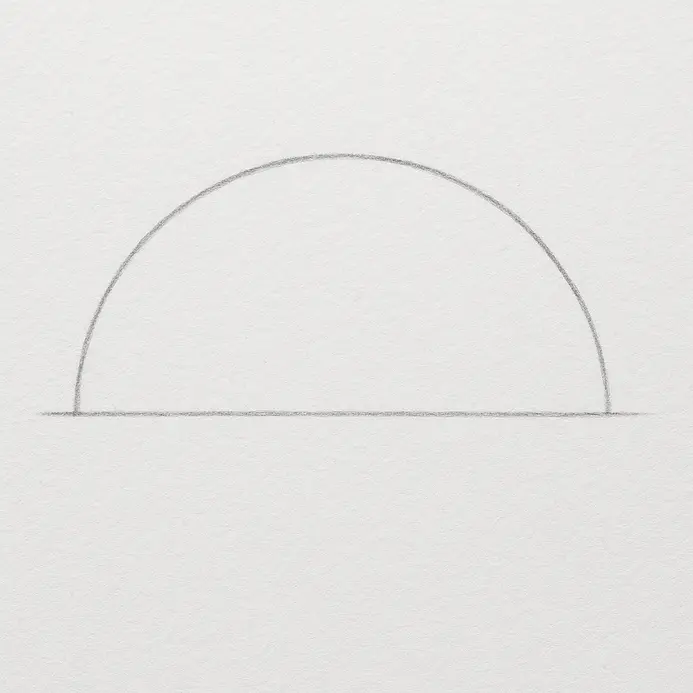
Locking in the sweeping top line defines your entire composition. Every color band inside must mirror this primary curve. Lightly sketch a vertical center line to establish balance across both sides of your rainbow drawing. Begin your sweep from the left edge, engaging your shoulder muscles for fluid motion. Trace a gentle arc upward, crossing the apex, and descending to the right side. The peak distance must remain identical on each half. Once satisfied with the symmetry, reinforce the curve using a 2B graphite pencil. Checking accuracy requires rotating your workspace completely upside down. Visual fatigue hides minor distortions, while flipping reveals immediate asymmetry. Correct any lopsided sections with light graphite marks. Exploring different color combinations can greatly enhance your rainbow drawing. beautiful mandala drawing ideas provides exceptional practice for symmetrical control. This rotational verification remains essential for mastering how to draw a rainbow effectively. You should practice verifying alignment regularly.
3. Add Inner Parallel Arcs to Build the Structure

Transform your single outer curve into a multi-layered composition. Adding concentric sections inside the primary outline generates realistic color depth. Maintain precise parallel spacing throughout each new layer. Lightly position your HB graphite pencil slightly inward from the top curve. Trace the exact path while preserving identical curvature. Repeat this inward progression until you reach your desired band count for a colorful rainbow. Light construction marks allow easy erasure later in the workflow. Pre-measuring spacing prevents irregular widths across different sections. Place subtle tick marks at fixed distances before committing to full lines. Connecting these reference points guarantees flawless alignment. You will discover that practicing how to draw a rainbow techniques improves your overall curvature control. Review additional resources to expand your structural drafting abilities and enhance your rainbow drawing. Maintaining consistent spacing ensures professional results every time.
4. Want Fluffy Ends? Sketch Cloud Shapes at the Base

Ground the arch with atmospheric, overlapping shapes for natural realism. This addition breaks rigid edges and simulates natural precipitation. Apply gentle pressure along the bottom termination of your arch. Sketch irregular circular formations using fluid wrist flicks. Vary each shape to prevent mechanical repetition. Allow some forms to extend slightly beneath the main horizon line. Creating organic cloud puffs establishes a soft foundation for the entire piece. Uniform circular placements produce a stiff, unnatural appearance. Lifting the pencil at each stroke end generates soft, tapering tips. Maintaining varied pressure creates an airy, voluminous texture in your rainbow drawing. Studying how to draw clouds enhances your atmospheric shading accuracy. These techniques prove invaluable when learning how to draw a rainbow compositions with realistic environments. Always vary your stroke direction.
5. Refine Your Art by Erasing the Excess Guide Lines

Removing temporary construction marks prepares your piece for permanent finishing. Clean edges ensure crisp results during the inking stage. Begin by targeting obsolete lines within each completed section. Use a kneaded eraser and employ gentle dabbing motions to lift graphite without tearing paper fibers. Reshape the material into a sharp point for detailed corner removal in your rainbow drawing. Sweep away graphite dust with a soft brush to eliminate accidental smudges. Wait for complete ink drying before touching graphite guidelines again. Verifying proportions prevents premature line removal. Excessive eraser pressure damages delicate paper surfaces. Gentle lifting preserves original structural integrity. Drafting initial guidelines with a 2H pencil simplifies cleanup significantly. Maintaining pristine edges supports advanced projects, including anime characters with white hair drawings. Proper cleanup routines distinguish amateur efforts from professional how to draw a rainbow masterpieces.
6. Permanent Outlines That Make Your Semicircles Pop

Transitioning to permanent ink locks your design into sharp definition. Bold boundaries create high contrast that enhances pigment saturation. Trace initial graphite curves using a Fine-liner pen: A great tool for adding details to your colorful drawings.. Engage shoulder muscles for continuous, uninterrupted sweeps from left to right. Even line weight prevents distracting thickness variations. Follow the initial trace with a broader permanent marker, positioning the new stroke slightly inward. This offset method generates instant dimensional depth across every contour. Anchoring your drawing hand stabilizes the entire forearm. Steady pressure eliminates shaky, fragmented ink lines. Consistent pacing ensures professional-quality outlines. Practicing examples of line drawing art strengthens muscle memory for precision strokes. Executing this stage correctly determines how well how to draw a rainbow compositions hold up against detailed scrutiny. Focus on smooth pacing.
7. Apply Soft Graphite Shading to the Base Clouds

Adding tonal variation breathes volume into flat cloud shapes. Gradual shading transitions transform simple outlines into colorful three-dimensional forms. Hold your HB pencil at a shallow angle to engage lead edges. Apply minimal pressure using loose circular motions inside shadowed areas away from your light source. Keep your grip relaxed to allow graphite particles settling naturally into paper texture. Introduce a 2B pencil for deeper tonal buildup in recessed areas. Layer graphite gradually, working outward until pigment fades into blank paper surfaces. Gently buff the surface using a paper blending stump for seamless gradients. Consulting cloud shading techniques here refines your atmospheric rendering approach. Mastering graphite pressure control elevates every step-by-step drawing technique. how to draw a rainbow illustration. Practice blending daily.
8. Ready for Color? Fill the Red and Orange Bands

Introducing the first pigments generates immediate visual impact. Accurate placement establishes a structured foundation for subsequent layers. Position your red medium at the top outermost boundary. Sweep long, fluid strokes along the curve using shoulder-driven movements to achieve great results in your drawing. Apply gentle pressure to maintain uniform density across colored pencils. Layer pigment slowly, working inward for maximum saturation control. Execute light layers for optimal results. Apply the second layer beneath the initial band while maintaining parallel width. Keep your tool tip aligned with inner boundaries to prevent crossover. Rotate your workspace frequently for comfortable wrist angles. Allow slight color overlap at boundaries to blend transitions naturally. Practice aerial motions before committing ink to paper surfaces. Understanding proper pigment application separates successful attempts from muddy outcomes when mastering how to draw a rainbow workflows. Continue exploring advanced layering methods through targeted practice sessions.
9. Color the Yellow and Green Middle Arc Layers

Adding sunlit tones bridges the transition to cooler shades. These central layers anchor the overall spectral progression. Position your yellow medium directly beneath the previous orange section. Use continuous arm pivots to maintain uniform sweep trajectories. Apply consistent pressure to eliminate patchy pigment distribution. Heavy strokes often produce uneven saturation that complicates neighboring layers. Focus on smooth layering. Switch to your green medium and fill the adjacent lower segment. Ensure edges meet cleanly while preventing aggressive pigment bleeding. Marker users should execute single-pass sweeps to prevent paper warping. Maintain strict curvature alignment for professional-looking results. Practicing these techniques builds essential skills for fat cartoon characters drawings. Proper layer management guarantees successful how to draw a rainbow completions.
10. The Final Layers: Blue, Indigo, and Violet Bands

Completing the inner spectrum finishes the entire composition. The tightest arcs provide visual closure and balanced contrast. Sketch the blue layer immediately inside your existing green band. Maintain fluid arm movement to preserve consistent curvature. Draw indigo and violet bands progressively closer to the center. Use feather-light pressure to simulate delicate pigment dusting. Overlap adjacent strokes slightly to eliminate visible paper gaps. Employing a scumbling motion encourages smooth color integration. Small circular overlaps soften boundaries between cool tones. Skip blending entirely for sharp, graphic visual results instead. Developing precise boundary control strengthens your overall drafting capabilities. Reference beautiful mandala drawing ideas for beginners to accelerate your technical proficiency. These final steps complete the process.
Refining Your Drawing: Common Corrections and Professional Tips
Complete the composition twice consecutively without referencing notes. Practicing standalone curves improves spatial accuracy and proportion control. Experiment with scaling the overall structure to observe proportional relationships shifting. Introduce simple background landscapes or subtle tonal shading to enhance dimensional presence. Mastering how to draw a rainbow relies heavily on repetitive structural reinforcement. Implementing these refinement strategies accelerates long-term technical development.
Conclusion
You successfully discovered effective methods for completing this project from initial sketch to final coloring. Advancing through sequential phases established reliable baseline structures, consistent parallel guides, and permanent ink boundaries before introducing vibrant pigments. Translating curved structural accuracy applies directly to architectural drafting and organic subject rendering in future compositions. Attempt freehand arch drafting from memory or adjust overall canvas dimensions during subsequent trials. Integrating atmospheric weather elements or testing alternative pigment blending methods expands your technical range. Building foundational competence unlocks unlimited creative variations across future projects. Understanding how to draw a rainbow equips artists with essential proportional drafting skills. Exhibit your finished composition proudly to document your artistic evolution.
FAQs
Q: How do I learn to draw a rainbow with a simple step-by-step tutorial?
A: Start with a light pencil and follow a step-by-step tutorial that shows how to sketch a large curved line for the outer arc, then add smaller curved lines inside to form each band of color; take your time, add color in the order of ROY G (red, orange, yellow, green, blue, indigo, violet) and remember to make each band of color fit evenly so the picture looks balanced.
Q: Is there a free video or download I can use to teach a kid to draw a rainbow?
A: Yes — many websites offer a free video lesson or a downloadable PDF instruction set that shows kids how to draw a rainbow with simple shapes; look for a short video that breaks the process into small bits and shows each curved line clearly so a child can join the lines and learn to draw with confidence.
Q: What is the best way to show the order of the bands of the rainbow?
A: The easiest method is to learn the mnemonic ROY G BIV which helps you remember the order of colors (red, orange, yellow, green, blue, indigo, violet); when you draw, start with the outermost curved line for red and work inward, making sure each band of color is possible to see by keeping contrast high.
Q: Can I make a rainbow that fits a small page or picture book?
A: Yes — to fit a smaller page, draw a smaller outer arc and reduce the spacing between curved lines so all bands of the rainbow still show; take your time measuring roughly equal widths so the colors remain distinct and the final picture fits the page without crowding.
Q: How do I add clouds, nature elements, or other fun details after drawing the rainbow?
A: After you finish the rainbow, add soft cloud shapes at each end and simple nature elements like grass or a sun; use light strokes and a bit of shading to show depth, and remember the overall composition so the extra details don’t overpower the bands of the rainbow.