Essential Drawing Tools for Precise Curve Control
Mastering how to draw a spiral demands reliable supplies that deliver consistent results across long sessions. A graphite pencil remains essential for mapping your initial structural layout with minimal pressure. Keep a vinyl eraser close by to remove misplaced construction marks efficiently without damaging fibers. Standard white sketchbook pages provide the ideal texture for precise graphite work. A transparent ruler establishes accurate baseline measurements without covering your existing lines. A permanent black ink pen secures your drafted curves before final cleanup and display. Adding soft core colored pencils introduces dimensional shading and vibrant contrast to the finished piece. These budget-friendly materials produce professional artwork without requiring expensive studio equipment.
How to Use This Tutorial to Build Lasting Muscle Memory
Executing each sequence in exact order guarantees predictable muscle development and consistent line quality. Sketch foundational shapes using barely visible pressure so guides disappear cleanly later during revision stages. Minor inaccuracies during early construction phases remain completely normal during skill acquisition. Following this progressive assembly method transforms your initial marks into a polished geometric design while demonstrating exactly how to draw a spiral confidently without relying on reference grids.
1. Center Point: The Anchor for Your Entire Composition

Locating the exact middle section establishes a reliable anchor point for your entire composition. Placing this single reference mark determines whether the final shape expands evenly or becomes asymmetrical. Understanding how to draw a spiral correctly requires establishing this fixed location before introducing any curvature into the artwork. Every subsequent line radiates outward from this precise coordinate to maintain mathematical symmetry. Hold your writing instrument loosely between your fingers and choose a clear spot on your canvas. Press gently to create a faint dot that functions as your compositional keystone for upcoming revisions. Avoid applying heavy pressure because the graphite needs to vanish cleanly during the final stage. All upcoming arcs will rotate around this central anchor point to maintain uniform expansion. A perfectly centered placement works well for balanced geometric practice and structural study. Placing the mark slightly offset creates dynamic tension by following the Rule of Thirds for visual interest. Visualize your canvas divided into equal thirds both vertically and horizontally before making contact. Rest the reference mark exactly where two imaginary lines cross to establish optimal focal weight. Establishing a deliberate starting position prevents your curves from drifting or warping unexpectedly during rotation, much like how you would draw a line for precision. A solid reference point gives your eyes a constant visual checkpoint while you maneuver the sheet. Missing this preparation stage often results in distorted proportions that ruin the final output. Recognizing how to draw a spiral effectively depends heavily on this foundational placement. Artists frequently make this initial guide mark too heavy or excessively large during early practice. Maintaining a feather-light touch ensures the graphite lifts away without leaving paper indentations or grooves. Keep your strokes delicate and measurable while studying basic drawing skills and exercises to build foundational accuracy.
2. Sketch Light Grid Lines Across the Blank Page
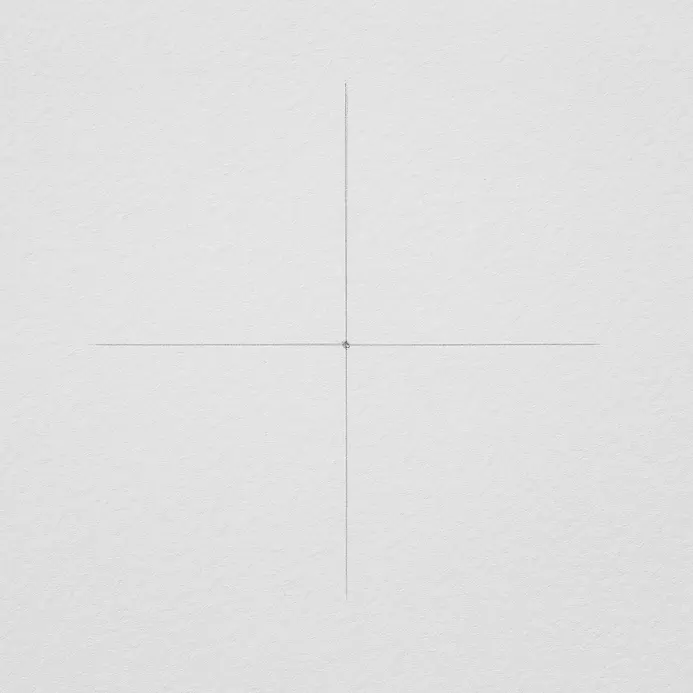
Constructing an underlying framework simplifies the process of mapping uniform radial distances across your canvas. Establishing a faint measurement network guarantees proportional growth instead of jagged irregular lines. This structural support system remains entirely invisible once the final inked contours cover the graphite marks. Recognizing precise spacing intervals remains essential when learning foundational geometry. Select a hard graphite lead rated around two H or four H for faint marking on smooth surfaces. Position your straightedge precisely along the edge and glide smoothly to leave barely visible traces. Maintain identical intervals between each vertical stroke to preserve mathematical proportion across the entire drawing area while ensuring that each segment can fit within a circle. Keeping pressure minimal ensures easy removal later, particularly when working on delicate areas like the edges of a circle. Rotate your straightedge to create perpendicular horizontal intersections that form uniform square compartments, which can also help when trying to draw a circle. Maintain consistent pressure and spacing to generate a reliable coordinate system for complex curves. This mathematical grid serves as your primary guide for maintaining accurate expansion ratios while you learn how to draw a spiral without guessing placement intervals. Trust the framework during drafting. Simplify the layout by using a single vertical and single horizontal crossing if a full matrix overwhelms the page. This streamlined approach reduces visual clutter while maintaining precise alignment for radial growth. Beginners often find this minimal framework easier to manage during the learning process. Explore additional foundational concepts within the archive of artistic techniques for continued improvement.
3. The Expanding Curve: Your Guide to Perfect Symmetry

Transitioning from the rigid grid into fluid curves requires gradual pressure release and smooth wrist rotation. This phase transforms your structural guides into a continuous, expanding pathway across the sheet. Understanding exponential growth patterns allows artists to execute how to draw a spiral naturally without forcing rigid mathematical plotting. Maintaining consistent spacing prevents awkward overlaps or unintended gaps between revolutions. Position your graphite tip lightly over the central mark and extend a faint horizontal guideline outward. Create a tight initial arc that follows one side of your reference axis without heavy contact. Rotate the sheet gently and mirror the motion with a slightly wider curve following the established rhythm. Multiply the previous arc length progressively to achieve that characteristic outward expansion without sharp corners. Focus on organic growth patterns instead of rigid mathematical plotting to achieve fluid results that mimic nature. Prioritizing natural flow creates visually appealing geometry that avoids mechanical stiffness across the composition. Review advanced composition strategies in our collection of these core artistic methods for additional shape mastery. Practice consistently to improve fluidity.
4. Erase the Structural Grid for a Clean Foundation

Removing the temporary framework reveals your finished geometric design with perfect clarity and sharp definition. This essential cleanup stage separates your draft from the polished artwork ready for presentation or coloring. A kneaded eraser lifts excess graphite without tearing the delicate paper surface or leaving residue. Knowing how to draw a spiral professionally includes mastering this delicate subtraction phase to preserve line integrity. Pinch your cleaning tool into a sharp tip and target individual grid intersections carefully without touching final arcs. Press gently and lift vertically to absorb stray particles without smudging adjacent lines. Avoid aggressive back-and-forth scrubbing motions that smear graphite across your carefully drawn curves and ruin contrast, particularly when trying to define a circle. Maintain precise control over your working area by clearing small sections sequentially. Patience during removal prevents accidental damage to your permanent ink or final pencil lines before display. Rushing this cleanup stage ruins careful preparation and precise drafting invested in earlier phases. Study additional layering and cleanup methods in our paintings and foundational techniques library to improve your revision workflow. Clean surfaces elevate finished results. A structured grid provides necessary boundaries until the primary form establishes itself through repeated revolutions. Removing the guide too early causes misalignment and forces constant guessing during curve placement. Wait until every segment connects smoothly before clearing the workspace completely. Secure foundations yield polished outcomes.
5. Black Ink: The Permanent Contour That Defines the Shape

Permanent contours give your geometric construction lasting stability and visual weight for gallery display. Tracing over temporary graphite marks commits your design to a final, unchangeable form suitable for framing. Applying steady ink pressure locks your expanding arcs into place for coloring or exhibition. Every artist discovers exactly how to draw a spiral effectively by practicing confident, uninterrupted strokes. Select a quality fine-liner pen that delivers consistent ink flow across your chosen paper weight without bleeding. Start precisely at the central anchor and follow the temporary path outward with steady momentum. Apply uniform pressure while guiding the nib along the curve without lifting or pausing. Complete one full unbroken contour to establish a professional and polished silhouette. Move your hand toward your body while turning the canvas to maintain optimal pen control during long lines. Short choppy strokes create jagged edges that disrupt the smooth geometric expansion intended by the artist. Developing muscle memory through repetitive line work produces fluid and confident mark-making that elevates technical proficiency. Consult our resource on artistic techniques to refine your inking control strategies.
6. Shade Along One Edge for True Dimensional Depth

Adding tonal values alongside your ink contour instantly transforms flat lines into dimensional coils that suggest physical volume. This shading step convinces the eye that your shape possesses realistic mass rather than resting flat on the sheet, enhancing the visual impact of a circle. Determining light direction establishes consistent shadow placement across every single curve rotation. Understanding how to draw a spiral in three-dimensional space starts with mastering this contrast principle. Choose a consistent light source direction to maintain believable shadow angles throughout the composition before beginning. Position a soft graphite stick at a shallow angle near your selected inner edge to begin layering pigment. Apply heavy pressure directly against the black outline and gradually lighten your touch outward toward the page. Maintain this gradient progression along the entire length of the expanded curve for uniform depth. Rolling your wrist naturally along the curve prevents harsh parallel streaks from disrupting the illusion of rounded form. The biggest error involves applying uniform dark pressure that flattens the dimensional effect instead of enhancing it. Adjust overly dark transitions by gently lifting excess pigment with a soft cleaning block to restore smooth gradients. Controlled pressure yields lifelike volume. This tonal technique succeeds because human vision interprets gradual value shifts as curved surfaces receding into shadow, similar to how a circle appears in three dimensions. Observe how professional illustrators build volume in our gallery of drawings for more techniques that demonstrate advanced shading strategies. Replicate this methodical approach on future geometric practice pieces, such as drawing a circle, to accelerate skill development. Form shading operates independently from line weight and relies entirely on value transition to communicate shape. Maintaining clear separation between shadow and highlight areas prevents muddy blending that obscures structural clarity. Practice gradual pressure variation across multiple study sheets to train your hand. Precision shading elevates basic sketches into professional illustrations.
7. Ready for Color? Apply a Vibrant Gradient Layer

Introducing harmonious hues adds atmospheric depth and emotional resonance to your structured geometric form. Applying smooth tonal transitions requires patience and controlled layering to avoid muddy pigments that obscure underlying lines. Select light pastel shades initially to maintain visibility of your structural framework beneath the chromatic overlay. Many beginners find that learning how to draw a spiral with digital tools simplifies gradient blending significantly. Activate the gradient blending brush Inside your preferred software interface, you can draw a line to establish smooth color bands across the surface. Create an isolated overlay layer that allows your original outlines to remain fully visible during chromatic application. Click at the lightest point and drag toward the darkest shadow area following your established directional light orientation. Adjust opacity gradually to maintain realistic luminosity across the curved surface without flattening contrast. Mapping a specific color palette to your existing tonal values automatically generates cohesive atmospheric transitions. High contrast graphic styles often utilize bold saturated blocks instead of smooth gradients to create visual tension. Explore alternative color blocking approaches through our archive of Tattoo design styles can incorporate various elements, including the ability to draw a circle or other geometric shapes. that demonstrate dramatic light manipulation techniques. Apply these principles selectively based on your final artistic vision, whether you aim to create a simple circle or a complex geometric pattern, and intended display environment. Maintain extremely light digital pressure or physical pencil strokes when introducing new chromatic layers to prevent saturation overload. Selecting excessively vibrant pigments frequently flattens the dimensional illusion you spent careful hours creating. Choose two closely related complementary tones and slightly reduce their saturation for realistic shadow behavior that mimics natural lighting conditions. Controlled color layering preserves structural integrity.
8. Finalize Bright Highlights and Clean Up the Edges

Adding precise reflective spots completes your volumetric illusion and delivers a polished final result ready for display. Placing calculated bright marks emphasizes the curvature closest to your imaginary light source while guiding viewer attention, especially in designs that include a circle. This finishing step unifies all previous construction layers into a cohesive three-dimensional object. Artists consistently improve their output quality by mastering how to draw a spiral with accurate highlight placement that anchors visual weight. Mold your cleaning material into a fine tip to target specific high-gloss areas accurately during the final revision. Press firmly along the uppermost curves to lift maximum graphite down to the bright white paper surface. Follow the immediate highlight with gentle smudging to soften harsh transitions into surrounding shadow zones. This careful value separation creates convincing optical volume that mimics reflective materials, enhancing the overall size perception of the design. Reinforce your outer boundary with a sharp mechanical pencil to restore lost detail during heavy erasing phases. Increase line weight slightly where the form recedes away from the light source to enhance depth perception across the composition. Clear surrounding workspace areas diligently to present a pristine final presentation free of stray marks. Place a protective barrier beneath your resting palm to prevent accidental oil transfer during final detailing. View your completed artwork from varying distances or mirror reflections to identify hidden inconsistencies immediately before signing. Evaluate edge sharpness and contrast levels before considering the project finalized and ready for framing. Advance your structural understanding by studying comprehensive drawing tutorials that explore advanced geometric construction methods. Consistent practice guarantees measurable progress.
Troubleshooting Common Issues Like Uneven Spacing and Shaky Lines
Addressing proportional inconsistencies requires slowing your execution speed and reevaluating your initial measurement markers across the grid. Uneven gaps typically appear when artists increase pressure or forget their established interval rhythm during long rotations. Focus entirely on maintaining consistent negative space between each successive revolution while trusting your underlying guide network. Implementing strict pacing eliminates visual distortion and restores geometric balance while you practice how to draw a spiral with reliable hand control. Shaky movements stem from anchoring too heavily on your wrist joint instead of engaging the shoulder for stability, which is crucial when you need to draw a line accurately. Rotating the canvas frequently aligns your natural pulling motion with comfortable anatomical range and prevents fatigue. Replace jagged fragments with smooth continuous practice arcs to train your neuromuscular response before attempting final ink. Clearing residual guidelines completely before inking prevents accidental permanent mistakes and preserves clean presentation standards.
Conclusion
Completing this precise geometric exercise successfully demonstrates growing confidence in your hand control and structural awareness. By constructing a measured grid, forming radial arcs, and finishing with clean outlines, you establish a foolproof standard for producing complex repeating patterns without guesswork. This exact approach transitions smoothly into other demanding subjects requiring spatial accuracy and proportional discipline. Try drawing the same form again from memory without relying heavily on grid mechanics to test retained skills. Varying the gap width incrementally creates exciting forced perspective effects on the page. Learning how to draw a spiral efficiently guarantees solid foundation skills for future geometric designs that demand mathematical precision. Next, attempt drawing natural objects featuring similar mathematical patterns, like a snail shell or a rolling ocean wave. Display your finished artwork on a corkboard to track your ongoing artistic progress. Your dedication to mastering foundational shapes translates directly into achieving higher accuracy across all future illustrations.
FAQs
Q: What are the basic steps to draw a spiral?
A: Start by choosing the spiral type (Archimedean, logarithmic, or simple circular), mark the center point, draw a small circle or dot, then gradually expand outward by increasing the radius at a steady rate while rotating the drawing instrument around the center; keep consistent spacing between turns until you reach the desired end size.
Q: Can I learn how to draw a spiral online?
A: Yes, many tutorials and videos teach spiral drawing techniques online, including step-by-step guides for free; look for lessons that show grid methods, polar-coordinate approaches, or digital tools to practice and speed up learning.
Q: Which tools work best for drawing a spiral by hand?
A: Use a pencil for initial lines, a compass for precise circles, a protractor or ruler to control angle increments, and an eraser to refine curves; for smoother results, you can switch to ink or a fine-liner once the spiral shape reaches its end form.
Q: How do I draw a perfect spiral using mathematical methods?
A: Translate the spiral equation (for example r = a + bθ for an Archimedean spiral) into polar coordinates, increment θ in small steps, compute r for each step, and plot points either by hand using radial measurements or digitally using graphing software to connect the points smoothly toward the spiral’s end.
Q: What techniques help maintain even spacing between spiral turns?
A: Use a consistent increase in radius per revolution (constant b in Archimedean spirals), draw light guideline circles at regular intervals from the center, or employ a grid or polar graph paper to ensure even spacing until the spiral reaches the outer end.