Paper Weight For Markers And Paint
Choose smooth cardstock of at least 200 gsm for marker work, since thin printer paper lets ink bleed through the tail and woodland background. Smooth cardstock keeps broad rust, cream, and brown fills cleaner, while its firm surface supports washable markers and dual-tip markers without buckling. For watercolor pencils or light paint, use 250 to 300 gsm watercolor paper with a cold-pressed surface, which holds moisture better and reduces curling.
Place a spare sheet beneath marker work to protect the table and the next page, which helps when handling fox coloring pages. Heavy paper also suits jumbo crayons, though rough paper adds texture and increases pencil drag. Keep printer settings at actual size so pointed ears, paws, and narrow muzzles retain their intended proportions.
Warm Woodland Palettes For Fur Details
Use burnt orange with cream and warm gray for the main fox before adding darker brown to the paws, ear tips, and tail edge. This palette gives cute woodland designs clear separation between rounded bodies and pale chest markings. Golden ochre suits cheek fur and leaf accents, while a small amount of black defines almond-shaped eyes without swallowing their expression, a technique that works beautifully on fox coloring pages.
For realistic designs, layer rust, brown, and muted orange in separate fur sections rather than filling every area with one flat tone. Arctic scenes need white, pale blue, soft gray, and muted evergreen, especially around snow, birch trunks, and cold streams. Leave cream or white highlights near the muzzle and tail tip so the line art stays readable after darker colors fill the surrounding fur.
1. Cute Chibi Fox Cartoon Illustration: Bold Lines for Young Colorists
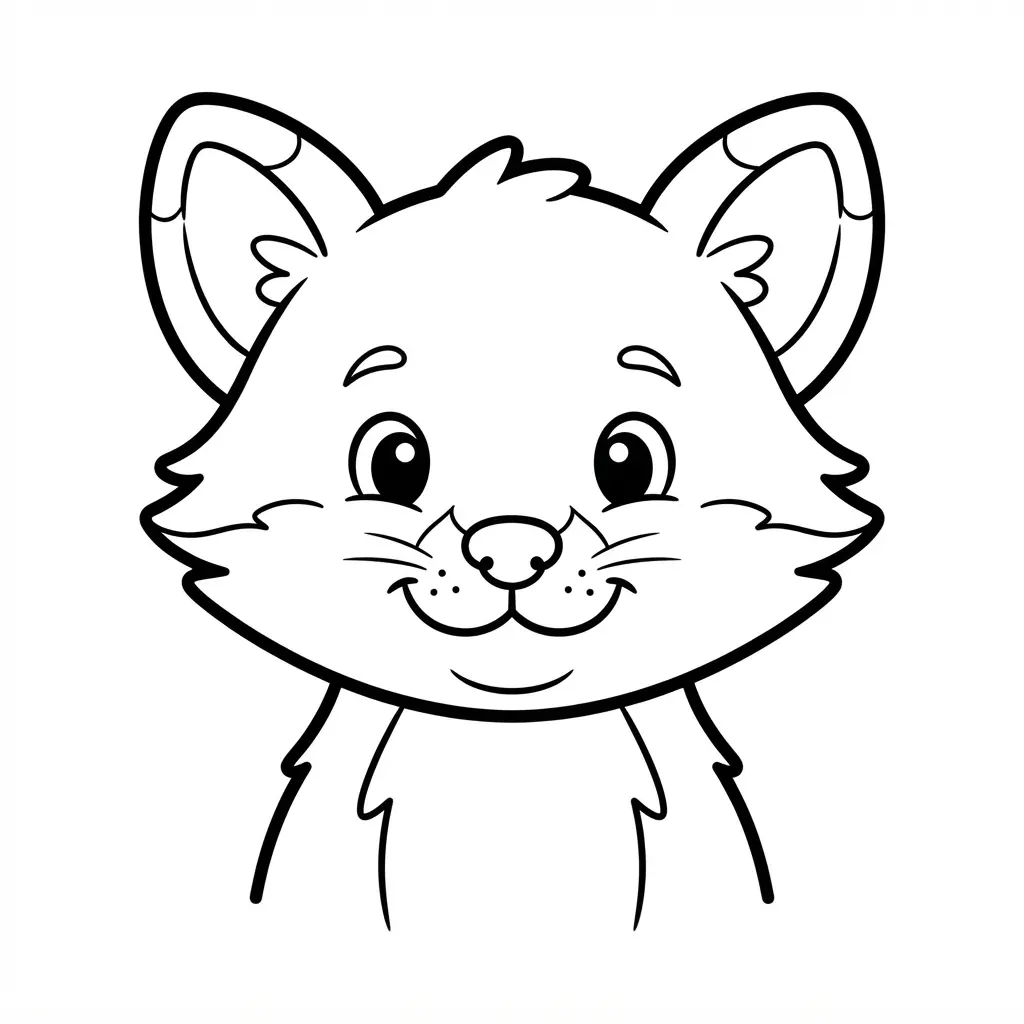
Ever tried turning a friendly fox into a page a young artist will love? Start with a seated chibi fox, giving it an oversized head, rounded cheeks, tiny paws, bright eyes, and a cheerful smile. Add a large fluffy tail beside its body, then surround the character with a few simple mushrooms, flowers, leaves, and soft clouds. Use thick smooth outlines around every shape so each section stays easy to follow.
Keep the portrait layout open, with a plain white background and generous spaces inside the face, body, tail, and woodland details. Skip shading, gray tones, and tiny patterns, since clean black-and-white line art gives young colorists clear places to fill. I love how this simple structure makes fox coloring pages feel welcoming without crowding the paper. Pro tip: print the page at full size, then let your child choose warm orange, soft cream, or any playful colors for a happy finish.
2. Realistic Red Fox Woodland Scene — Forest Detail for Older Colorists
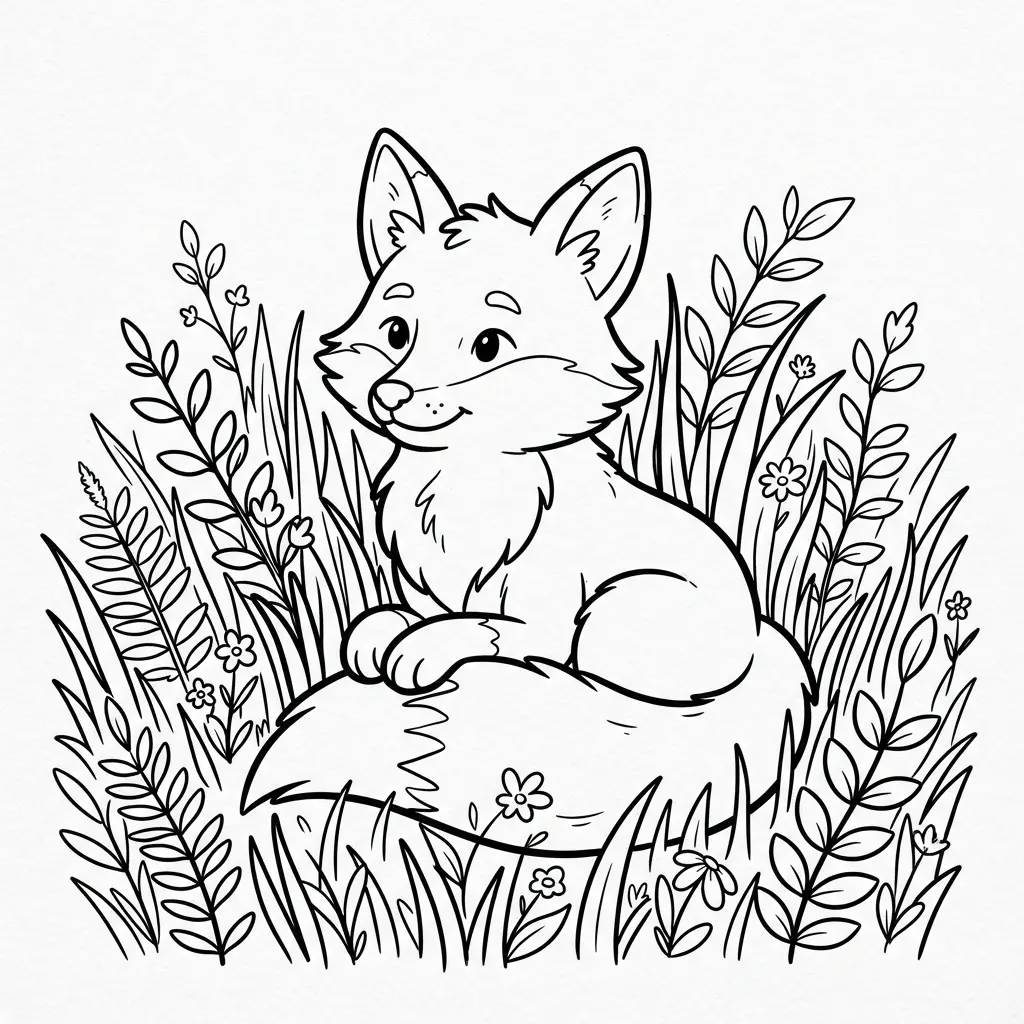
This woodland scene feels calm and detailed from the first glance. Start with the resting red fox beneath an old oak, then give its face, ears, paws, and tail careful attention. I love how the animal stays central while the tree and foliage frame it without hiding its shape. Sound complicated? It is not, once you work from the middle outward, which helps beginners navigate fox coloring pages.
Build the foreground with ferns, mushrooms, fallen leaves, and stones. Add grooves to the bark and several layers of foliage, keeping each edge distinct. The small natural textures give your pencils plenty of areas for gentle color changes, while the layered woodland foliage keeps the scene from looking flat. Trust me on this one, leave a few open spaces around the fox so the focal point stays easy to see, a tip that greatly improves most designs.
Finish with distant tree trunks and lighter shapes behind the oak for forest depth. Why focus only on the animal? The background gives older colorists more detail to enjoy, and clear, defined outlines help every mushroom, leaf, and stone stay easy to identify. Use darker tones near the foreground, lighter tones in the distance, and feel proud when the whole woodland scene looks complete, just like a well-made set of fox coloring pages.
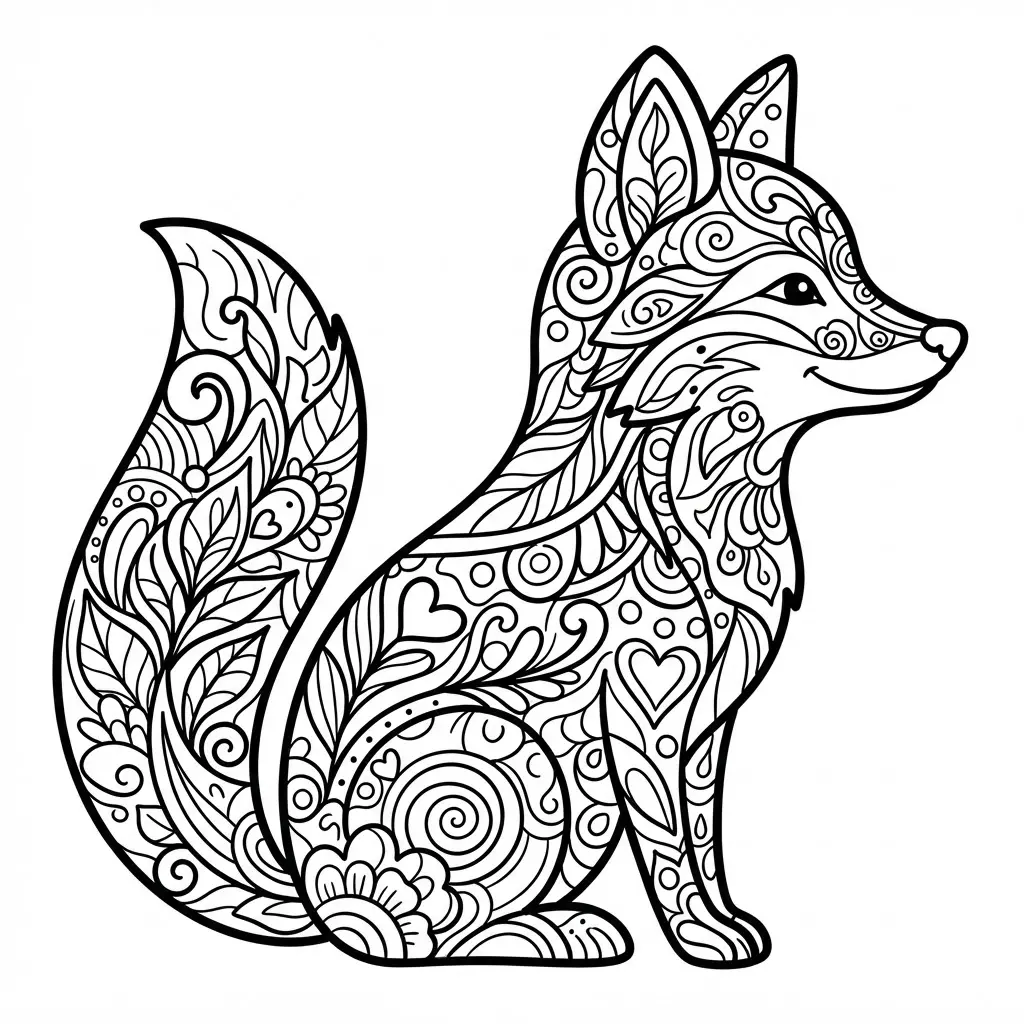
3. Mandala Patterned Sitting Fox Design: Repeating Shapes for Calm Coloring
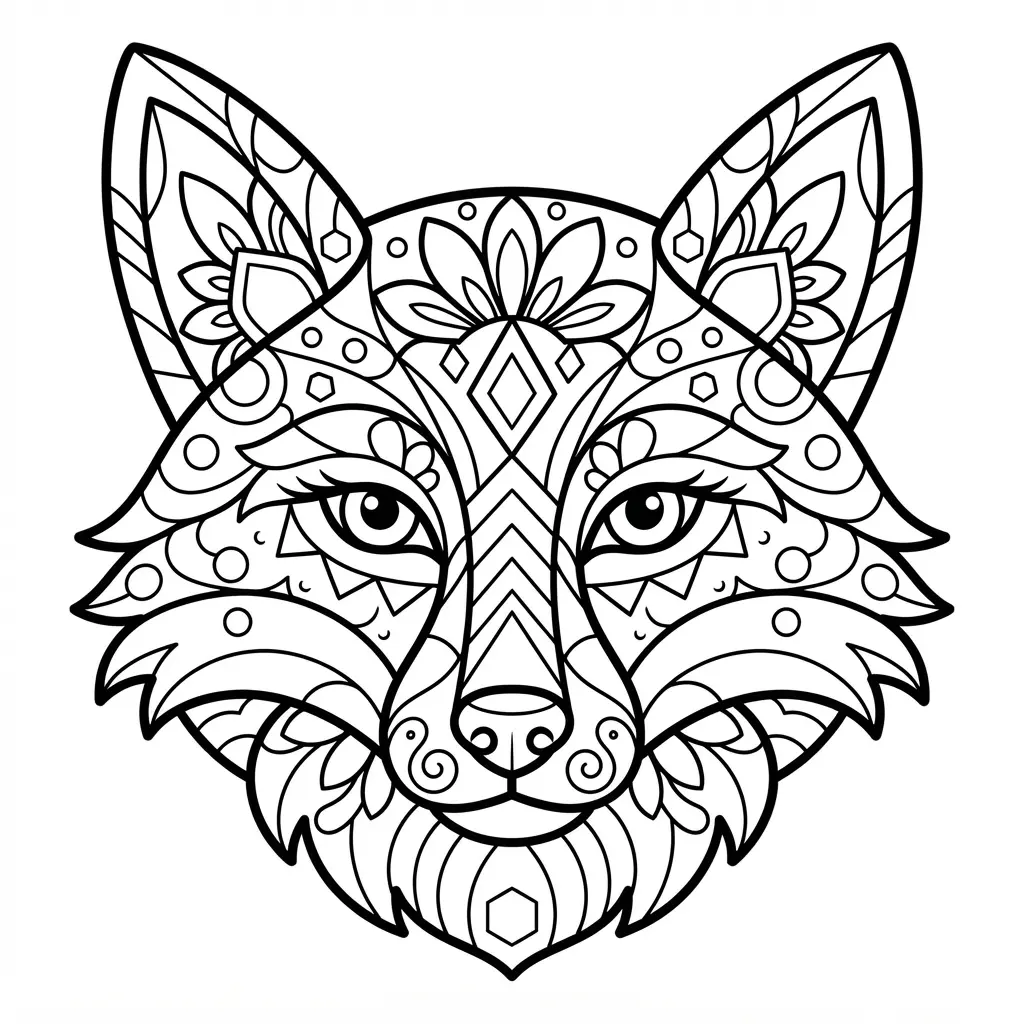
This sitting fox is one of my favorite designs because it feels peaceful from the first glance. Ever tried coloring a pattern where each small shape leads naturally to the next? Start with a centered fox outline, keeping the pointed ears, gentle face, balanced body, and curled fluffy tail easy to see. Fill the tail, body, and ears with repeating flowers, spirals, leaves, circles, diamonds, and decorative lines. Keep the fox as the main focus while the surrounding details create a neat frame.
Extend a few motifs into the background, leaving open spaces between each shape. Use clean black outlines instead of gray shading or solid areas, so every section stays ready for pencils, crayons, or markers. I love how steady repetition gives your hands a calm rhythm without pulling attention away from the fox. Keep each detail large enough to color comfortably, and check the spacing as you work. Feel proud when the balanced pattern comes together.
4. Arctic Fox Winter Snowscape Illustration — Snowy Details and Open Space
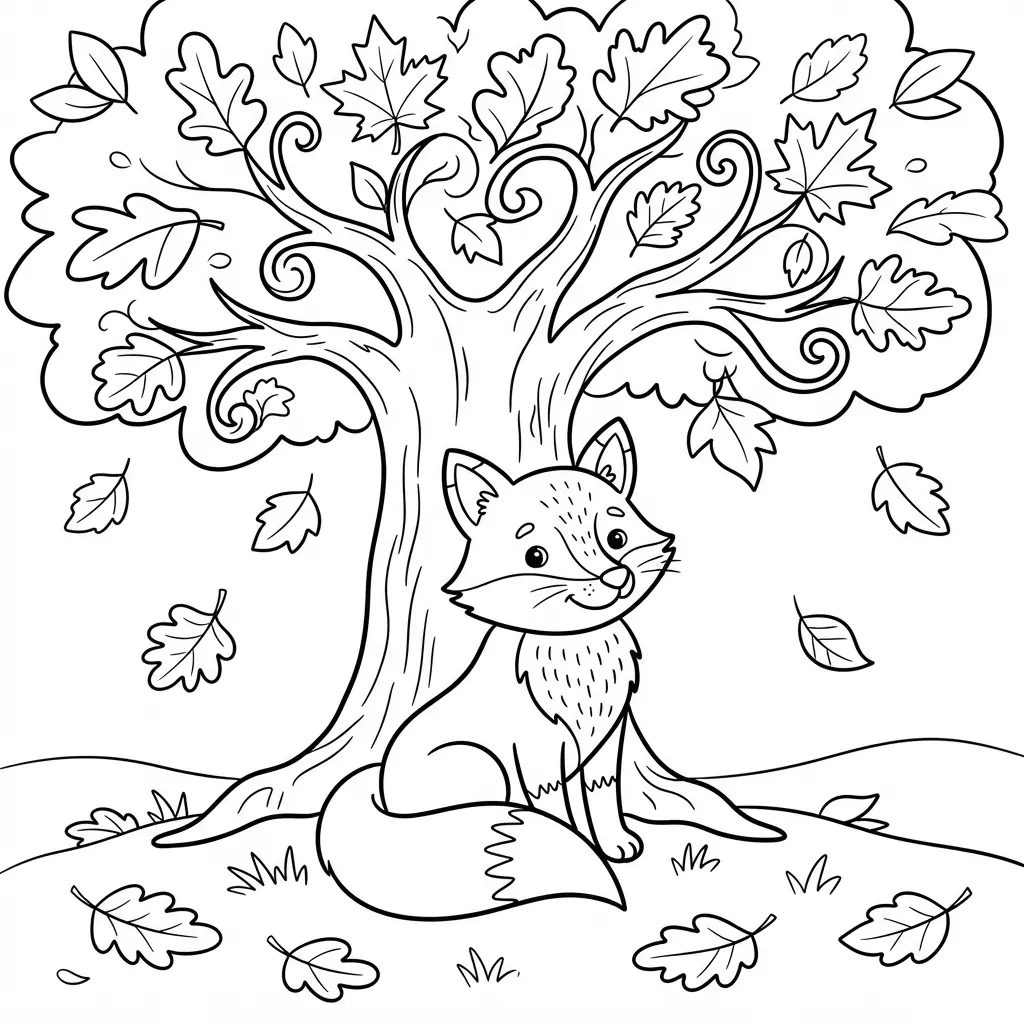
Soft flakes drift across pale blue snow as an arctic fox stands quietly off-center, its thick white fur edged with gentle gray. The broad field feels cool, still, and spacious, with a pastel sky fading into a misty horizon. Doesn’t this peaceful setting make you want to reach for powder blue first, a color that shines on winter-themed fox coloring pages?
Begin with a wide horizontal format, then place the fox slightly to one side rather than in the middle. Leave generous open areas around its body, adding shallow paw prints in the foreground, a few icy grasses, and small snow-covered rocks. Keep the fox’s fur lines crisp enough for easy coloring while the distant snowbanks stay soft and low, a layout that suits many designs.
I love this one because the detailed animal gives your eyes a clear resting point, while the open snowfield keeps the page calm and uncluttered. Use white, ivory, powder blue, and soft gray for a gentle winter palette. Diffused lighting will help the fur blend with the snow without letting the fox disappear. Try selective snowy textures instead of filling every section with marks.
A few wind-swept lines and scattered snowflakes add depth, while untouched space protects the minimalist mood. Trust me, the quiet balance between detail and openness feels wonderfully soothing to color, making it easy to finish fox coloring pages.
5. Fox Sleeping Under Mushroom Canopy: Cozy Forest Coloring Scene
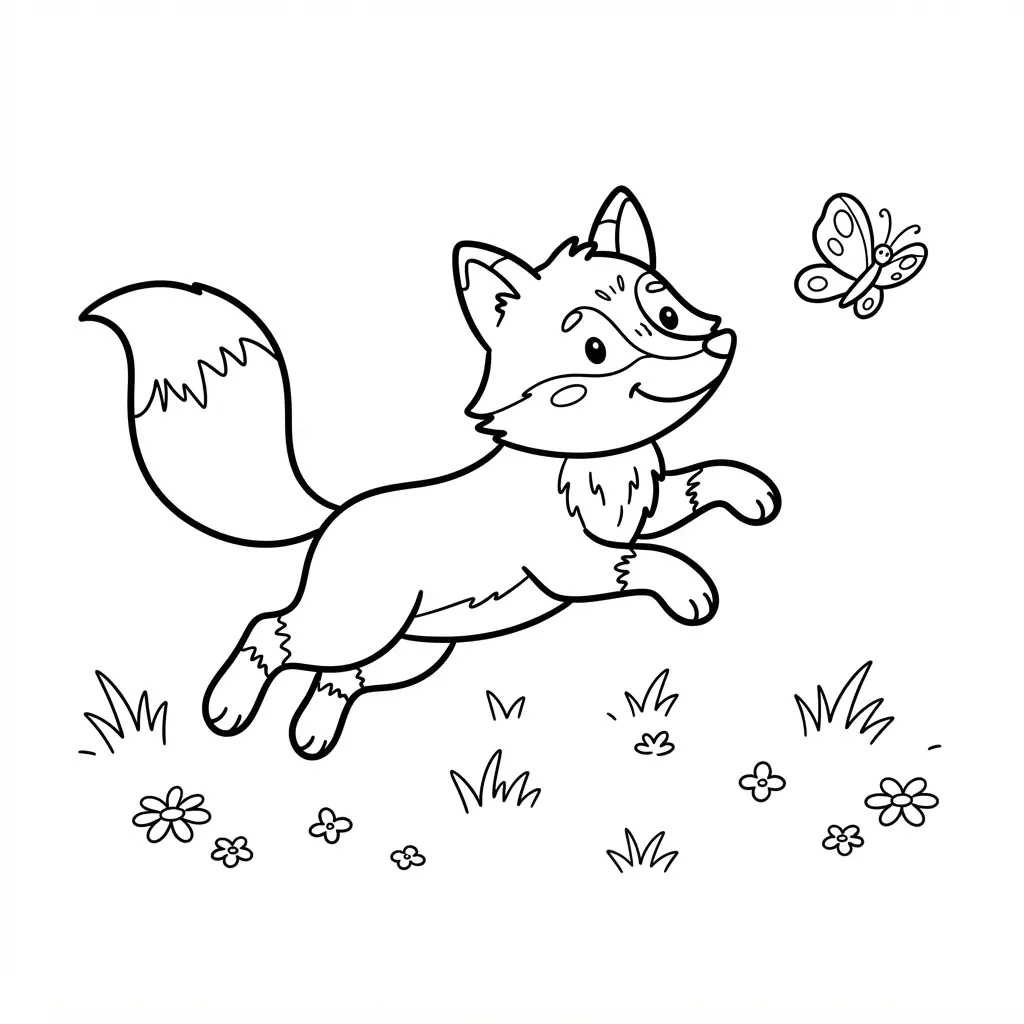
A common mistake with this scene is making the mushroom canopy so busy that the fox gets lost. Does a cozy shelter need dozens of tiny details? Not at all. Start with the curled fox in the center, then draw two or three oversized mushrooms above it, keeping their spotted caps clear and open. Add the fluffy tail around the body, closed eyes, and a small, gentle smile. I love how this simple focus gives the picture its calm feeling, which matches the gentle style of many designs.
Build the forest clearing around the fox with small mushrooms, ferns, acorns, wildflowers, and fallen leaves. Tree roots and moss-covered stones help anchor the scene, while hanging vines and a few fireflies add friendly woodland detail without crowding the page. Use bold outlines, simple shapes, a white background, and no shading or gray tones, so each section feels easy to fill with color. Leave a little open space between the fox and the canopy for a clean storybook look, a layout trick that elevates fox coloring pages. Trust me, the finished page feels snug, peaceful, and ready for a warm forest palette.
6. Geometric Style Origami Fox Portrait — Crisp Angles and Clear Sections
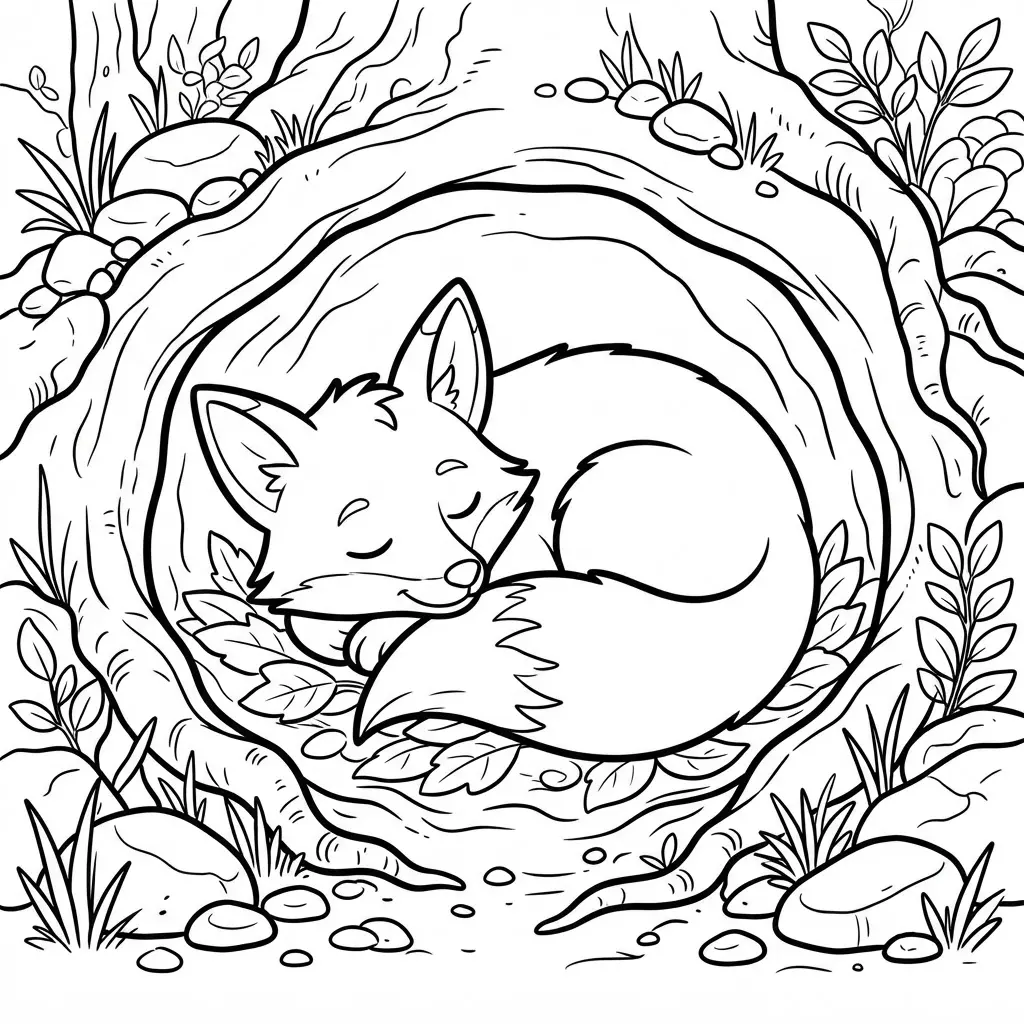
Place a sheet of paper beneath your reference and begin with a centered head structure. Use straight lines to build the forehead, cheeks, and narrow muzzle, keeping both sides balanced. Add pointed ears with triangular sections, then mark alert eyes using small charcoal accents, a technique that works beautifully on detailed prints. Sound complicated? It is not.
Layer each plane with clean edges, allowing rust orange, burnt sienna, and cream to separate the folded sections. Extend the lower shape into a curled neck with broad, faceted pieces rather than rounded curves. A minimal background keeps the portrait focused, while subtle paper texture gives the surface a soft handmade feel. I love how each section stays easy to follow as the image takes shape, proving that simple geometry enhances fox coloring pages.
Finish with a limited natural palette and reserve deep charcoal for the eyes and a few sharp accents. This approach suits detailed prints because every area has a clear boundary and a simple coloring choice. Keep the design symmetrical, and avoid extra scenery or unrelated shades. Your finished portrait will feel neat, modern, and satisfying.
7. Playful Baby Fox Chasing Butterflies — Cheerful Woodland Movement
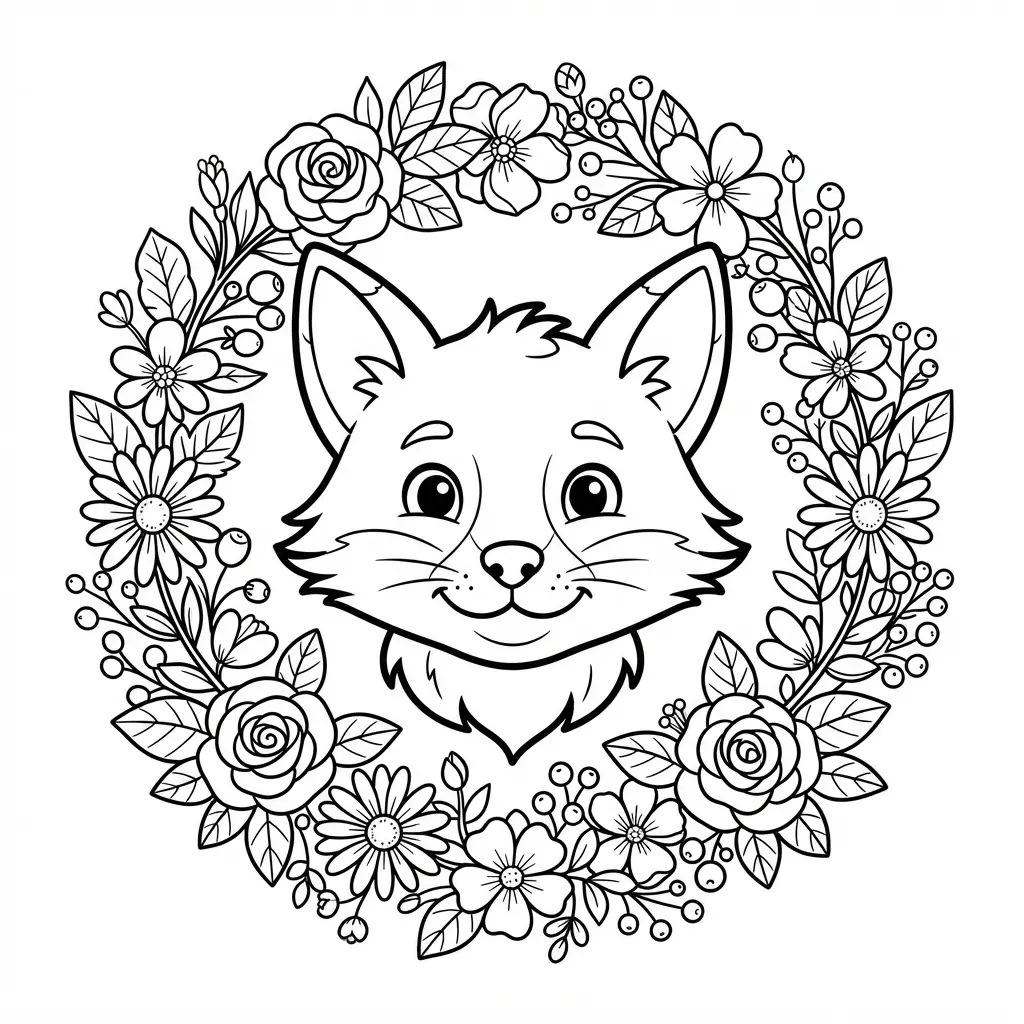
Ever wondered how a still picture makes a little fox look ready to spring? Start with a dashing baby fox pose, giving its front paws a lively reach and directing its oversized, curious eyes toward two butterflies ahead. Add fluffy orange fur, a bouncing bushy tail, and a few curved motion lines, while keeping clear space between the fox and the insects, keeping the layout open for fox coloring pages. I love how this pose gives the whole scene a playful storybook feeling without making the page hard to follow.
Frame the action with a sunlit meadow, wildflowers, tiny woodland plants, and leaves lifting from the ground. Use soft golden light beams between the trees, then save bright colors for the butterflies and small flower centers so the fox stays the focus. Gentle swaying stems and fluttering leaves add movement around the edges, while open areas keep coloring comfortable for small hands. Trust me, a clean layout makes this cheerful chase feel warm, lively, and full of heart, an approach that defines great fox coloring pages.
8. Detailed Zentangle Forest Fox Graphic: Fine Lines for Patient Colorists
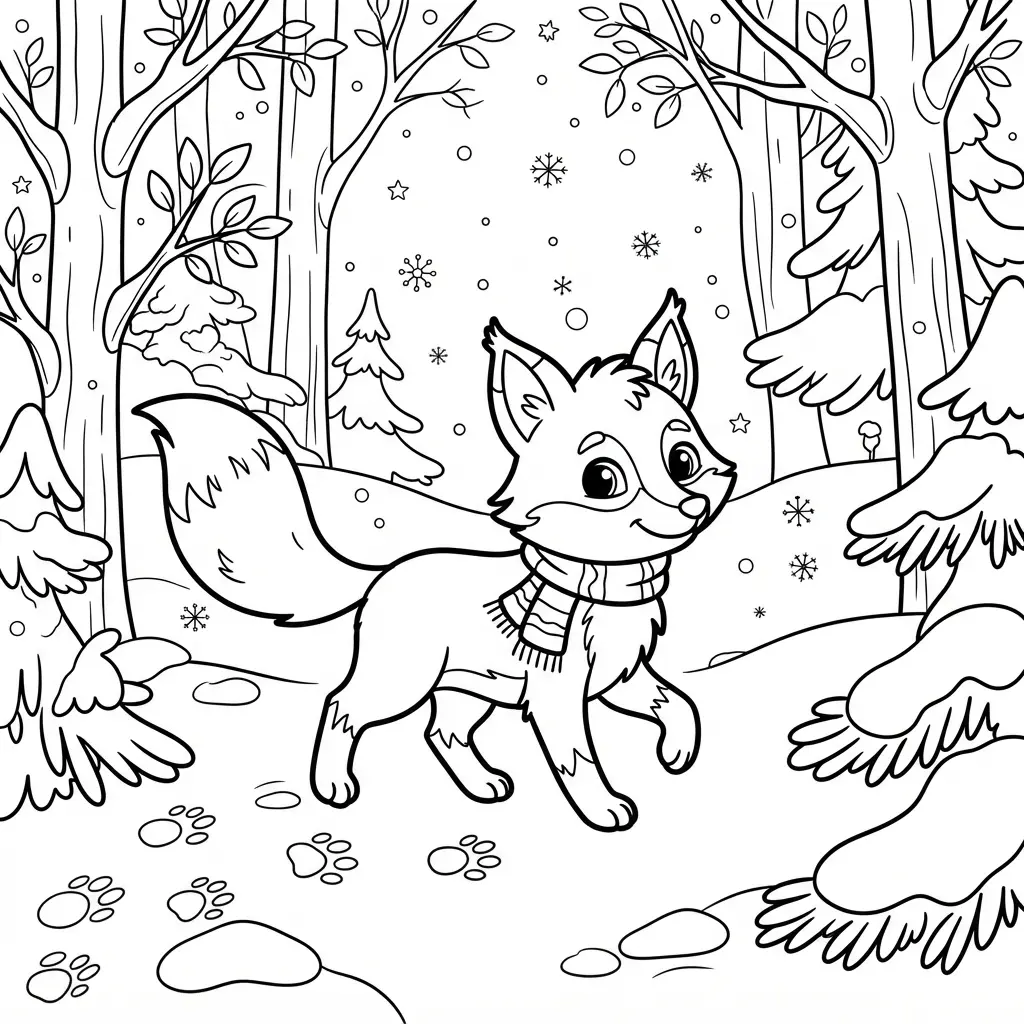
This detailed forest fox is a slow, satisfying project for anyone who enjoys careful coloring. Start with the centered fox, keeping its alert eyes, pointed face, body, and curled fluffy tail easy to read. Use a fine-line black pen to keep every contour crisp, then split the fur into sections filled with spirals, leaves, paisleys, diamonds, feathers, and small rosettes, preparing your prints for detailed work.
Sound complicated? The woodland grows around the subject through pine trees, twisting branches, mushrooms, ferns, berries, acorns, vines, and tiny insects, while an intertwined leaf border completes the page. Leave each space white and skip gray shading, gradients, and solid black patches so your pencils have room to show color. I love choosing a separate palette for each fur section, then repeating one hue in a few forest details for a connected finish.
Keep the smallest marks for the end, using a sharp pencil and a light touch. Your patience pays off as the fox stays clear among all those careful patterns. Feel proud of every section you finish.
9. Fennec Fox Desert Oasis Scene — Warm Sand and Palm Details
I love this scene because it gives prints a peaceful setting filled with color choices. Start with a large-eared fennec fox in the foreground, giving it bright eyes, a rounded body, delicate paws, and a soft cream coat. Ever tried making those oversized ears the first detail you color? They instantly make the animal recognizable.
Place the oasis beside the fox, using an irregular shoreline and a few gentle curves across the water. Leave the ripple areas open so turquoise, blue, or green stays separate from the surrounding golden sand. A few smooth stones and tiny desert flowers will add interest without crowding the scene.
Frame the background with tall date palms and curved sand lines. Spread the fronds clearly, then add loose fallen leaves, dune ridges, and long shadow shapes beneath the fox and trees. Older colorists will enjoy short fur strokes, while younger artists will have plenty of open spaces to fill.
This arrangement works because the cool oasis stands apart from amber dunes and cream fur. Trust me on this one, a touch of pale yellow in the sunlight and light brown beneath the paws gives the finished picture a calm storybook feeling. Feel proud when the desert scene comes together.
10. Fox Wearing Autumn Leaf Garland: Seasonal Woodland Character
Golden light touches the fox’s russet fur while orange, red, and yellow leaves drift around its fluffy tail. I love how the autumn leaf garland gives this woodland friend a clear seasonal personality before you add a single color. Sound complicated? It is not, since the necklace shape guides your eye straight toward the fox’s face.
Start with warm russet shades for the coat, then add amber eyes and soft highlights along the cheeks and tail. Keep each leaf separate as you fill the garland, using red near the center and golden yellow along the outer leaves for a gentle change in tone. A few drifting leaf shapes around the ears and tail will make the scene feel active without hiding the character.
Finish the forest floor with mushrooms, moss, acorns, and visible tree roots, leaving clean spaces between every detail. These small woodland touches give your fox coloring pages a cozy storybook setting, while open areas keep the picture comfortable to color. Trust me on this one: clear outlines help every part stay easy to see, and the finished page feels warm, cheerful, and ready for display.
11. Fantasy Kitsune Mythical Fox Concept — Tails, Charms, and Folklore Details
A common mistake is treating all nine tails as matching decorations. Sound complicated? It isn’t. Give each tail its own pattern, such as ember lines, mist curls, moon tips, briars, river waves, bells, paper seals, shadows, or stars. Tsukihana’s pointed ears, dark paws, mismatched gold and violet eyes, fox mask, and flowing shrine clothing keep her animal nature clear. I love adding small maple leaves and blue foxfire around the figure for extra story detail.
Use nine symbolic tails as the main coloring map, then add red cords, brass bells, a moonstone hairpin, wooden wish plaques, and a black fan. Warm russets and crimson suit the fur and robes, while cream, blue-white, indigo, gold, and violet separate the moonlit folklore details. Keep charms large, leave open spaces between robe patterns, and give every tail a clean outline so young artists spot each symbol with ease. For printable fox coloring pages, a bold outline keeps the face, accessories, and tail tips easy to color. The finished scene feels mysterious, personal, and full of gentle folklore charm.
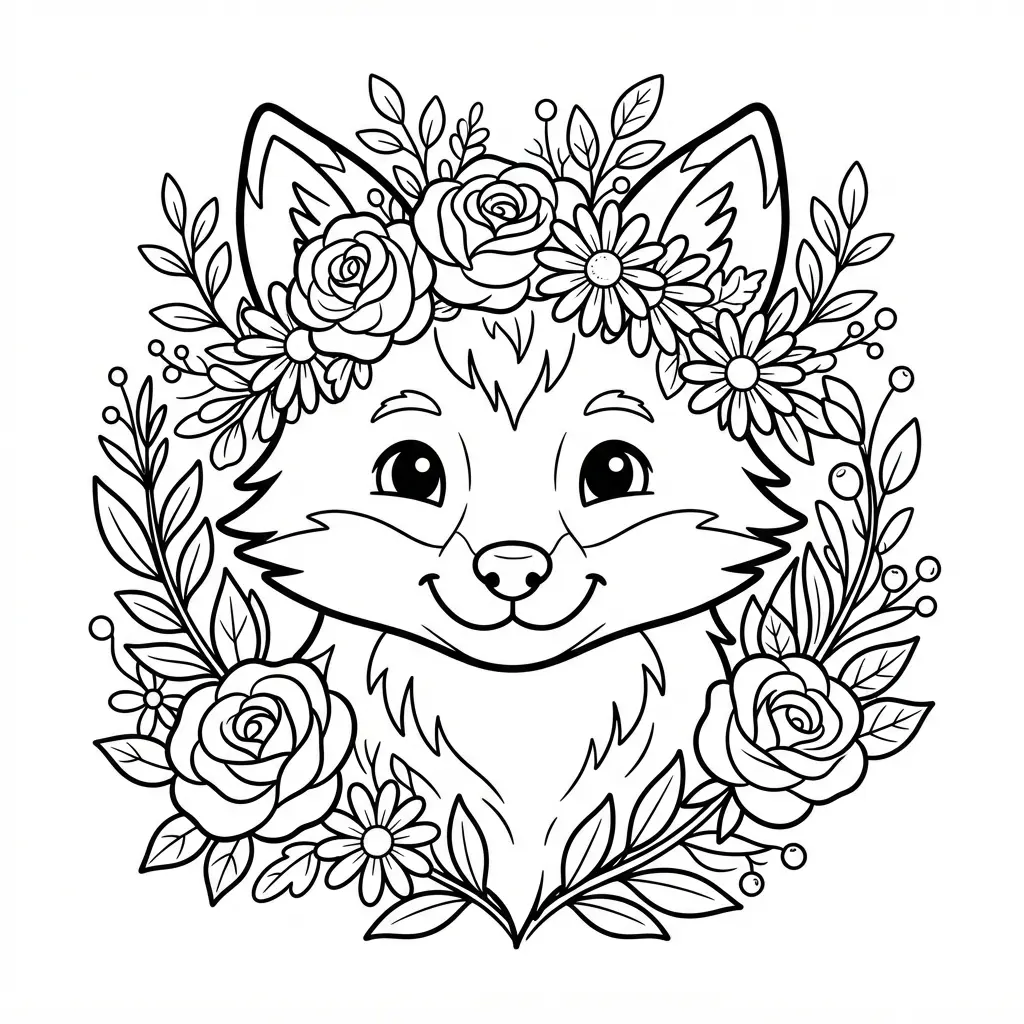
12. Detailed Floral Fox Head Portrait: Blooms Framing a Gentle Expression
Start with a centered fox head, outlining the perked ears, calm eyes, narrow muzzle, and soft cheek curves. Keep the face open and easy to color, with small sections suggesting russet fur and gentle highlights. Does this look detailed? It feels far simpler once the main shapes sit in place.
Build a balanced floral frame around the head, placing roses and larger wildflowers near the ears, then filling open spaces with daisies, lavender, and tiny blue blossoms. Tuck soft green leaves between each bloom so the arrangement feels connected without covering the eyes or muzzle. Vary the petal sizes and outline each shape clearly for smooth coloring.
Add amber eye details with relaxed pupils and a small highlight in each eye. I love how a peaceful expression changes the whole portrait, especially beside the neat symmetry of the flowers. Use russet shades across the fur, gentle green for foliage, and soft pastels for a serene storybook finish. Keep your lines clean, and enjoy the calm feeling as this woodland portrait takes shape.
13. Fox Family in Den Setting — Warm Woodland Family Scene
Does a small den feel more welcoming than a wide forest scene? This cozy family portrait places a mother fox nuzzling two playful kits while the father rests close by. Keep their bodies near one another, yet leave clean spaces between tails, paws, and faces so each character stays easy to color.
Start with the den entrance and let tree roots curve around the opening. Add moss, dried leaves, and pine needles beneath the family, then fill the edges with ferns, mushrooms, and scattered autumn leaves. I love giving the opening a soft golden glow, with lighter lines on the foxes and gentle shadows beneath their bodies. Rich russet fur looks lovely beside cream muzzles, bright chests, and darker ear tips.
This scene works because the close grouping tells a peaceful family story without needing extra action. Use soft shadow lines rather than sharp marks, and keep the roots and plants slightly less detailed than the foxes. Your finished page will feel warm, sheltered, and ready for cheerful coloring. Trust me, those little kits bring the whole den to life.
14. Kawaii Fox With Hot Cocoa: Cozy Winter Character Page
This cozy character page brings winter warmth to a simple seated fox. Start with the seated fox shape, giving it oversized sparkling eyes, round cheeks, a curled fluffy tail, and clear paws wrapped around the mug. A scarf, beanie, falling snowflakes, and small hearts add seasonal charm without filling every open space. Sound complicated? It is not, since the rounded forms keep the picture friendly for young colorists.
Place the steaming cocoa mug between both paws, then add a few marshmallows floating on top. Keep the evergreen tree, mittens, and snow-covered ground small and easy to recognize. Use bold black outlines around each feature, leaving the background white and the coloring areas wide. The complete fox, tail, accessories, and mug should stay inside the printable portrait frame, with no cropped edges or extra limbs.
I love this one because familiar winter details make the page feel warm while the simple anatomy stays approachable. Choose crayons, colored pencils, or markers for the scarf, cocoa, and snowy setting, then leave room for your own color choices. Pro tip: check the paws before printing so both appear to hold the mug clearly. Feel proud when this sweet winter scene comes together.
15. Vintage Style Woodcut Fox Print — Classic Lines and Rustic Texture

This one is a favorite of mine because it feels handmade from the first glance. The fox stands out through bold carved linework, with firm marks shaping its face, tail, paws, and flowing fur. Short strokes follow the direction of the coat, while uneven gaps add the look of an old printed image. Does this style sound difficult? It is friendly for beginners once you focus on clear shapes first.
Keep the fox easy to recognize before adding rustic texture around its body. Small lines in the ears, chest, and tail suggest fur without filling every open space. Add a few woodland details, such as leaves, branches, or grass, while leaving enough white area for comfortable coloring. The warm, nostalgic look suits a storybook page, a library corner, or a cozy farmhouse display.
I love how each colored section still leaves room for the antique character to show through. Use two earthy color families, such as russet with cream or orange with brown, then add muted green for nearby leaves. Avoid turning every inch into texture, since the fox’s face should stay open and expressive. Trust me on this one, the finished page feels personal, calm, and full of old woodland charm.
16. Celestial Moon and Star Fox — Night Sky Details for Fine Pens
The finished scene feels quiet and airy, with a crescent moon glowing above a fox while its curled tail winds through tiny stars. Four-point stars, diamond shapes, and soft dots give the sky a gentle rhythm. Doesn’t the mix of dark outlines and open paper look lovely? I love how peaceful this design feels.
Begin with heavier focal outlines around the fox and moon, then add the face, whiskers, nose, and bright eye details. Shape the fur with short, flowing strokes around the ears, cheeks, chest, and tail. Fill the night sky with varied stars, faint constellation lines, wispy clouds, curved wind marks, and a few specks. Add thin contour lines and small crater marks inside the crescent.
This approach works because your eye goes first to the fox and moon, then travels through the smaller sky details. Keep constellation lines pale and leave open space near both main subjects, since a crowded sky hides their clean shapes. Trust me on this one: place the darkest marks around the face, paws, and tail for a crisp finish. Feel proud when the final details settle into place.
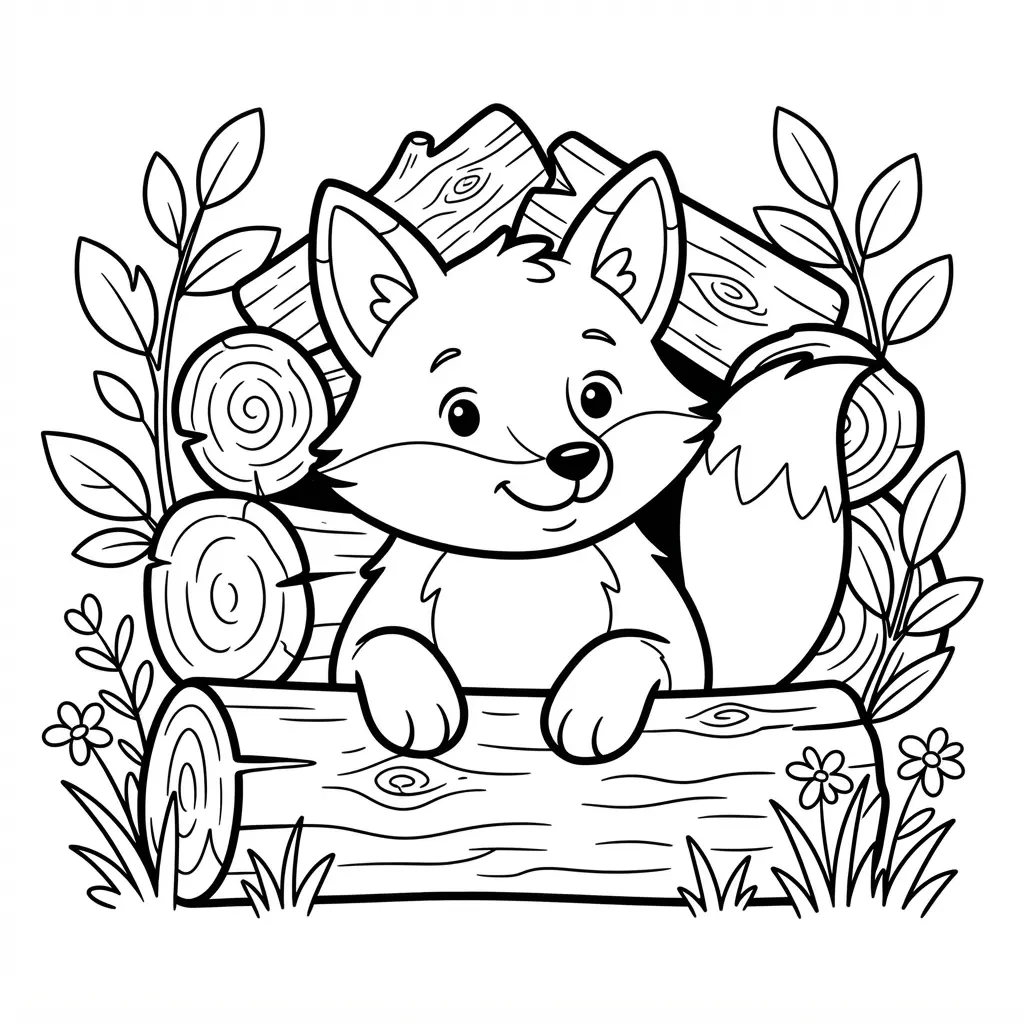
17. Curious Fox Peeking From Logs: Playful Woodland Peek
A common mistake is showing the fox’s whole body, which removes the playful peek. Keep the cub partly hidden behind two fallen logs, with its face, upright ears, and tiny paws appearing through the gap. Start with bold outer outlines around the logs and fox so each section stays easy to color. Doesn’t this pose feel extra friendly?
Give the cub fluffy orange-and-white fur, large eyes, and small paws resting against the bark. Add moss in uneven clusters along the logs, then surround the frame with fern fronds, mushrooms, and little wildflowers. The oversized eyes should have clean shapes, while the ears need visible inner sections for easy color choices. I love how these details give the fox a curious woodland scene without hiding its expression.
Finish with soft woodland light behind the logs, leaving open areas for gentle yellow or pale green touches. Use bark lines, moss shapes, fur marks, and plant outlines with different levels of detail, while keeping the face area calm. Light background spaces help the fox stand forward and keep the page inviting for children and adult animal lovers. Trust me, those tiny paws create a sweet payoff.
18. Abstract Ink Blot Fox Illustration — Bold Shapes and Freeform Coloring
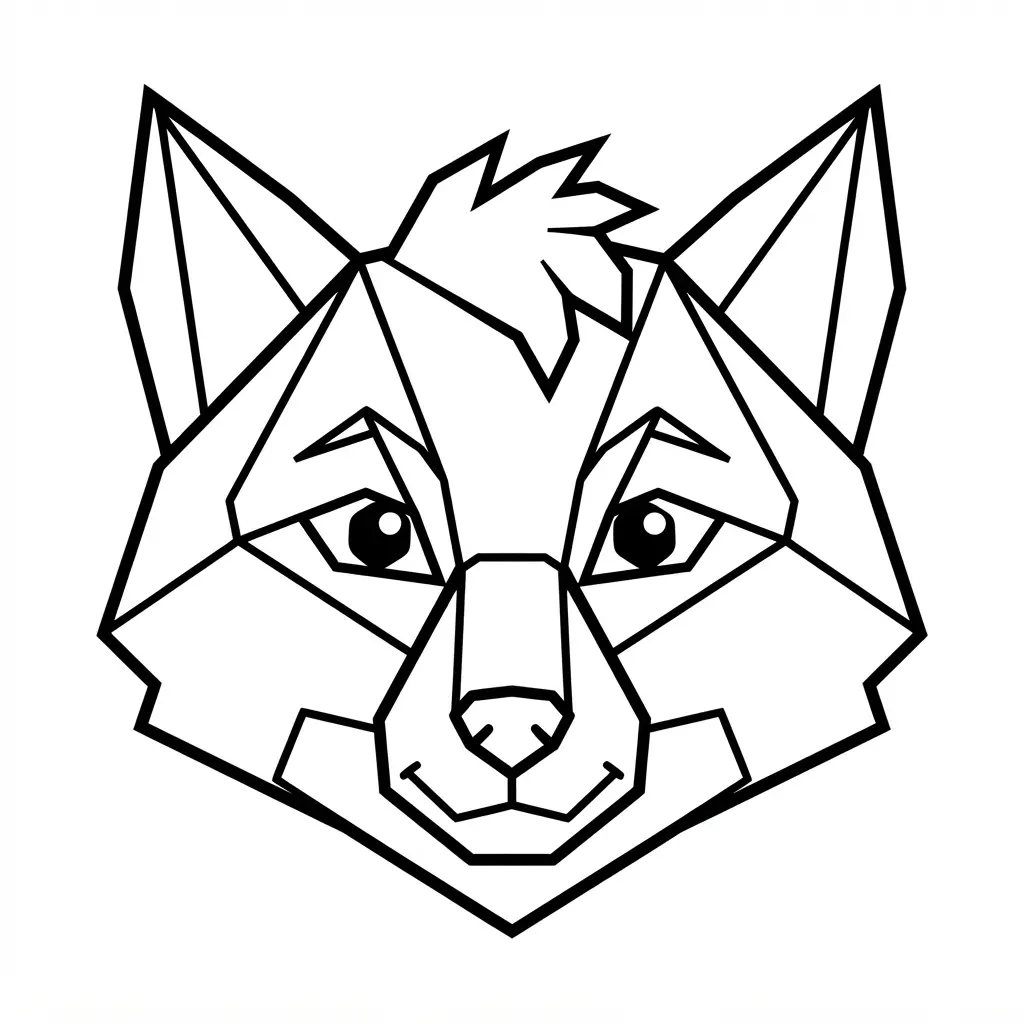
Start with a bold fox silhouette, giving it an angular head, pointed ears, oversized eyes, and a long, bushy tail. Keep the pose flowing in portrait orientation, so the outline feels lively while the animal stays easy to recognize. Sound complicated? It is not.
Next, trace the edges with thick irregular black lines, then split the body into uneven sections. Mix sharp geometric patches with loose organic splashes, overlapping a few shapes and leaving the pattern asymmetrical. I love how the unexpected spaces invite you to switch colors without worrying about perfect matching.
Leave every section white and open for your pencils, crayons, or markers. A clean white background and high contrast keep each area clear, while the oversized eyes and pointed ears protect the fox’s identity. Avoid gradients, tonal shading, thin lines, and crowded details, since they take away from the freeform coloring experience. Try warm oranges beside cool purples, or give every patch its own hue, then feel proud of the playful result.
19. Cute Cartoon Fox Cub Portrait for Young Colorists

Who doesn’t love a friendly fox cub with huge eyes and fluffy cheeks? This portrait keeps every feature clear, from the pointed ears and tiny nose to the small leaves and flowers framing the head. Bold black outlines help young artists follow each shape without losing their place.
Start with the front-facing face in the center of a black-and-white printable page, which works perfectly when printing fox coloring pages at home. Leave wide, open spaces inside the ears, cheeks, and eyes, then add a few curved leaf shapes around the head. A portrait layout gives the fox plenty of room while keeping the page neat and easy to hold.
I love this one because it feels cheerful without asking for advanced skills. Try orange for the fur, warm cream for the cheeks, and gentle greens for the leaves, or choose any colors your child enjoys. Use clean coloring strokes and keep shading out of the picture so each section stays bright and clear. Trust me, this little face brings an instant smile to the finished page.
20. Realistic Woodland Fox in Grass — Natural Fur Details

This realistic woodland fox looks lively before a single color touches the page. Begin with a realistic standing pose, checking the long back, slim legs, alert head, and full tail. Sound complicated? It is not. Once the anatomy feels balanced, add russet-orange fur with lighter and darker areas instead of one flat block.
Keep the amber eyes, moist black nose, black-tipped ears, and white tail tip clear so the face stays easy to read. Build texture with fine directional hair marks around the muzzle, cheeks, back, legs, and tail, which is a great approach for advanced fox coloring pages. Let each mark follow the body’s form, with shorter strokes near the face and longer strokes along the back and tail.
Darker legs add depth, while subtle muzzle fur gives the expression a soft, alert quality. I love this one because every small stroke makes the animal feel more present. Finish the scene with tall green grass, wildflowers, and muted woodland undergrowth. Add warm back highlights for filtered golden-hour light, then place gentle shadows beneath the body.
Keep the forest background softly blurred, so the crisp eyes and face receive the most attention. Feel proud when the fur looks varied, touchable, and full of woodland character.
21. Geometric Mandala Style Fox Face for Focused Coloring

I love this design because it looks detailed while keeping every section easy to follow. Start with a centered facial axis, then place the sharp eyes, pointed muzzle, and large triangular ears evenly on both sides. Isn’t it satisfying when the two halves begin to match?
Add layered fur shapes, repeating polygons, leaves, and small swirls around the face, keeping each outline separate for smooth coloring. Use a portrait layout with a pure white background and bold black outlines throughout, especially if you prefer intricate fox coloring pages. Leave the eyes, ears, muzzle, and radial patterns open, with no gray tones or preset color, so you choose every shade yourself.
I find the repeated shapes helpful during quiet coloring sessions because your attention moves from one small area to the next without feeling scattered. Keep the ornamental details clear rather than crowded, and check the symmetry before adding the final lines. Choose warm rust, soft cream, deep brown, or playful custom colors for a focused woodland-animal page.
22. Fox Sitting Under Autumn Tree — Warm Seasonal Scene

Golden leaves glow around a seated fox beneath a broad tree, with soft afternoon light touching its rust-orange fur. Start with a seated fox outline, keeping the alert ears, fluffy white chest, and gentle expression easy to see. Frame the animal with branches above, then scatter golden, amber, and crimson leaves across the mossy forest floor and through the air.
This scene suits printable fox coloring pages because the animal stays central while every surrounding detail invites warm seasonal color. Doesn’t this feel peaceful already? I love giving the fox a distinct white chest so it stands apart from the busy leaves and dark tree shapes. Add short fur lines along the tail and shoulders, plus small moss patches and crisp foliage near its paws.
Leave open spaces between the drifting leaves, since overcrowding makes the gentle pose harder to enjoy. Use orange, yellow, red, brown, and soft green together, while keeping the brightest light near the fox’s face. Trust me on this one, a calm expression and consistent sunlight direction bring the whole woodland scene together. Feel proud when your page takes on its warm autumn glow.
23. Playful Fox Chasing Butterfly Scene for Kids

Many children’s woodland scenes lose their playful feel when the fox looks ready to pounce. Keep the face gentle, add a small smile, and show a playful leaping pose with paws reaching forward. Doesn’t the scene feel friendlier when the butterfly stays a little ahead?
Start with the orange fox in the foreground, giving its fluffy tail a clear white tip, which works wonderfully for beginner fox coloring pages. Draw the butterfly slightly beyond its paws, with open wings and a curved flight path. A sunny meadow, soft green grass, and bright flowers make the chase easy to follow without making the page feel crowded.
Fill the distance with rounded trees, tiny mushrooms, floating clouds, and cheerful birds. Use smooth outlines and simple shapes, leaving wide spaces around each detail for small hands to fill. I love how these gentle background touches turn one coloring sheet into a small story.
Try a pastel color palette with peach, coral, pale yellow, mint, and sky blue. Keep the fox warm orange, then give the butterfly two or three clear colors so it stands out. Trust me, friendly expressions and soft colors make this scene welcoming, playful, and satisfying to finish.
24. Sleeping Fox in Forest Den — Peaceful Woodland Rest

Start by drawing a curled fox shape inside the den opening, with its nose tucked near the chest and its pointed ears resting low. Add the large tail around the body, using rounded lines and a few fluffy tufts to show warmth. Closed eyes and a relaxed muzzle make the sleeping pose clear.
Ever tried giving a fox this peaceful expression when you browse relaxing fox coloring pages? Frame the animal with thick tree roots, soft moss, fallen autumn leaves, pine needles, and tiny wildflowers. Behind the den, sketch tall trunks, distant ferns, and thin beams of sunlight slipping between branches.
A few small fireflies add gentle background interest without pulling attention from the fox. I love using earthy browns, muted greens, warm orange fur, and golden light for this woodland scene. The curved body, wrapped tail, and sheltered entrance work together because every line supports comfort and quiet rest.
Keep the fox outline clear, especially around the face and tail, while adding extra bark and moss texture around the edges for older colorists. Younger artists will enjoy larger spaces, while animal lovers might fill each leaf and fur tuft with care. Add soft color in layers, then enjoy the calm feeling of a peaceful den.
25. Detailed Fox with Floral Wreath — Botanical Line Art
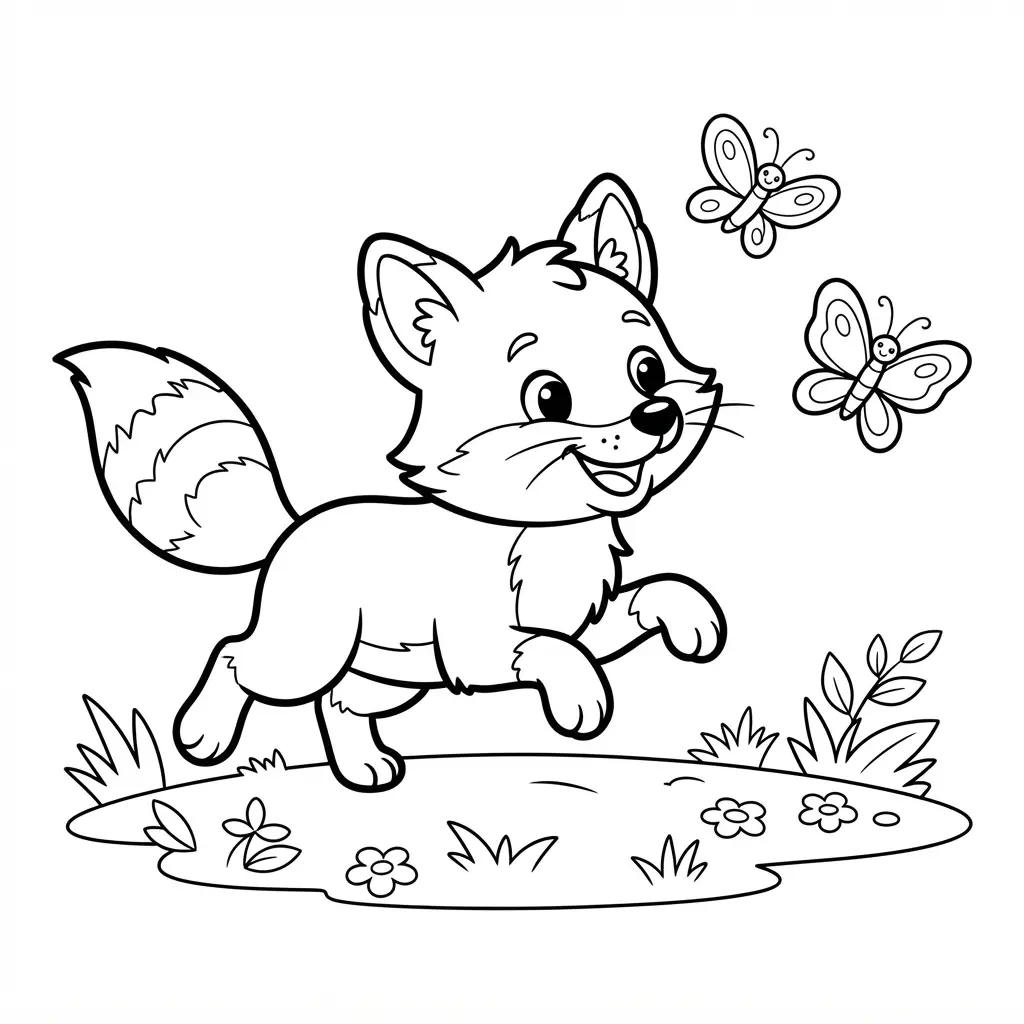
Ever wondered how a fox portrait turns into elegant botanical line art? The profile-view fox sits at the center, with a calm gaze and a graceful outline ready for color. Follow the direction of the fur with flowing contour lines, keeping each stroke light and open.
Add small natural textures around the cheeks, neck, and tail without filling any section with gray or heavy ink. A fine black pen helps keep every edge crisp on the white page. Build the wreath around the neck and ears with wildflowers, roses, daisies, ferns, vines, and small leaves. Keep the flowers spaced around a balanced circular wreath so the fox stays easy to see.
I love how the botanical details give the woodland scene a finished, decorative look. Choose soft greens for the leaves, warm reds for roses, and gentle yellows for daisies, or try an unusual woodland palette. Leave tiny gaps between nearby outlines so each shape stays clear during coloring. Trust me on this one, open spaces make the finished page feel calm, polished, and satisfying.
26. Winter Fox in Snowy Woods — Quiet Seasonal Portrait
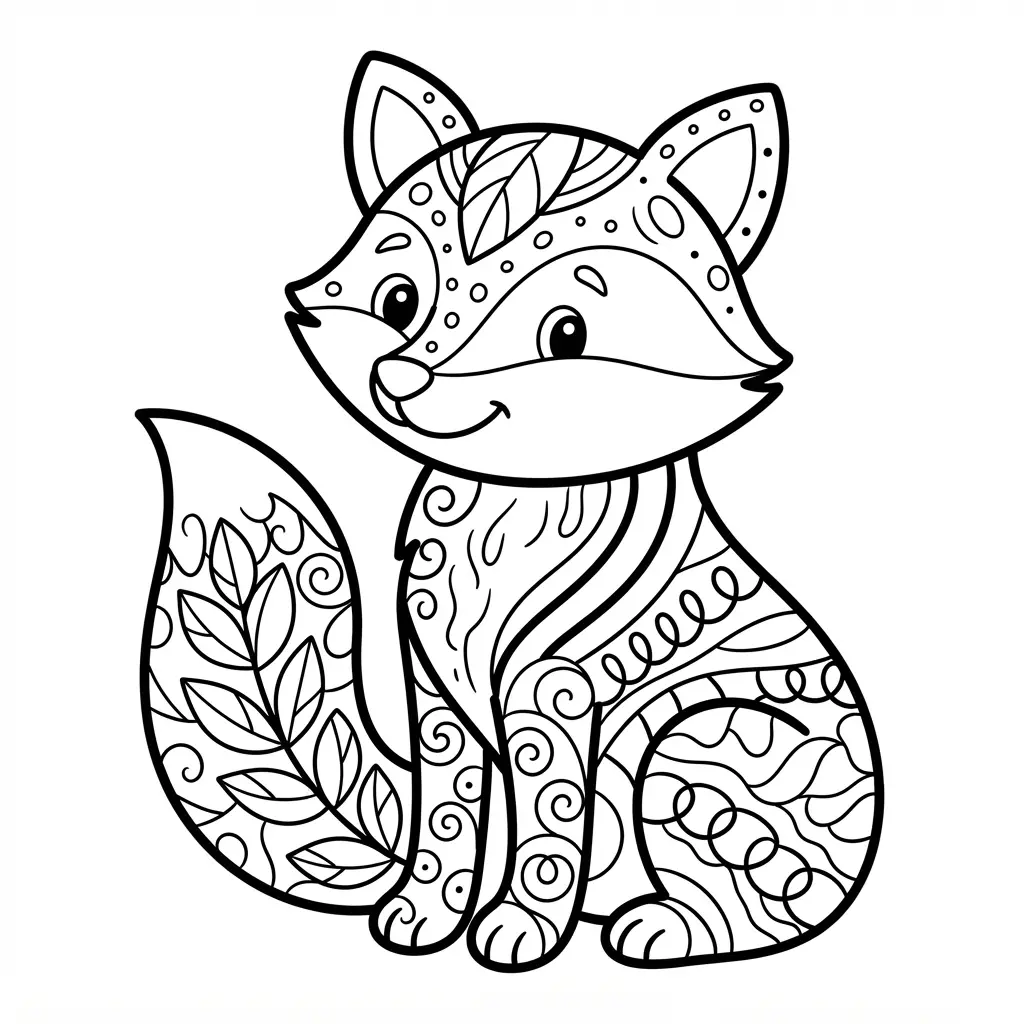
This winter portrait feels peaceful from the first glance, with a solitary red fox standing among snow-covered birch and pine trees. Start with the russet fox, giving its fur layered strokes of warm amber, copper, and soft brown while keeping the eyes alert and the gaze turned slightly aside. Add small snowflakes along the ears and back, then frame the body with slender trunks and gentle pine branches.
Isn’t it satisfying how warm fur becomes the clear focus against pale snow? Keep broad snowfields mostly white, or add the lightest touches of pale blue and silver beneath the fox and around the tree bases. Soft, diffused shading creates winter light without harsh dark patches, while short marks on the branches and fur bring texture without crowding the scene. My go-to tip is to color the snowy woodland last, so the main subject keeps its visual strength.
You’ll love the quiet finish, especially with a small amber glow near the fox’s face, and this approach perfectly matches winter fox coloring pages.
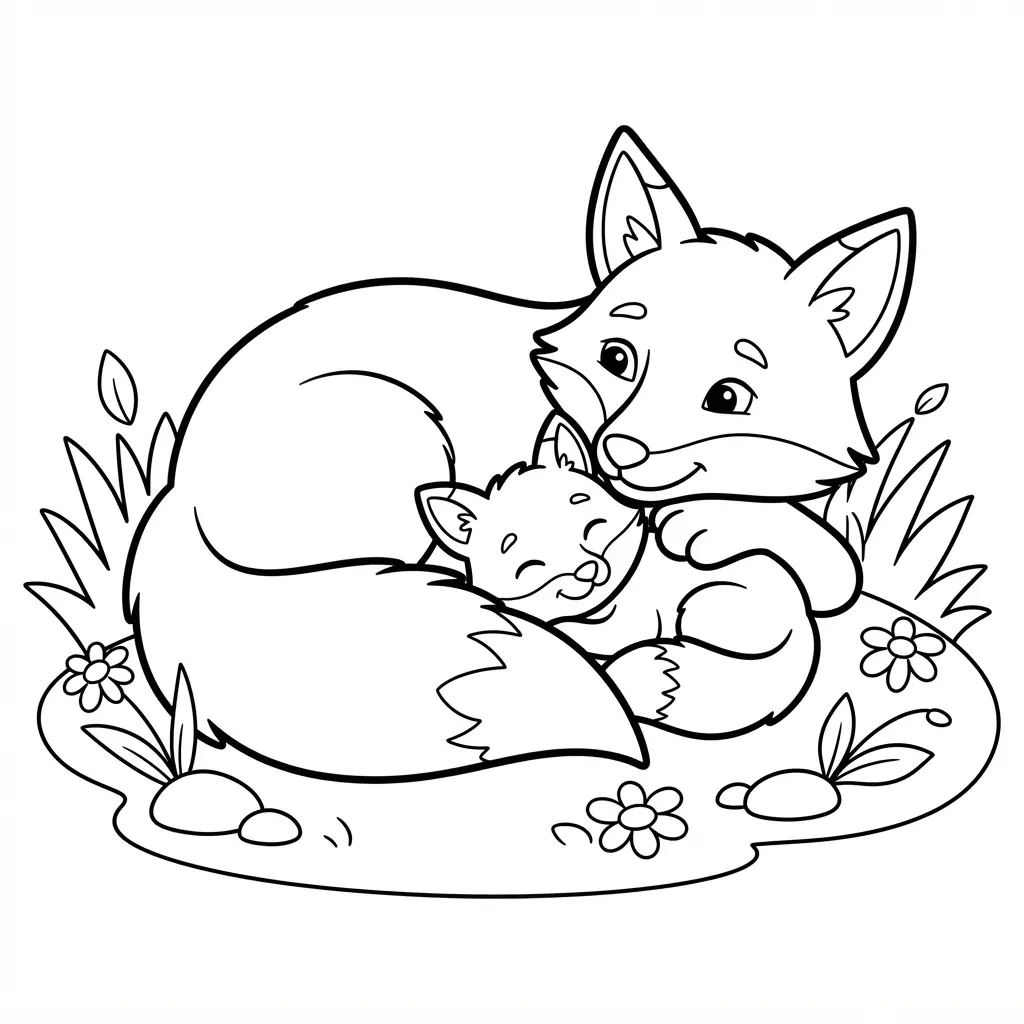
27. Mother Fox and Kit Duo with Woodland Details

This one is my favorite because the pair brings such a warm feeling to a woodland scene. The adult fox sits close to her kit, with relaxed faces and fluffy tails forming the main focus. Start with soft orange shading on their coats, then add cream around the muzzles, chests, and tail tips.
Leave small white areas in the fur so the forms stay clear. Isn’t it sweet how a few simple lines show their close bond? Build the setting around them with leafy stems, mushrooms, acorns, and tall tree trunks, making it ideal for fox coloring pages meant for family themes. Keep the background lighter than the foxes, so the family stays easy to see.
Add short strokes along the tails and cheeks for a furry look, while curved lines in the leaves bring gentle movement to the page. I love using a fine-tip marker for tiny woodland details after the main colors are finished. Try warm browns, rust, moss green, and muted gold for a cozy forest palette, then enjoy the proud feeling of seeing both characters come together.
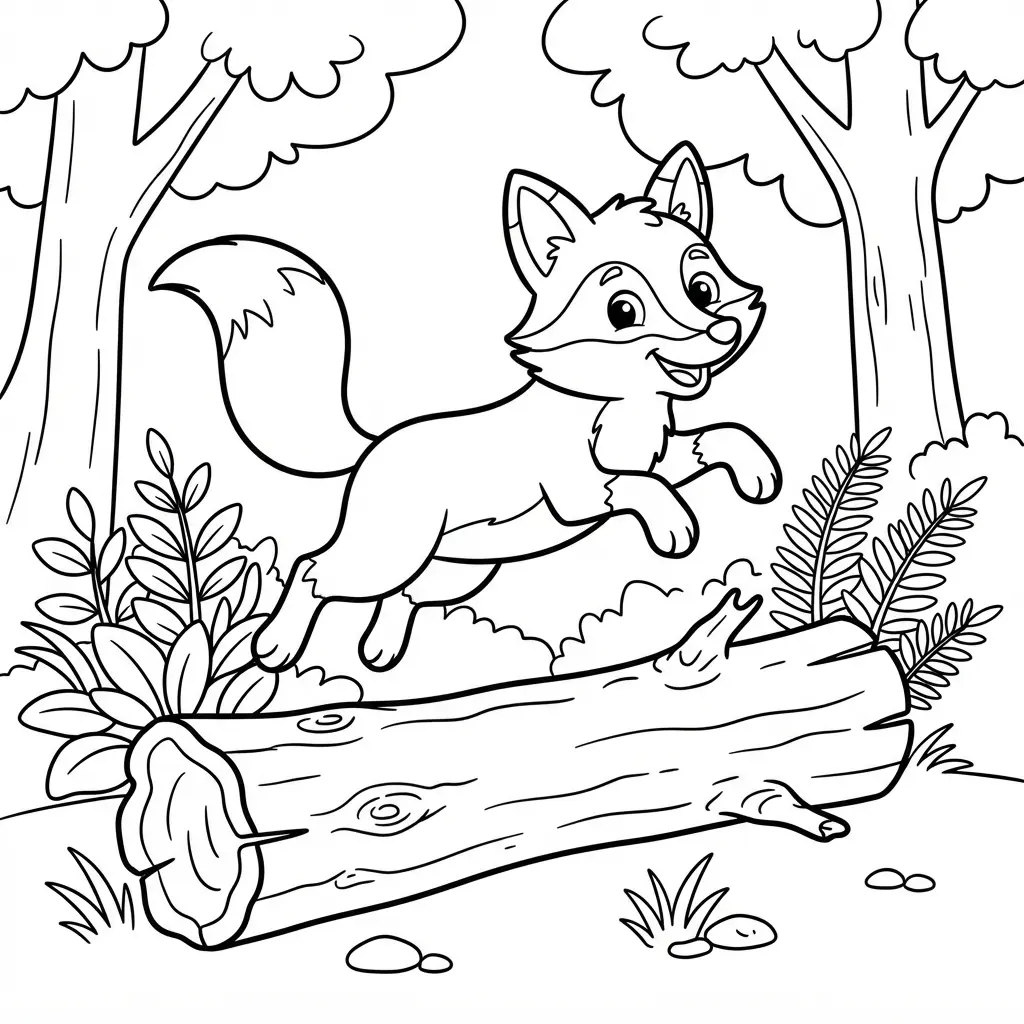
28. Fox Jumping Over Log Design — Active Forest Pose

Warm sunlight slips through pine branches as a fox hangs above a mossy log, its front paws reaching forward and its broad tail streaming behind. Doesn’t this pose make a woodland scene feel full of movement? Start with a three-quarter body shape, keeping the chest open, the hind legs tucked, and the fallen log clearly below the belly.
Use clean expressive linework around the fox before adding ferns, mushrooms, loose leaves, and patches of moss. I love how the stretched body leads your attention across the page, while the tucked legs keep the leap easy to read, which is perfect for action-packed fox coloring pages. Add soft sun rays between the trees, then bring warmth with rust, amber, cream, and deep green coloring.
Keep background marks lighter than the fox so the action stays clear, and vary the bark lines without filling every space. Trust me, a flowing tail and a few lifted leaves give the strongest sense of movement. Give the log a rounded top and a dark underside, then add small moss shapes along its bark.
Finish with warm autumn colors for a cheerful storybook finish you will feel proud to hold up.
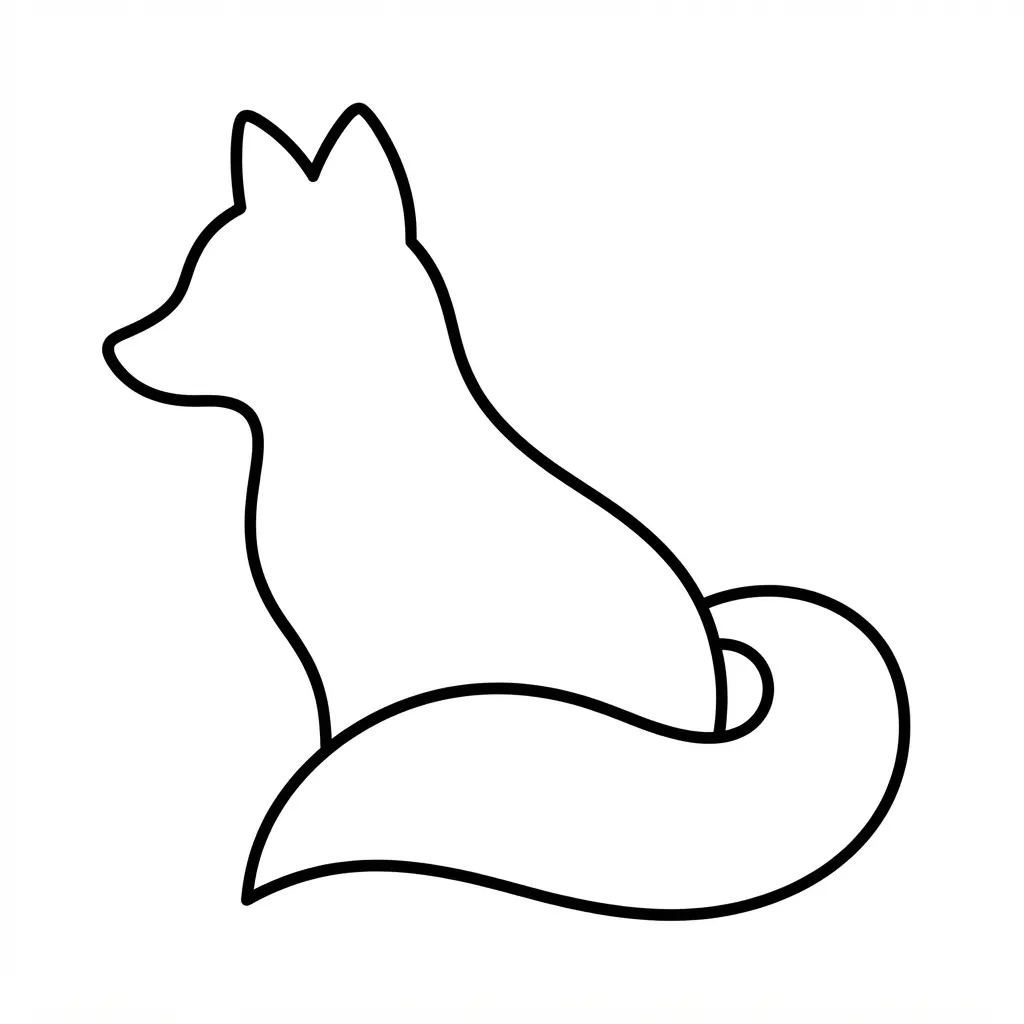
29. Minimalist Fox Silhouette Art Page for Simple Coloring
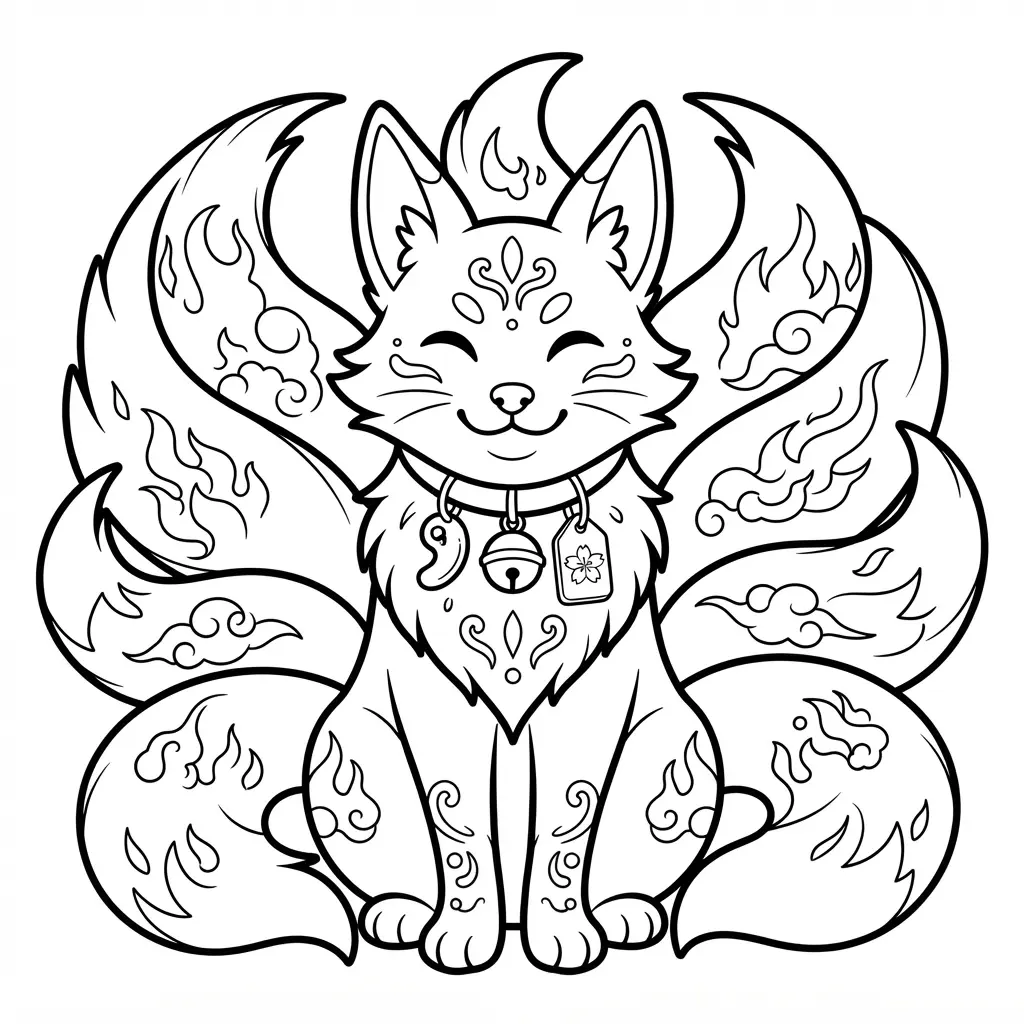
A common mistake is filling the fox with solid black, yet a more animal printable coloring sheets clear spaces for pencils or crayons. Keep the seated animal recognizable through a bold outer contour, showing the pointed ears, full tail, chest, and paws in profile. A plain white background keeps the portrait layout fresh and easy to print.
Place the fox in the center of the page, leaving generous space around its body. Add only a few natural shapes, such as short grass blades, scattered leaves, or a small crescent moon, which makes minimalist fox coloring pages very accessible. Skip gray tones, shadows, and busy textures so the large open areas stay comfortable for young artists and adults.
Doesn’t this sound simple? It is, and I love how the limited detail lets you focus on warm russet fur, soft orange accents, or a playful rainbow palette without losing the animal’s shape. Use a thick black marker for the main lines, then check each section before printing so no tiny gaps or crowded marks interrupt your calm coloring session.
30. Zentangle Patterned Fox Profile View — Fine Line Design
Start with a fine-line fox profile facing left, then outline the pointed ears, alert eye, sleek muzzle, flowing neck, and head shape. Keep the outer edge clean so the animal stays easy to recognize from a quick glance. Fill the silhouette with swirls, leaves, vines, feathers, paisleys, geometric shapes, and floral motifs.
Let each section hold its own pattern, with varied line weights and open pockets of negative space between details, which works beautifully for zentangle fox coloring pages. The clean white background keeps every mark crisp and clear. Sound complicated? It is easier once you treat the fox as several small areas instead of one large drawing.
I love this style because the strong profile gives your eyes a clear path, while each interior section offers a calm spot for careful coloring. Use a fine-point black pen for the outline and lighter strokes for tiny decorations. Skip shading, borders, text, and scenery so the centered fox stays the only focus.
Leave a few sections open rather than filling every corner, and feel proud when the alert expression still stands out.
31. Baby Fox Among Spring Flowers for Gentle Coloring

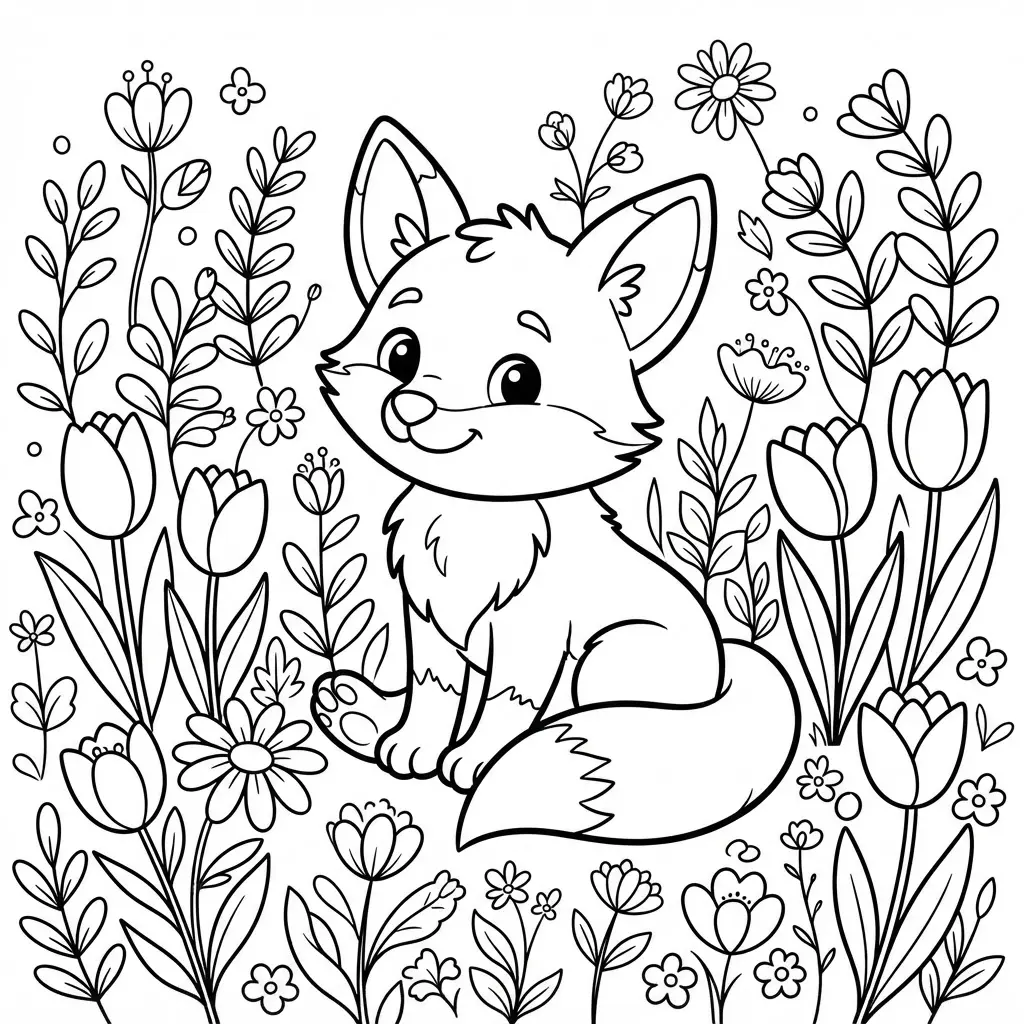
Ever notice how a small fox face makes a coloring page feel friendly right away? Place the baby fox sitting calmly in the center of a spring meadow, with large gentle eyes, fluffy cheeks, a curious smile, and a soft bushy tail curling beside its body. Surround the little figure with daisies, tulips, buttercups, and small wildflowers, then add rounded leaves, delicate grass, and two butterflies for movement.
Use bold, clean outlines around every feature so young artists identify each shape with ease. Keep the black-and-white line art open, with minimal shading and plenty of white background between the flowers. I love how the uncluttered scene feels peaceful while still giving children varied spaces to fill. Leave the fox’s face and tail free from tiny marks, and let flower centers stay large enough for easy coloring.
Pick crayons or broad markers for a cheerful finish, and feel proud of this gentle meadow scene, which aligns perfectly with beginner fox coloring pages.
32. Friendly Fox Wearing Winter Scarf — Cozy Character Art

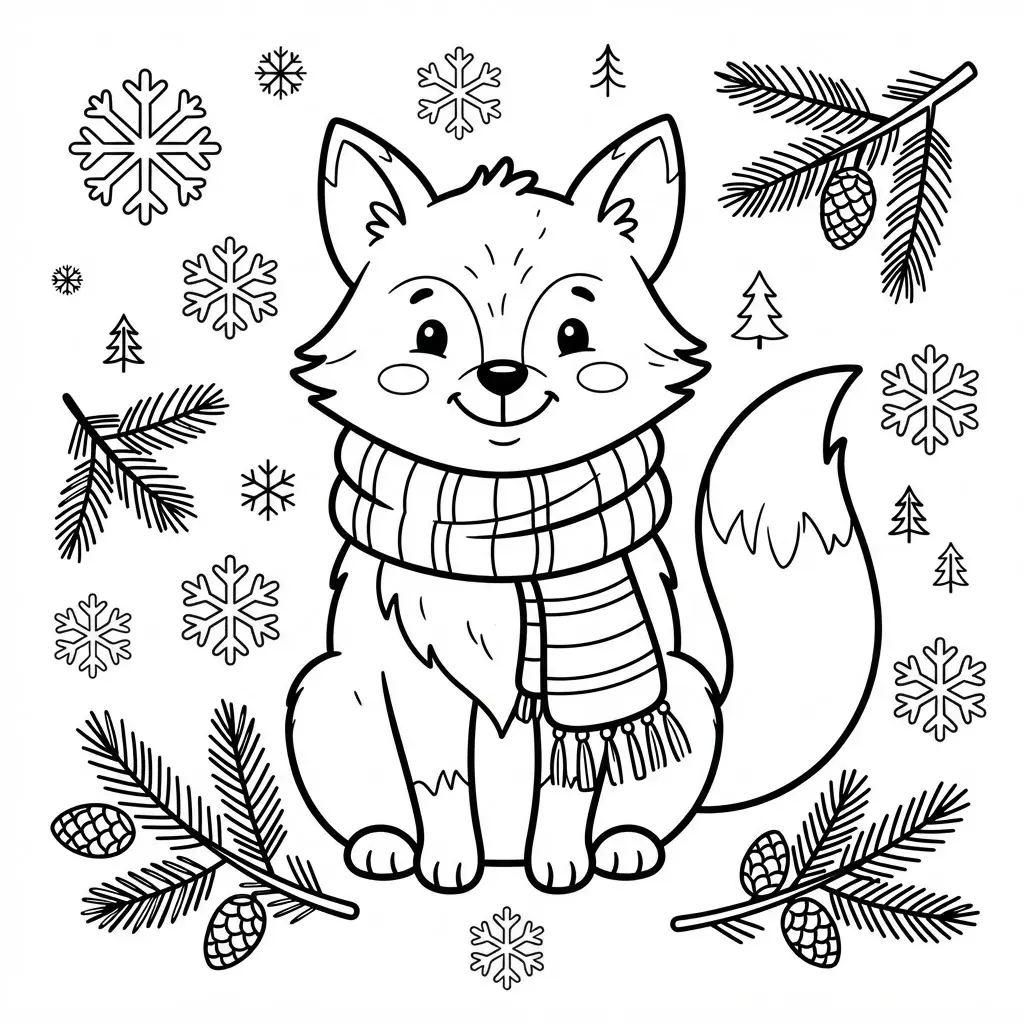
This friendly fox has a soft expression and a cozy winter mood from the first pencil line. Start by placing the fox in a snowy woodland clearing, then build the body with rounded character shapes instead of sharp predator angles. Add bright, curious eyes, fluffy fur, rosy cheeks, and a gentle smile so the face feels open and welcoming.
Sound complicated? It isn’t, especially when you keep the ears and facial features clear, just like many cozy fox coloring pages. Finish the scene with a thick knitted scarf, drifting snowflakes, and snow-covered pine trees behind the seated character. Use orange fur beside crimson scarf accents, then add muted winter shades around the background for a soft contrast.
Warm golden light filtering through the trees gives the picture a comforting storybook finish, while small fur lines and scarf stitches add texture. I love this one because every detail supports the fox’s friendly personality. Pro tip: leave open space around the ears, eyes, and smile so your coloring stays neat and expressive.
33. Fox Head with Leaf Background for Nature Lovers
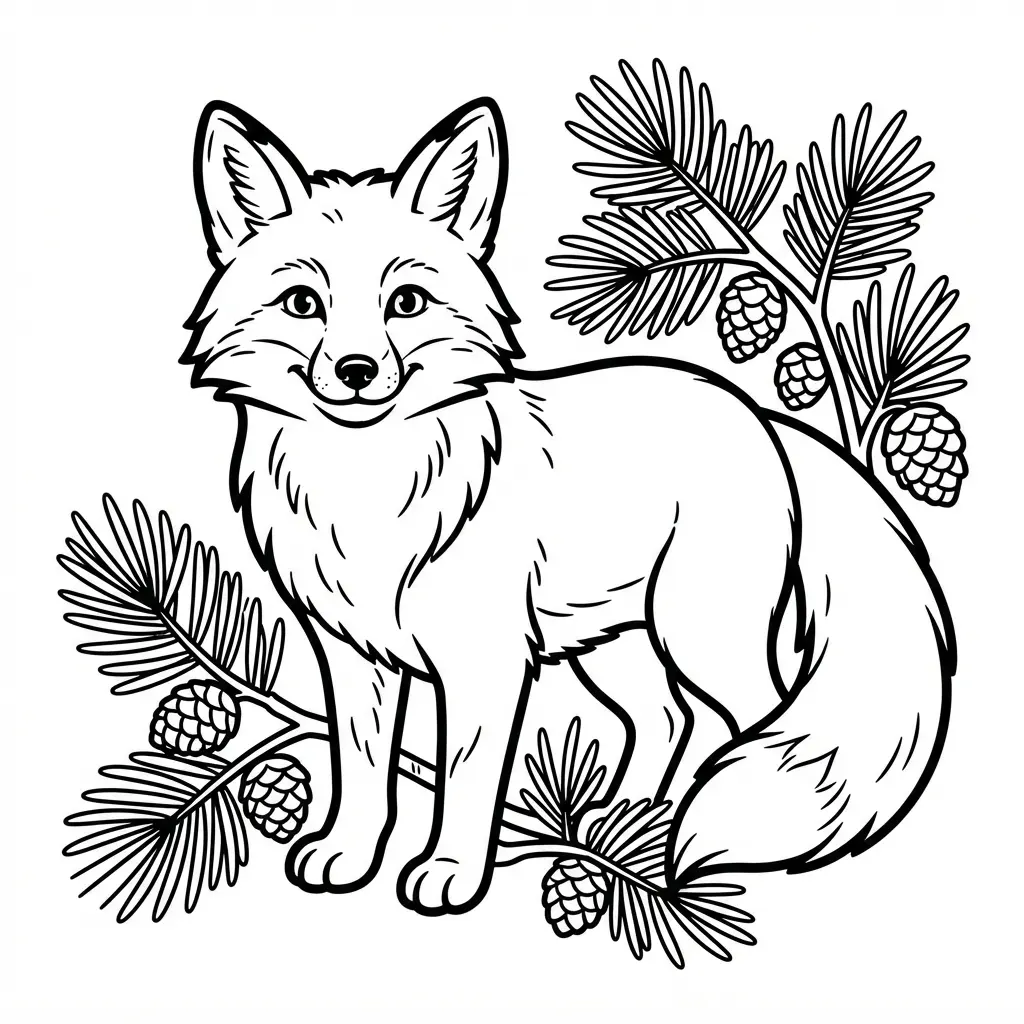
This is one of my favorite pages because the leafy frame gives the animal a calm woodland setting. The fox head stays in the center, with expressive eyes, pointed ears, and textured fur inviting careful coloring. Sound complicated? It is quite friendly once you separate the face, fur, leaves, and vines into clear sections. Begin with light pencil outlines so each area stays easy to adjust.
Use warm orange across the main fur, then add rust along the cheeks, ears, and darker fur patches. Cream suits the muzzle, inner ears, and small highlights around the eyes, while earthy green brings the leaves and vines into the background. Keep botanical shades softer than the fox so wildlife enthusiasts notice the face first.
I love how this balance creates a peaceful page with a rustic décor feel, and a few subtle woodland elements make the finished picture feel cozy, especially for nature-themed fox coloring pages. Choose layered strokes for the fur, keep the foliage gentle, and feel proud when the nature scene comes together.
34. Storybook Style Fox Forest Adventure — Whimsical Scene

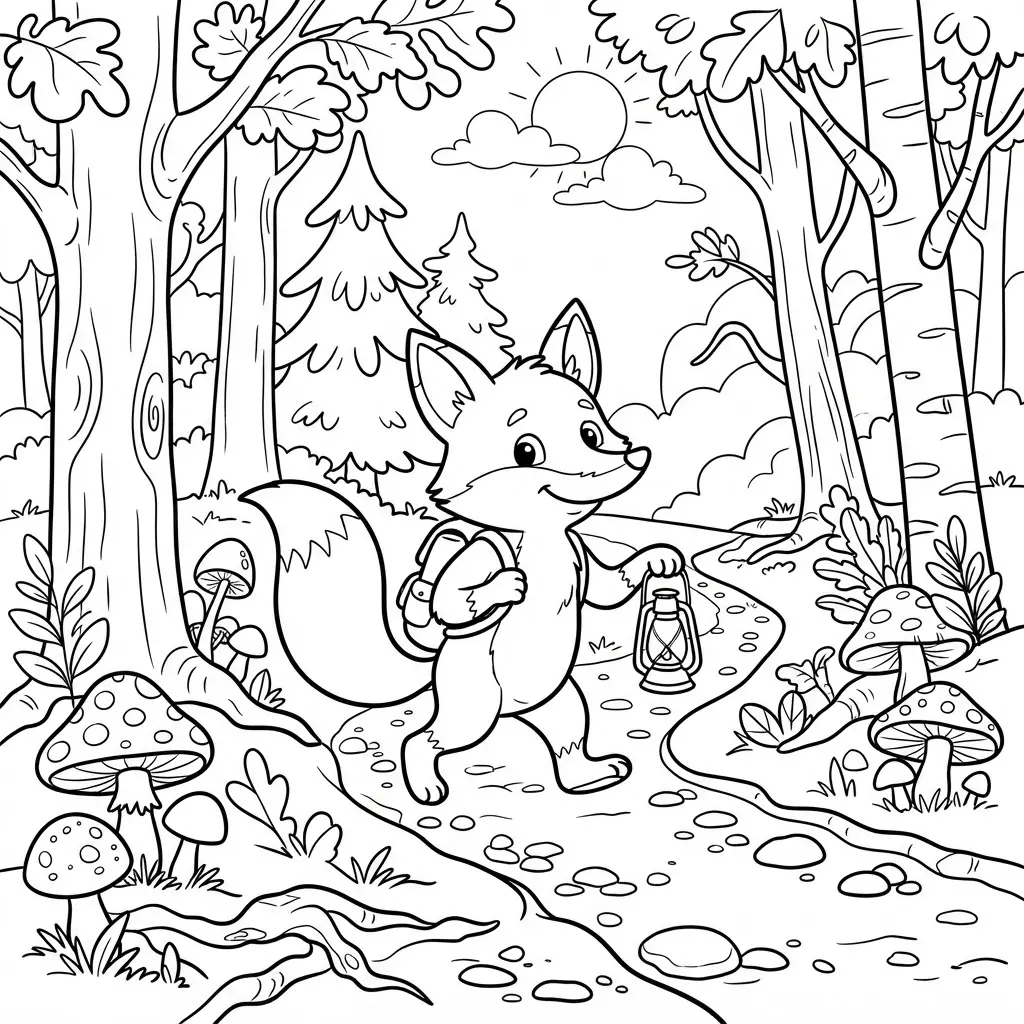
Golden sunrise slips between leafy branches, touching the fox’s russet coat and turning each firefly into a tiny point of light. I love how the finished scene feels warm, quiet, and ready for a gentle woodland tale. Begin with the fox on a winding path, then frame the foreground with clear black outlines around ferns, mushrooms, wildflowers, and exposed roots.
Let the mossy trail lead through tall ancient trees toward a sparkling stream and rustic wooden bridge. Add tiny woodland creatures peeking from behind roots, along with a cozy treehouse tucked among the branches. Keep the fox’s small green satchel easy to notice, while soft canopy gaps create simple sunrise beams across the middle ground. Sound complicated? It is not, since each layer has a clear place.
Use distinct contours for every major shape, leaving enough open space for comfortable coloring, which matches popular storybook fox coloring pages. A few fireflies and glowing mushrooms add storybook charm without crowding the page, while gentle curves give the forest a friendly painted feel. This arrangement works because your eyes follow the path from the fox to the distant scenery. Keep all lettering out of the illustration, then enjoy the cozy adventure waiting in every section.
35. Fox Playing with Fallen Leaves in Autumn
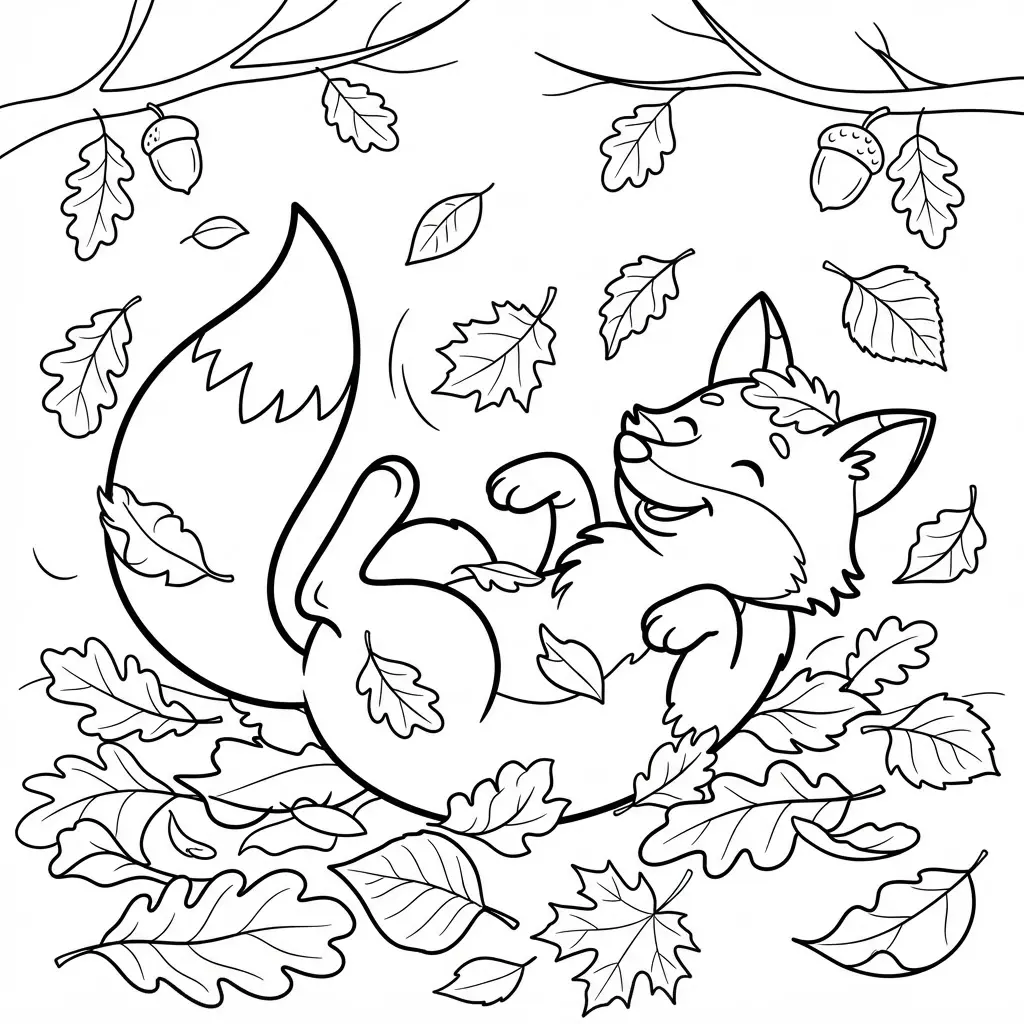
A common mistake is giving every leaf the same shade. Use a warm autumn palette with golden yellow, crimson red, amber, and brown so the pile feels full and seasonal. Leave a few pale spaces between leaves for a clean, airy look.
Place the fox in the center, leaping above the leaf pile with its bushy tail lifted high. Trace lively eyes, alert ears, curved paws, and small leaves flying around its body, which makes autumn fox coloring pages incredibly fun. Overlapping leaves beneath the fox add depth, while scattered shapes guide the eye across the scene.
Frame the action with tall trunks and amber foliage, then add open gaps for filtered sunlight. A soft mist in the distance keeps the forest gentle and helps the detailed fur stand out. Sound complicated? It isn’t. I love this one because every section offers a different coloring rhythm.
Use light pencil shading around the mist and between tree trunks rather than filling those areas with dark color. Keep the fox brighter than the forest, then add warm brown touches near the ground. Your finished page will feel cheerful, active, and full of autumn play.
36. Abstract Geometric Fox Head Shape — Modern Line Art
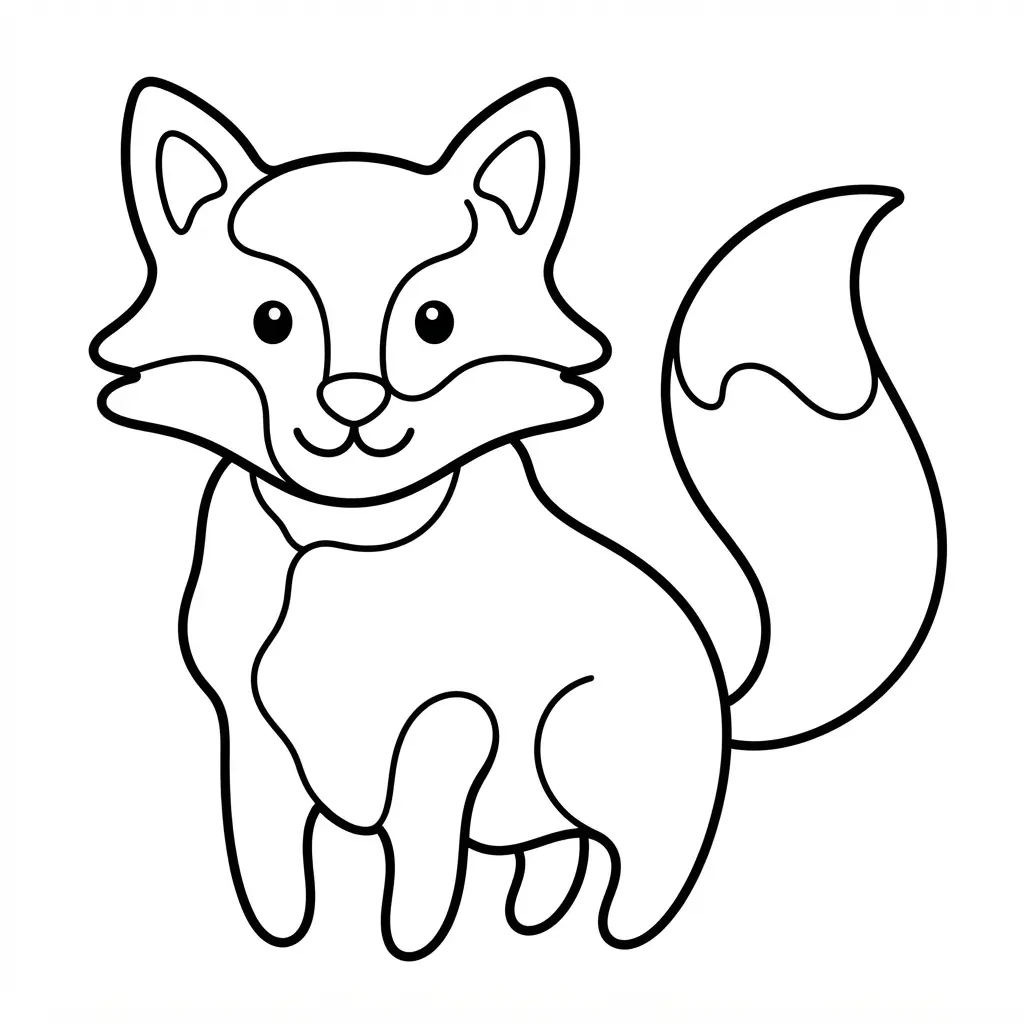
Start with a centered head outline on white paper, placing two pointed ears at equal height and distance from the middle. Extend sharp outer lines down toward a narrow muzzle, then add a small angular nose and short cheek edges. Sound complicated? It is not. The clean silhouette already reads as a fox, so you do not need fur texture or extra decoration.
Add a few polygonal fur sections inside the cheeks and forehead, keeping each line crisp, open, and easy to follow. Leave generous negative space between segments, and keep the black line weight steady from ear tips to chin. I love how this structure gives artistic fox coloring pages a fresh logo-like feel while open white areas welcome colored pencils, crayons, or markers. Trust me on this one: check the symmetry before coloring, since uneven ears or an off-center muzzle quickly disturb the balance.
Displaying Finished Woodland Animal Artwork
Mount finished fox artwork behind UV-protective glass when watercolor pencils or markers need long-term color protection. A simple 5-by-7-inch frame suits a single page, while a larger frame gives grouped woodland scenes enough border space without hiding the tail or ears.
Choose an acid-free backing board so paper fibers stay cleaner and the page keeps its shape. A white, pale blue, or warm wood frame supports arctic and woodland palettes without competing with fine fur lines.
Keep the artwork away from direct sunlight, radiators, and damp rooms, since heat and moisture warp paper and fade warm colors. For children’s pages, use a lightweight acrylic glazing panel instead of glass, especially in playrooms or bedrooms where a dropped frame presents a safety concern.
FAQs
Q: What paper works best for fox coloring pages?
A: Use 80lb cardstock for broad-tip markers and smooth bond paper for colored pencils. Always test one small area first for bleeding or feathering.
Q: Which age group are these fox coloring pages suitable for?
A: Bold-outline pages with large shapes suit preschoolers; designs with fine patterns, fur details, and intricate backgrounds are perfect for older children, teens, and adults.
Q: How do I print fox coloring pages clearly?
A: Select a high-resolution file and print at its original size (100% scale) on a plain white sheet. Check printer settings for best quality and preview before printing to ensure crisp outlines.
Q: Which coloring tools suit realistic fox drawings best?
A: Colored pencils excel at fur details, soft shading, and layered woodland textures. Fine-line pens work well for zentangle patterns, while crayons and markers are great for bold, simple designs.
Q: How do I prevent marker ink from bleeding through?
A: Place a spare sheet beneath the page before coloring. Use cardstock of at least 200 gsm, apply light layers of ink, and let each section dry before adding more color.