Essential Tools For Mithila Line Art
The signature crisp lines of Mithila artwork, much like the bold ink work of black anime characters drawings or the meticulous detail of neo traditional tattoo designs, rely on specific equipment selection. For initial sketching and fine borders, a fine-liner pigment pen with archival ink prevents smudging and creates consistent weight. Small round acrylic brushes in sizes zero to two allow control for both broad fills and fine hatching during color application. Your drawing surface must receive proper priming to stop bleed; applying smooth acrylic gesso onto canvas board produces an ideal tooth for exploring easy madhubani painting ideas without compromising line integrity.
Selecting Motifs For Beginner Art Projects
Choosing the right subject determines your success with this structured style. Beginners should select a single, iconic motif like a fish, peacock, or lotus flower to practice core techniques efficiently. A strong design focuses on balancing dense, repetitive patterns inside the chosen form against solid blocks of your selected pigment. Focusing on one element allows you to apply easy madhubani painting ideas while mastering rhythmic hatching and solid filling on a manageable scale.
1. Paint a Geometric Peacock Feather Motif Art Piece

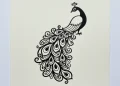
This motif turns a natural wonder into a stunning pattern you will master quickly. The geometric peacock feather emphasizes symmetry and sharp lines, built from triangles and concentric curves around a central eye shape. You will use a fine-tip black marker for the bold outline before filling in the sections with deep reds, yellows, and greens. Following easy madhubani painting ideas for symmetry ensures the repetition creates a balanced look that feels authentic without requiring advanced drawing skills. Planning your symmetry with light pencil guides establishes proper alignment before inking in your madhubani art project. If the center feels slightly open, fill it with a simple sunburst pattern to complete the visual weight. This approach serves as a reliable starting point for artists seeking more structured projects to build confidence and line control.
2. Stylized Sun Border Detail Design: A Foundation for Classic Mithila Framing

This classic border gives your work an instantly traditional appearance while providing significant symbolic weight. It consists of repeating sun forms, each containing a central core and radiating spikes drawn along the edge of your paper. The rhythm and visual structure of the pattern contain your central subject, framing it with deliberate precision. Applying easy madhubani painting ideas to border design teaches you how to establish consistent spacing and rhythmic flow. Visual containment keeps the viewer attention focused, while the sun motif represents life and prosperity. Drawing your outline on heavy stock using a fine-liner pen ensures crisp edges before filling with earthy poster colors. This method produces clean results suitable for both practice sheets and display-ready artwork.
3. Central Lotus Flower Mandala Pattern — The Core of Traditional Geometry

The central lotus mandala serves as your primary anchor when building highly balanced compositions. This design uses a stylized, geometric center point where petals radiate outward in perfect symmetry. Each segment receives careful pattern filling with precise lines, dots, or small scale markers. Incorporating easy madhubani painting ideas into radial layouts simplifies proportion management while producing a vibrant two-dimensional aesthetic. Symmetry and order symbolize creation and purity within this folk tradition. Drawing petal guides with a compass and protractor eliminates awkward gaps and guarantees accurate radial balance from the first step. Light pencil marks provide a reliable foundation before committing to permanent ink borders.
4. Create a Double Line Tree Life Scene with Fine Black Pens

Building an elegant double line tree establishes a strong focal point through controlled repetition. You draw a central trunk and branches using two parallel black lines that create a hollow, ribbon-like structure. Filling the interior space with small repetitive marks adds decorative depth to your diy projects without requiring complex color theory. The double-line technique produces a controlled aesthetic that remains forgiving while you practice easy madhubani painting ideas on structural forms. Using your whole arm for long, sweeping curves prevents unwanted shaky marks along the trunk path. Maintaining steady wrist support while applying parallel strokes ensures consistent spacing between the lines. You can expand your technical range by studying additional landscape compositions alongside these foundational border exercises.
5. What Makes Miniature Fish Pattern Border Art Ideal for Beginners?

A border of repeating fish shapes operates as a reliable training exercise for initial projects. This design features a rhythmic line of simple almond forms, each containing a small fan tail and a circular eye marker. Drawing one shape repeatedly builds a continuous frame that reinforces muscle memory without pressure. Mastering this art form enhances your skills in creating intricate designs. basic shape allows you to practice simple madhubani painting ideas while developing consistent stroke pressure and alignment. Working at a smaller scale teaches precise line control without overwhelming blank paper space, making it a perfect hobby for beginners. Maintaining consistent ink flow with a fine-liner pen keeps each miniature form distinct and visually uniform. The repetition naturally corrects minor hand fluctuations while reinforcing the cultural symbolism of abundance.
6. Stylized Human Face Silhouette Motif — Master the Classic Folk Profile

This classic profile relies on bold geometric lines and a distinctively large eye shape, echoing the appeal of cartoon characters big eyes drawings and the stylized boldness of famous female cartoon characters, to establish recognizable character. Starting with a single flowing curve maps the forehead, nose ridge, and chin structure before adding interior details. Connecting the dramatic fish-shaped eye directly to the nose line unifies the facial architecture. Applying easy madhubani painting ideas to portrait silhouettes eliminates complex anatomy requirements while preserving traditional aesthetic markers. Stylized representation bypasses realistic proportions, allowing decorative filling to convey emotional expression. Filling the interior sections with repetitive mark patterns using a size 0 brush builds rich folk texture across the flat surface. The modular outline structure adapts easily to repeated placement across larger narrative canvases.
7. Paint an Elephant Figure Decorative Profile Piece

Unlike realistic animal pencil drawings that aim for lifelike detail, this project features a large elephant silhouette decorated with detailed internal patterns across the body. We place a draped blanket across the back while framing the figure with surrounding foliage and floral elements. The expansive form provides an excellent canvas for applying dense geometric marks across a unified surface. Focusing on easy madhubani painting ideas helps beginners understand how to distribute pattern filling across curved boundaries effectively. Starting the initial sketch with a large almond-shaped eye establishes a reliable center point before positioning the trunk. Drawing a double-outlined border around the main body creates a secure container for all internal decorative marks. This structural boundary prevents wandering lines while maintaining consistent visual weight across the composition.
8. Nested Square Floral Frame Design: Sharp Symmetry Without Advanced Spatial Skills

Constructing a professional-looking border relies entirely on consistent measurement and repeated floral elements. This layout arranges concentric squares to build a rigid geometric boundary filled with uniform botanical marks. The measured framework guides viewer attention directly toward the central subject while maintaining visual equilibrium. Practicing easy madhubani painting ideas through measured grids strengthens spatial planning without advanced perspective training. Grid-based construction eliminates guesswork and produces clean intersections across all four sides. Treating the outer frame as a standalone exercise builds reusable templates for future projects. This structured approach yields highly polished results through predictable, repeatable mark placement.
9. Tribal Bird Pair Painting Study — A Lesson in Traditional Balance

Creating a mirrored pair of decorative birds teaches the fundamental principle of visual equilibrium, evoking the romantic symmetry of old school love drawings. Drawing two stylized profiles facing each other across a central axis guarantees perfect symmetry throughout the layout. Establishing a simple madhubani style layout can enhance your artistic expression. faint vertical center line before outlining prevents alignment drift during the initial drafting phase. Following easy madhubani painting ideas for paired subjects reinforces rhythm and proportion across negative space. This composition encourages filling empty areas with small botanical sprigs to unify the visual field in a living room setting. Balanced arrangements feel inherently satisfying while internal geometric marks maintain decorative consistency. The mirrored structure serves as an excellent exercise for measuring spacing and maintaining equal weight distribution.
10. Add a Spiraling Vine Leaf Border Element to Your Main Canvas

Framing your central artwork with a classic spiraling vine leaf border, with twisting curves reminiscent of traditional madhubani art motifs. cartoon characters curly hair, introduces immediate elegance and directional flow. Drawing a continuous curved spine along the canvas edge establishes the primary guide for subsequent leaf placement. Arranging alternating teardrop shapes along this path creates a rhythmic progression that redirects viewer attention inward. Studying easy madhubani painting ideas for curved borders improves hand control when navigating organic pathways without breaking symmetry. Practicing the foundational S-curve on scrap material prevents uneven spacing along the final surface. Applying clean ink lines with a fine-liner pen maintains crisp leaf boundaries after the pencil layout receives approval. The contrast between the steady central curve and alternating botanical shapes produces authentic traditional movement.
11. Angular Moon Phase Pattern Art: Bold Folk Shapes Constructing the Sky
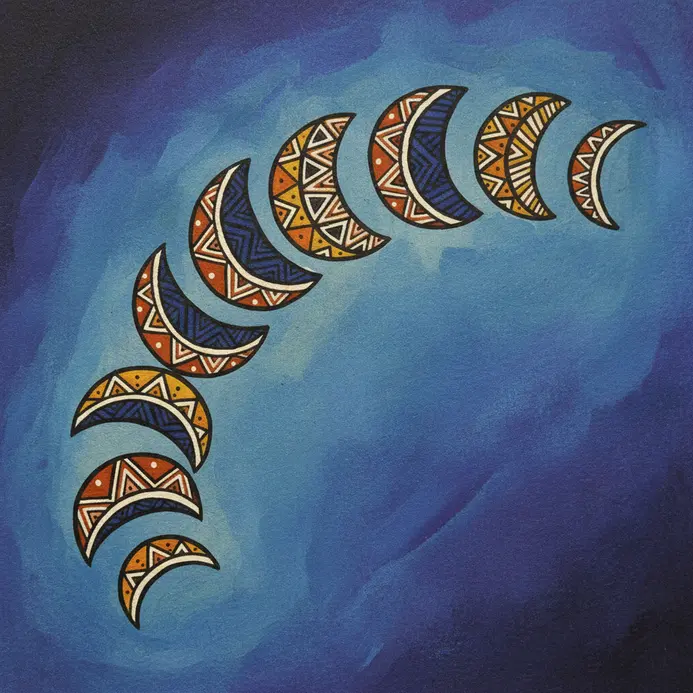
Transforming a flowing natural subject into rigid graphic lines simplifies proportion management for beginners. This concept reconstructs lunar phases as a sequence of sharp polygonal forms arranged like a structured sky grid. Using a drafting ruler to establish clean crescent edges provides a reliable framework for subsequent internal filling. Incorporating easy madhubani painting ideas into angular designs replaces unpredictable freehand curves with measurable geometric boundaries. Treating each segmented tile as an independent unit allows unique internal patterns without disrupting overall alignment. Strict boundaries provide clear edges for dense cross-hatching or uniform dot work across all phases. This architectural approach emphasizes controlled line placement while preserving recognizable celestial forms.
12. Why Choose a Symmetry Based Sun God Motif for Your Early Practice?

A central sun layout with evenly distributed rays provides a highly predictable structure for early exercises. Drawing a reference circle and mapping radiating lines that mirror each other establishes firm directional guidelines throughout the piece. Planning your initial grid layout with light marks eliminates proportion guesswork before committing to permanent lines. Applying easy madhubani painting ideas to radial subjects builds foundational rhythm without requiring complex measurement tools. Focusing on simple repeating shapes across mirrored quadrants reinforces visual consistency across all ray segments. Selecting heavyweight cartridge paper prevents surface buckling while you work through dense marking sequences. Matching opposite sides during correction phases ensures immediate accuracy recovery when minor deviations occur.
13. Blend Colors on a Minimalist Bamboo Cluster Painting Piece

Gentle color transitions transform flat vertical forms into rounded structures with subtle dimensional presence. Starting with a light base wash inside each bamboo segment allows darker pigment diffusion during the blending phase. Pulling a concentrated edge into damp areas produces smooth gradients from deep green perimeters toward lighter centers. Following easy madhubani painting ideas for gradient techniques reduces reliance on heavy pattern filling while preserving surface elegance. Applying a clean, damp brush immediately after pigment placement softens hard boundaries into seamless tonal shifts. Controlled moisture levels prevent muddying while maintaining distinct segment divisions along the stalk. This shading method introduces volume through simple layering rather than complex geometric subdivision.
14. Interlocking Diamond Border Pattern Design: Foolproof Geometric Framing Techniques

The interlocking diamond weave creates a visual depth through repetitive geometric intersections. Arranging rhomboid shapes in alternating layers generates a woven illusion that draws attention inward toward your central motif. Relying on measured spacing ensures mathematical alignment across all four canvas edges. Exploring easy madhubani painting ideas for woven borders teaches precise gap management and structural continuity. Measuring equal segments along parallel guide lines requires a clear plastic ruler before connecting diagonal intersections in your diy project. Leaving microscopic gaps at crossing points during the inking phase produces the classic overlapping effect. Allowing complete pigment desiccation before applying interior fills prevents unwanted pigment migration across adjacent sections.
15. Stylized Butterfly Wing Texture Art — Filling Spaces with Clean Hatching

Focusing on precise parallel lines transforms expansive wing surfaces into organized decorative compartments. Dividing each wing section into distinct triangles or teardrop shapes establishes clear boundaries for subsequent mark placement. Maintaining uniform spacing and crisp border stops creates rhythmic visual flow across all compartments. Applying easy madhubani painting ideas to hatching exercises strengthens pen control while building recognizable surface texture. Defining compartment edges with a technical drawing pen guarantees consistent line weight before beginning internal shading exercises. Drawing parallel strokes in a single direction per cell maintains visual cohesion across the expanded surface. The contrast between organic outer shapes and rigid interior lines produces striking geometric harmony.
16. Capture a Central Tortoise Motif Folk Piece Using Bright Acrylics
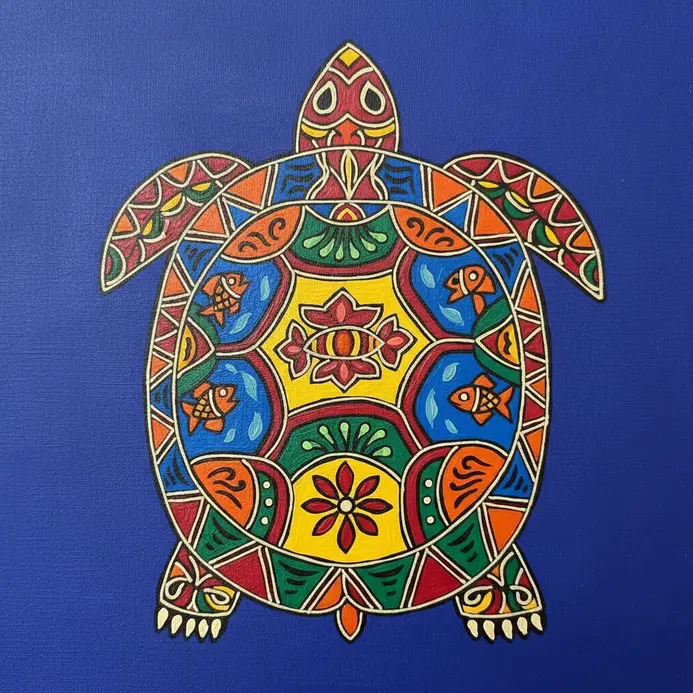
The central tortoise silhouette divides naturally into manageable segments through its geometric shell architecture. Filling each scute with dense patterns using bright acrylics establishes high visual contrast against thick defining outlines typical of beautiful madhubani style. Rendering the form from center outward prevents accidental smudges across freshly applied pigment layers. Practicing easy madhubani painting ideas with segmented organisms teaches compartmentalized filling without overwhelming composition scale. Structuring the shell interior with uniform grids guides mark direction while maintaining proportion across curved surfaces. Starting pigment application away from your working hand keeps edges sharp and unmarked. This divided approach simplifies color management while reinforcing traditional structural boundaries found in madhubani art.
17. Traditional Border Scroll Floral Design: An Accessible Edge Treatment

Drawing a continuous winding vine along your composition perimeter establishes a recognized traditional edge treatment. Inserting stylized floral forms along the curved path creates density and visual weight along the perimeter outline. Defining parallel boundary lines before adding scrolls maintains consistent spacing throughout the layout. Following easy madhubani painting ideas for border treatments reinforces repetitive layout planning while delivering polished framing results. Using a fine-liner pen for final outlines ensures the clean line quality that defines this cultural aesthetic. Applying flat pigment blocks after complete ink desiccation preserves sharp edge definition across all botanical forms. Building identical sections across each canvas side guarantees uniform framing distribution in your home decor.
18. Simple Deer Silhouette Folk Motif — High Visual Impact with Basic Outlines

A bold outer contour acts as a secure container for complex internal filling throughout the layout process. Lightly sketching a graceful profile establishes proportion before committing to permanent defining strokes. Preparing cold press watercolor paper with light gesso provides optimal tooth for repeated marking and layering sequences. Applying easy madhubani painting ideas to wildlife silhouettes teaches structural containment without sacrificing interior complexity. Maintaining sturdy leg proportions prevents unwanted visual thinness while allowing expanded marking space. Filling the interior with geometric grids or fine line work builds density across the contained area. This compartmentalized approach separates structural planning from decorative execution for reliable results.
19. Use Solid Color Fills on a Sun Burst Grid Pattern Art Composition

Arranging radiating lines from a central anchor generates a structured layout similar to stained glass architecture. Dividing these segments into equal geometric compartments provides clear boundaries for flat color application. Selecting saturated solid color fills produces strong contrast that energizes the overall design composition. Studying easy madhubani painting ideas focused on color blocking simplifies pigment distribution while honoring traditional Bharni techniques. Planning a repeating two-color sequence before application maintains consistent rhythm across radial divisions. Applying opaque layers evenly across each compartment preserves sharp line integrity along dividing walls. This measured approach eliminates guesswork while producing highly dynamic directional movement.
20. How Does a Stylized Serpent Border Element Design Anchor a Composition?

Drawing an unbroken wavy line around your perimeter establishes a continuous boundary that seals scattered visual elements. Applying a continuous border line creates a high-contrast container that grounds interior details effectively. This structural constraint unifies separated components while directing viewer attention toward the central focal area. Exploring easy madhubani painting ideas for perimeter containment teaches spatial organization through unbroken directional flow. Repeating uniform U-shapes along the spine generates steady visual cadence that balances dense interior sections. Keeping the outer form simplified prevents boundary competition with central narrative elements. Sketching a single fluid guide first ensures smooth rhythm before adding decorative scale markers.
21. Abstract Petal Mandala Folk Piece: Concentric Rings Guiding the Eye

The concentric framework guides your marking sequence outward from a central anchor point with predictable alignment. The concentric ring structure provides measured intervals for placing uniform petal motifs across each successive layer. Applying solid color to alternating rings creates visual breathing space between dense pattern zones. Following easy madhubani painting ideas for radial expansion guarantees balanced distribution while maintaining structural harmony across all layers. Drawing preliminary circles with a drafting compass establishes accurate spacing before committing to interior fills. Using a simple color separation rule allows viewer attention to rest between heavily decorated segments. This layered progression builds complexity gradually while preserving measurable proportion throughout the piece.
22. Paint a Small Bird Perched Floral Motif Using Natural Pigments

Concentrating on a compact scale isolates essential techniques for efficient early practice sessions. Rendering a stylized profile with a prominent eye marker perched above a lotus form establishes clear visual hierarchy. Preparing earth tone extracts like turmeric and indigo are commonly used colors in beautiful madhubani art. supplies traditional pigment ranges for subsequent filling stages. Utilizing easy madhubani painting ideas within miniature formats strengthens line confidence without overwhelming workspace management. Outlining all defining shapes before introducing color ensures crisp boundary protection across every segment. Allowing complete line desiccation prevents unwanted pigment migration during the filling sequence. Maintaining thin double borders around each element preserves sharp visual separation throughout the layered layout.
23. Triangular Motif Border Detail Art: Classic Indian Folk Art Framing

Repeating a sharp angular sequence along the canvas perimeter produces immediate traditional recognition. Filling each segment with dense cross-hatching or dot marks builds texture across the sawtooth boundary framework, enhancing your decor. Establishing a light pencil guideline before inking guarantees uniform alignment across all four canvas edges. Practicing easy madhubani painting ideas for perimeter angling refines measurement accuracy while reinforcing structural discipline throughout the layout. Treating each side as an independent strip prevents awkward distortion around corner junctions. Decorating meeting points with small floral buds conceals alignment seams naturally. This segmented approach maintains clean geometry while honoring traditional enclosure principles.
24. Stylized Frog Figure Folk Scene — A Playful Introduction to Fauna

Constructing a rounded body filled with chevron patterns, much like the playful proportions of fat cartoon characters drawings, alongside simple aquatic shapes establishes an engaging beginner layout. Drawing an U-shaped outline before adding surrounding water waves creates immediate environmental context. Applying a fine-liner pen over pencil guides secures permanent edges before erasing initial drafting marks. Applying easy madhubani painting ideas to playful organisms introduces pattern distribution across forgiving curved surfaces. Allowing complete ink drying before pigment removal prevents unwanted graphite contamination across clean surfaces. Selecting earthy ochre or bright green pigment layers establishes natural environmental harmony across the layout. This simplified anatomy approach reduces pressure while delivering recognizable folk character representation.
25. Achieve Crisp Symmetry in a Focal Point Star Burst Art Layout

Generating precise radial balance begins with mapping equal divisions from a central reference point outward. Using a compass and protractor establishes reliable segment boundaries before drawing expanding ray or petal sequences. Working inward toward outward progression maintains alignment consistency throughout each construction phase. Exploring easy madhubani painting ideas centered on star configurations builds measurable proportion control while eliminating freehand guesswork. Detailing the innermost circle first provides a stable anchor for subsequent outer layer expansion. Mimicking natural sun or floral geometry generates instant visual focus across blank surfaces. Maintaining strict angular intervals guarantees structural cohesion throughout the radiating framework.
Preserving Your Finished Mithila Inspired Artwork
Proper sealing protects the vibrancy and detail of your completed composition throughout its lifespan. After ink and pigment layers achieve complete desiccation, apply multiple light passes using a matte acrylic varnish delivered with a soft applicator. Allowing thorough drying between each application prevents unwanted clouding or sticky residue formation across the surface layer. This transparent shield establishes long-term protection against dust accumulation and ultraviolet exposure while preserving traditional earth tones. For sheet-based projects, applying aerosol coating provides an alternative method for protecting delicate linework without surface disturbance.
Conclusion
Developing confidence with repetitive motif patterns establishes the groundwork for larger compositional success across future projects. Finding preferred geometric forms transforms the learning sequence into an engaging routine that builds steadily measurable skills. Adding consistent dot fills or cross-hatching inside established borders produces polished results with reliable structural support. Each independent element you master directly strengthens overall layout architecture and line control accuracy. By practicing easy madhubani painting ideas repeatedly, you acquire the fine motor coordination required for professional execution standards. Consistent repetition of measured components yields balanced traditional artwork with clear decorative intent. Mastering these primary structural units transforms complex layout planning into an approachable workflow sequence. Select a specific subject that matches your available materials and establish clean boundary lines today to begin steady skill progression.
FAQs
Q: What are some easy Madhubani painting ideas for beginners?
A: Easy Madhubani painting ideas for beginners include simple floral borders, fish motifs, peacocks with repetitive feather patterns, and geometric mandalas. Start on handmade paper or cloth with a pencil sketch, then use a black fine liner and fill with bright colors or traditional white spaces; these simple themes let you practice the classic Madhubani design style while creating a hand-painted piece that captures the culture and charm of Bihar.
Q: Can I use a plate or pot as a surface for Madhubani designs?
A: Yes, painting on a plate or pot is a popular and classy way to display Madhubani art. Clean and prime the ceramic surface, sketch your Madhubani design, and use acrylics or ceramic paints for vibrant colours. These functional items become bright, modern masterpieces that can be used or hung as decor.
Q: How do I adapt traditional Madhubani design for a modern home?
A: To adapt Madhubani for a modern theme, choose a limited color palette like white and one or two accent colors, simplify motifs, and apply them to contemporary objects like side table tops, cushions, or curtain panels. Combining hand-painted traditional elements with minimalist arrangements keeps the beauty of the folk art while making it suitable for modern interiors.
Q: Where does Madhubani painting originate and what is its cultural significance?
A: Madhubani painting originates from the Mithila region of Bihar, India, and is traditionally done by women to decorate walls and floors during festivals and ceremonies. The art form symbolizes fertility, prosperity, and the cultural narratives of the region, using motifs from nature, mythology, and daily village life to preserve and celebrate local heritage.
Q: What materials are best for creating Madhubani art — paper, cloth, or handmade paper?
A: Traditional Madhubani often used mud walls and natural pigments, but today artists prefer handmade paper or cloth for portability and longevity. Both surfaces accept hand-painted ink and acrylics well; handmade paper gives an authentic texture while cloth allows you to hang the piece as a curtain panel or wall tapestry full of vibrant colours.