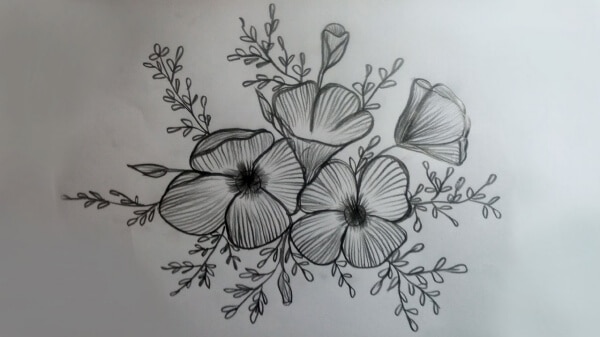
Why Simple Drawings Are Your Perfect Starting Point
Starting to draw often feels overwhelming for newcomers. Do you stare at a blank page and wonder where to begin? We all start somewhere on this artistic path. Mastering drawing does not begin with complex portraits or epic landscapes. It starts with specific simple drawings to practice that sharpen your skills. Think of them as the warm-up before a big game. These practice drawing sessions build your hand-eye coordination and help you gain confidence with your pencil. They represent the drawing fundamentals you will use forever.
The Mindset Shift: Practice Over Perfection
Your first sketches do not need to be great works of art. They merely need to exist on the paper. This process focuses on drawing regularly rather than creating a masterpiece every time. Many beginners get stuck trying to make each line perfect. Let’s shift that thinking entirely. Your goal should be to fill a page with lines and shapes. This art practice focuses on exploration. It allows for improving your drawing skills through repetition. Grab your sketchbook and a favorite drawing pencil immediately. We intend to start drawing with zero pressure.
1. Fundamental Line Weight Variations for Your Sketch

Look at a flat sketch and wish it had more pop. Let’s fix that with line weight variations immediately in our drawing and painting projects. We refer to using different stroke thicknesses to add depth and dynamism to your drawings. You use light lines for construction and background elements while heavy lines make foreground objects stand out. This mimics how light and shadow define form in the physical world and makes your sketches look three-dimensional. A fun way to practice involves an overlap study where you draw shapes like squares or circles over each other. Use thick lines for the front shape and thin lines for the back one to watch depth emerge. This constitutes a perfect exercise for simple drawings to practice at home. It represents a skill that improves all your future art endeavors, especially in life drawing. Grab an HB pencil for medium lines and a 2B for bold accents to give it a try today.
2. Negative Space Composition Techniques for Drawing
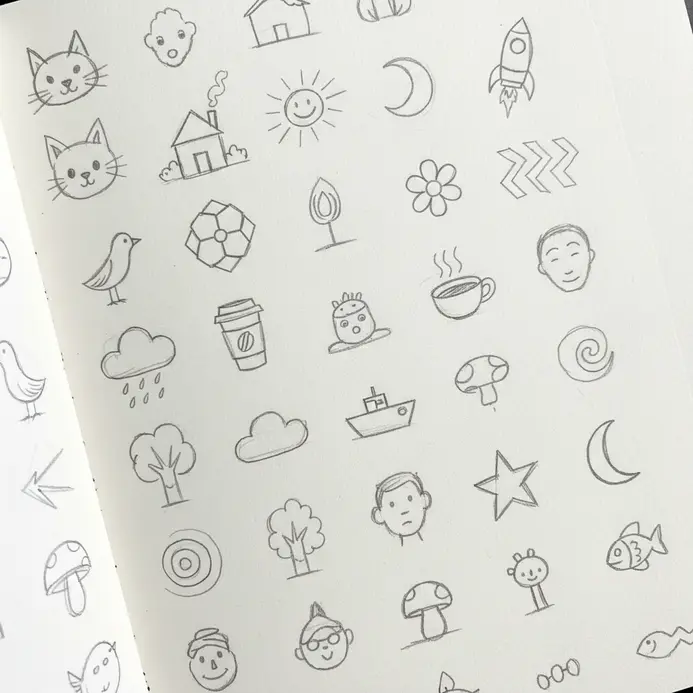
Let’s flip your brain upside down for a second. The secret to drawing that perfect vase might not be the vase at all, but the empty air around it. Negative space drawing forces you to focus on drawing the shapes of the empty areas instead of the object’s outline. It compels your brain to see shapes and relationships it normally ignores, which is why you need to practice. We love this technique because it cuts through mental clutter and makes proportions click instantly. A super effective subject for simple drawings to practice is a basic chair. Sketch the triangles and rectangles formed between its legs and back.
3. Single-Stroke Contour Drawing Methods to Practice
Let’s get your hand and eye talking directly to each other without awkward pauses. Single-stroke contour drawing requires putting your pen down and not picking it up until your drawing ends. This forces you to trace every edge and wrinkle in one continuous line. We train your brain to observe shapes instead of naming objects, which builds confident line work. It shuts off the mental habit of judging and erasing, making every mark appear decisive. Try starting your line on an internal detail like a leaf’s vein. Let it flow outward to the silhouette for a connected exploration of the form. This method offers excellent simple drawings to practice when you have limited time.
4. Geometric Shape Combination Principles for Simple Drawing

Staring at a blank page often leaves artists unsure where to start. Let’s make it fun by playing with shapes immediately. We combine basic geometric forms like circles, squares, and triangles to build anything we visualize. It feels like having a secret code for drawing construction. Once you see the shapes, the rest falls into place naturally. This method removes the intimidation factor and lets you focus on creativity. Grab your pencil and overlap two circles to sketch a face or a balloon. You will be amazed at how many simple drawings to practice come to life with this approach.
5. Basic Perspective Grid Applications for Beginner Drawing

Those rules for perspective often seem like a confusing jumble of lines. Let’s make it visual and fun with digital perspective grids. These act as training wheels for your sketchbook by letting you drag vanishing points and horizon lines around. You focus on drawing that cool building or cozy room instead of wrestling with construction lines. They turn a tough theory into a playful game that builds your confidence fast. Start with a free app like Krita or Perspective Drawing Studio to play with 1-point grids. Focus on simple drawings to practice like boxes or a road.
6. Texture Replication Through Hatching as a Drawing Exercise

Look at a texture like wood grain and wonder how to capture it effectively. Texture replication through hatching serves as your go-to exercise. We isolate a small area, observe the light and dark patterns, and use lines to mimic it on paper. This ranks as one of the best simple drawings to practice because it trains your eye to see like an artist. It is beloved for the quick confidence it builds. Start with a 2×2 inch grid and a texture like fabric using contour hatching to follow the surface curves.
7. Simplified Facial Proportion Systems for Practice Drawing

Drawing a face from scratch often feels overwhelming. Let’s ditch the guesswork and use a system to place features correctly. We break the head down into easy-to-remember guidelines like the rule of thirds for eyes, nose, and mouth. It turns a complex subject into a series of manageable shapes and spaces. This is perfect for simple drawings to practice regarding anatomy. It gives your hand a reliable roadmap so you focus on observation instead of panic. Start with an oval and lightly draw a vertical center line alongside horizontal markers. Think of it as building a framework before you add any details. This method builds your confidence fast because you construct the face logically. Try applying these proportion rules to some basic drawing exercises. famous female cartoon characters to draw. Their features often act as exaggerated versions of these basic rules.
8. Gesture Drawing Time Constraints for Quick Sketch Ideas

Let’s get wild and force ourselves to draw fast. Setting a timer and racing against it is the absolute best way to stop overthinking. This helps you start feeling the movement in your simple drawings to practice. We train your hand and eye to work together instinctively through simple exercises. You will be shocked at how much energy you capture in 30 seconds once you stop worrying about details. Think of it in three brackets starting with a 10-second blitz for the core action line. Next, a 45-second sprint nails the weight and basic shapes. Finally, a 90-second round suggests a little more structure in your drawing and painting practice. The time pressure makes you focus only on essential elements. Use your phone’s timer app with random intervals to practice these exercises effectively. Start with 15 seconds, then jump to 60, then back to 30. This keeps your brain agile and prevents you from settling into a slow routine.
9. Object Silhouette Recognition Drills for Your Drawing Skills
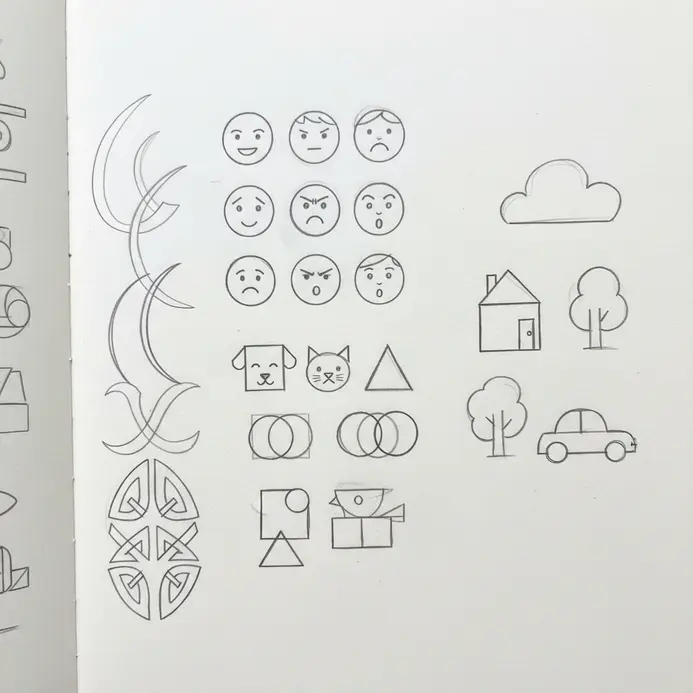
A great character or logo is instantly recognizable even as a solid black shadow. That represents the magic of a strong silhouette, and you need to train your eye to see shapes this way. We focus on the outline of things while ignoring all interior details and shading. This drill forces you to see the essential form. It leads to accuracy for all your simple drawings to practice. It cuts through the noise and lets your brain process the whole subject as one clean mass. Let’s try a super easy version right now. Grab a mug or your own hand and give yourself only 30 seconds to draw it. You must only draw the outside edge without internal lines. Squint your eyes at the object first to blur details and highlight the big shape. It is a perfect quick exercise to sharpen your observation before you tackle complex sketches.
10. Value Scale Creation Processes with Your Pencil

Access the power of light and shadow in your art with a value scale. It is one of the best simple drawings to practice for beginners. We create a gradient from white to black using your pencil. Grab a few graphite pencils like 2H to 6B, some paper, and a ruler. You draw a segmented grid or a smooth gradient rectangle before shading each box with increasing pressure control. This process works because it hones your shading skills and makes every sketch pop with realism. Use the mid-tone method by starting with box five to balance your scale perfectly.
11. Basic Form Intersection Studies to Improve Your Drawing

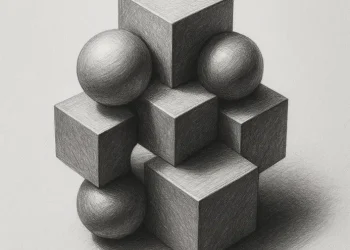
Let’s get spatial so your drawings start to feel solid and three-dimensional. We learn how forms like cubes and cylinders occupy the same space and intersect. Think of it as understanding how a straw goes through a box rather than simply sitting next to it. It forces you to think in 3D volumes instead of copying outlines. Start with a simple combination like a cylinder piercing a cube. Draw both forms transparently so you see all the edges as part of your basic drawing exercises. Use the plane-by-plane method to find where they meet. Visualize slicing your cylinder with each flat face of the cube and lightly sketch that cut. Connect those segments to find the intersection line. This methodical practice is one of the best simple drawings to practice for building a rock-solid understanding of space.
12. Still Life Simplification Approaches for Simple Drawing Exercises

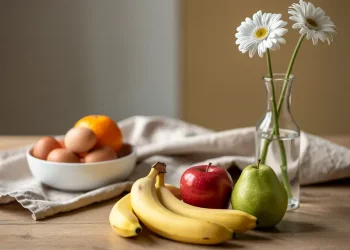
Staring at a cluttered table of fruit often causes brain freeze. Let’s fix that with variation by breaking down scene elements into friendly shapes. Think of a wine bottle as a tall cylinder or a teapot as a sphere with a spout. This approach cuts through the noise so you focus on the big picture while you’re drawing. It manages your brain’s workload and lets you build skills without frustration. Start with a Basic Shape Breakdown by sketching everything as circles, squares, and triangles. This instantly makes any object feel approachable and gives your sketch a solid foundation. Try a five-minute timed sketch of a setup. This forces you to capture the essence rather than getting lost in tiny details. It is a perfect way to get in your daily simple drawings to practice.
13. Symmetrical Pattern Development for Regular Practice

Feel that calm satisfaction when a pattern comes together perfectly? That is the magic of symmetrical drawing. Symmetrical pattern development creates balanced designs through mirroring or repetition. Start with reflectional symmetry by drawing a line and mirroring shapes. You might also try rotational symmetry for mandalas by looking at ideas in our drawing and painting section. beautiful mandala drawing guide. It gives beginners a clear path to improve their skills without pressure through drawing exercises for beginners. Use grid paper to keep everything aligned, making it a fun part of your simple drawings to practice.
14. Organic Shape Abstraction Methods for Drawing Styles

Staring at a flower often makes artists doubt their ability to draw every petal. Organic shape abstraction serves as one of the most freeing simple drawings to practice. We take wiggly forms from nature like clouds or leaves and simplify them into their essential essence. You do not copy every detail; you capture the feeling and the flow. It forces you to see the big shapes first and builds a strong foundation. Let’s break it down with contour reduction. Think of Henri Matisse’s elegant line drawings where a single curve suggests an entire body. Look at your subject and determine the absolute fewest number of lines needed to identify it. Try it with a houseplant by drawing only the outer silhouette. The magic happens because our brains love filling in the gaps. Want to play with color too? Check out our guide on easy things to paint for beginners to combine these abstract shapes with bold colors.
15. Limited Palette Shading Techniques for Your Pencil Drawing

Let’s talk about a strategy that makes your simple drawings to practice look incredibly sophisticated. Instead of reaching for every pencil in your set, grab only two. We suggest using a standard HB and a softer 4B or 6B. You use the lighter one for your base sketch and the darker one for your deepest shadows. This forces you to think about light and shadow in a clear way. It works because it simplifies decision-making. Create a small value scale with your two chosen pencils before you start your main sketch. This quick exercise reveals the full range of tones you achieve by varying your pressure. It acts as a warm-up that instantly improves your drawing skills.
16. Architectural Element Breakdowns as a Drawing Exercise

Drawing a whole building often feels overwhelming. Focusing on a single awesome window or door changes that dynamic. Breaking down architecture into its parts ranks as one of my favorite simple drawings to practice because it is manageable. You do not tackle the entire cathedral. You study how the bricks stack in an arch or the way light hits a column. This exercise trains your eye to see complex objects as collections of drawable shapes. Grab your sketchbook and find a cozy spot near a historic building to start with the front door.
17. Botanical Detail Simplification for Beginner Sketch Ideas

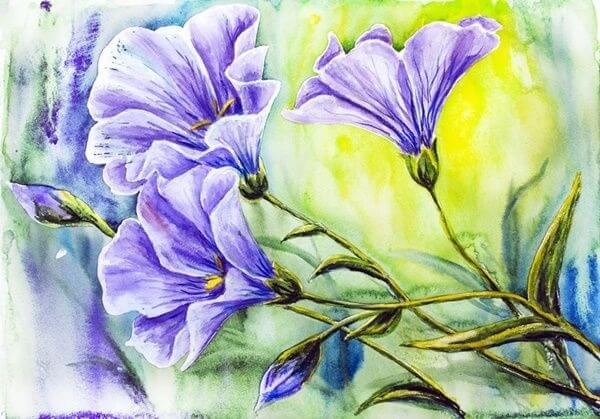
Trying to draw every tiny vein on a leaf often creates anxiety. Let’s flip the script and find the fun in botanical detail simplification. This approach trains your eye to see the big shapes first. Think of a leaf as a heart or a flower as a circle with petal curves. We ignore the fussy details and build our plant from basic forms. This ranks as one of the most relaxing simple drawings to practice available. It takes the pressure off and lets you capture the spirit of a plant. Try the “5-Line Leaf” exercise by using one line for the midrib and four for the outline and veins.
18. Animal Gesture Capture Exercises to Help You Learn

Let’s get your sketches moving with some life. Animal gesture drawing snags the energy and motion of a creature in a few quick lines. We do not aim for a perfect portrait here. We want the feeling of a cat stretching or a bird taking flight. Think of it as learning the dance before you learn the steps. It is one of the most fun simple drawings to practice for building confidence through drawing straight lines. You will be amazed how this approach trains your eye to see essential action. Start with super short timed sketches using a single flowing line to capture the spine’s curve. This forces you to prioritize the big shapes and rhythms. It is the key strategy for making your animals look alive instead of stiff. Try drawing from a paused wildlife documentary. Do not lift your pencil from the paper for the whole sketch to find that flow.
19. Everyday Object Perspective Variations for Drawing Practice

Picture your favorite mug drawn from a dramatic low angle. We move beyond flat sketches to build real spatial skills using stuff from your desk. Start with a basic two-point perspective view of a simple book as one of your drawing exercises for beginners. Rotate it to see how the shape changes. This exercise forces your brain to think in 3D by turning a flat rectangle into a solid form. Lightly sketch your vanishing points off the page first to keep lines consistent. This helps avoid those pesky vertical tilts.
20. Basic Compositional Flow Principles to Start Drawing

Let’s make your artwork feel more intentional and dynamic. Composition involves how you arrange everything on the page. We use the Rule of Thirds to place your focal points or draw lines that pull a viewer’s eye. This matters because it turns a random sketch into a piece that feels balanced. It guides someone through your story without them realizing it. Try a quick thumbnail sketch with just a few shapes before you commit to your final drawing exercise.
Your Next Steps After Mastering The Basics
So you have practiced your straight lines and basic shapes. This is where the real fun begins. Use these simple drawing exercises as your daily warm-up routine. Then, try drawing something simple from your kitchen like a mug. Focus on its contour and the light and shadow visible to you. This exercise helps you move from flat shapes to understanding form. Regular practice stays the only way to improve your drawing.
Building Your Personal Drawing Habit
Make drawing a habit if you want to improve your skills for good. Set aside ten minutes each day for these drawing exercises. Do not worry about running out of fresh ideas. You practice the same value scale or cross-hatching techniques differently every time. The key is consistency. Keep your drawing tools handy. Doodle while you appear on the phone. Sketch during your coffee break. These simple drawing exercises help your art skills grow before you know it.
More Simple Drawings to Practice to Try






Conclusion
And there you have it. Twenty straightforward exercises to kickstart your drawing habit. The key is not to overthink the process. Pick one exercise that sounds fun and give it a try for five minutes. Did you see how quickly that page filled up? These simple drawings to practice act as your building blocks. They train your hand and your eye without the pressure of creating a finished piece. If you make these drills part of your routine, you will notice a difference in your work. Your lines will get steadier. Your shapes will feel more solid. Grab your sketchbook and pick exercise number one to make your first mark right now.
FAQs
Q: How can simple drawings to practice help beginners who want to improve your drawing?
A: Simple drawing exercises will help by building basic control and confidence; start by drawing simple shapes and short lines, then progress to longer lines and more complex forms so the exercise will help you develop steady hand movements and visual understanding.
Q: What are the best simple drawing exercises will help build hand-eye coordination?
A: A few effective exercises will help you get accustomed to connecting vision and motion: scribble freely to loosen your wrist, practice draw a straight line drills, trace contours of objects, and repeatedly draw those shapes to reinforce muscle memory.
Q: How do I start by drawing when I have no idea where to begin?
A: Start by drawing a set of simple shapes—circles, squares, triangles—and then combine them into basic objects; use short lines at first, move to longer lines as you gain confidence, and focus on the contour of the object rather than details.
Q: Are scribble exercises useful or just a childish activity?
A: Scribble is a powerful warm-up and diagnostic tool: free scribble loosens your hand, helps you explore pressure and rhythm, and prepares you for more focused contour and shape work, so simple drawing exercises will help you progress faster.
Q: How can I practice drawing straight lines and longer lines without a ruler?
A: To draw a straight line, anchor your elbow, move your whole arm instead of the wrist, and practice drawing short lines repeatedly then connect them into longer lines; drawing tips include keeping your eye on the endpoint and maintaining steady motion.