

What Is Allegorical Painting and How to Recognize It
Before you dive into famous examples, it helps to grasp the core concept of allegory. An allegorical painting uses symbolic figures, objects, and actions to represent abstract ideas like love, death, or political power. To spot one, look beyond the surface narrative and ask whether the scene illustrates a moral, spiritual, or philosophical meaning rather than a single event. This deliberate layering sits at the heart of paintings with hidden meanings. The artist’s main tool is symbolism, often arranged so the viewer notices one story at first glance and a second one after a closer look. Once you train your eye to track repeated objects, hand gesture choices, and unusual depiction, the structure becomes easier to read.
The Difference Between Symbolism and Hidden Imagery in Art
Not all hidden meanings work the same way, and that distinction sharpens interpretation. Symbolism uses established icons, such as a skull for mortality or a lily for purity, to add a second meaning within the main composition. Hidden imagery points to concealed forms, distorted figures, or tiny scenes placed where only a patient viewer will look closely enough to find them. Many paintings with hidden meanings combine both methods in a single artwork. A famous painting might depict a saint with a symbolic object while also concealing hidden details in the background or along the ceiling line of an interior. Knowing whether you are reading symbolism or spotting covert imagery gives you a better path through the mystery.
How Artists Use Anamorphosis to Conceal Secondary Images
One of the most ingenious tricks for hiding meaning is anamorphosis. This technique distorts an image so it becomes legible only from a strange angle or a precise viewpoint. The most famous example is the elongated skull in Hans Holbein the Younger’s “The Ambassadors,” which snaps into focus when read from right to left across the floor line and viewed from the side. This device appears often in paintings with hidden meanings because it rewards the informed viewer. Artists used anamorphosis to conceal a secret message about mortality, politics, or faith while keeping the main scene intact. It turns looking into an active act of interpretation, where what meets the eye depends on where you stand.
1. Religious Allegory Paintings with Divine Symbolism

Have you ever looked at a painting and felt there was more than meets the eye? Religious allegory paintings with divine symbolism are masterpieces where artists like Michelangelo packed layers of spiritual meaning into every brushstroke. They use symbolic imagery like the Lamb of God or a hovering dove to represent Christ and the Holy Spirit, teaching complex theology through visual storytelling. This was crucial in periods when many people could not read, turning art into a tool for instruction and meditation, reminiscent of the iconic works of Vincent van Gogh. We are drawn to these paintings with hidden meanings because they push us beyond the surface, engaging both intellect and belief. When you see an old masterpiece, check halos, colors, and animals closely, since blue often points to heaven, red to martyrdom, and a pelican subtly to sacrifice.
2. Political Commentary Paintings with a Secret Message

Some of the boldest works in art history had to whisper because shouting was too dangerous, as seen in Vincent van Gogh’s poignant depictions of emotional struggles. These paintings with hidden meanings present an acceptable public scene while slipping in a critique of war, tyranny, or injustice beneath the surface. The result feels like an artistic form of covert resistance. This genre relies on dual meaning. An artist such as Goya paints a dramatic event, yet the deeper meaning becomes a wider anti-war statement; Bruegel stages a biblical scene, yet the target is the corruption of his own time. Allegory, coded color, and symbolic substitution helped these famous paintings carry hidden messages past censors while still reaching a scholar, patron, or ordinary viewer willing to look closely.
3. Personal Biography Paintings and Their Hidden Meanings

What if your favorite portrait is less about a face and more about an entire life story? Personal biography paintings turn portraiture into a visual diary, loading the composition with objects, colors, and spatial choices that point to relationships, trauma, ambition, or memory. The real subject is often the artist’s inner world rather than a simple depiction of appearance. Frida Kahlo stands as one of the clearest examples, since her artwork reads like a raw account of physical pain and emotional strain, echoing the intensity found in the Sistine Chapel. These are paintings with hidden meanings in the most intimate sense, inviting the viewer into a private narrative without spelling it out. When you study a portrait, recurring objects and odd details often provide the first clue.
4. Vanitas Paintings: The Skull That Meets the Eye

Have you ever locked eyes with a skull in a painting? In vanitas art, that symbol is an invitation to think about mortality, vanity, and time. These Dutch works are classic paintings with hidden meanings, pairing rich fabrics, coins, flowers, and glass with the blunt presence of death. The skull functions as a memento mori, reminding every viewer that status and beauty pass away. That tension gives the genre its strange pull, since the artwork is lush yet severe at the same time. If you study a vanitas still life, scan for bubbles, extinguished candles, ripe fruit, or an hourglass, because each object carries hidden meanings of its own.
5. Erotic Allegory Paintings with Disguised Meaning

The most suggestive scenes in art history often arrived dressed as moral lessons, much like the hidden meanings found in Michelangelo’s frescoes. Artists used mythology and scripture as cover, turning Venus, Susanna, and similar subjects into paintings with hidden meanings about desire, pleasure, and social performance. The public received a respectable story, while the informed viewer saw the private joke underneath. This method worked because it let patrons and painters approach taboo themes without open confrontation. In works like Fragonard’s playful scenes, the secret message rests in small details rather than a loud declaration. A flying shoe, a glance, or a tucked-away figure shifts a simple depiction into something far more charged.
6. Optical Illusion Paintings with Perspective Tricks

Some artists use perspective not to mirror reality but to disrupt it. Through trompe-l’oeil and anamorphosis, they create illusions that flatten depth, extend architecture, or hide images that appear only from one precise point. These works stand among the most playful paintings with hidden meanings because perception itself becomes the puzzle. The effect feels immediate and physical, akin to the emotional resonance in Vincent van Gogh’s expressive brushwork. The viewer is not only reading symbolism but testing the limits of the human brain through movement and angle. From Renaissance experiments to sidewalk illusionists, the principle remains the same: the image changes when you move, and the meaning shifts with it.
7. Philosophical Concept Painting with Abstract Ideas

Abstract art often carries its deepest meaning through form rather than narrative. A hard geometric shape might stand for reason or identity, while a dark field suggests mystery, void, or collective consciousness. In this type of painting, symbolism operates through visual analogy instead of familiar religious or historical signs. These paintings with hidden meanings matter because they convert difficult ideas into felt experience. The viewer does not need a literal story to sense conflict, affinity, or tension between order and chaos. Before making or reading this kind of artwork, it helps to map shapes and colors to concepts so the composition stays coherent.
8. Secret Society Paintings and Their Hidden Meanings

Secret society imagery often operates on two levels. The surface offers an elegant portrait or allegorical scene, while the underlying code speaks to initiated members through geometry, costume, emblematic jewelry, and hand gesture patterns. That double structure makes these paintings with hidden meanings especially compelling. Freemasonic imagery often leans on architecture and measuring tools, while Rosicrucian themes bring in alchemical vessels, transformation, and mystic rebirth. A checkered floor, a compass, or a phoenix alters the entire meaning of the work once you read the symbols together. The scene stops being decorative and starts to depict belief, hierarchy, and doctrine.
9. Historical Narrative in Famous Paintings with Hidden Context
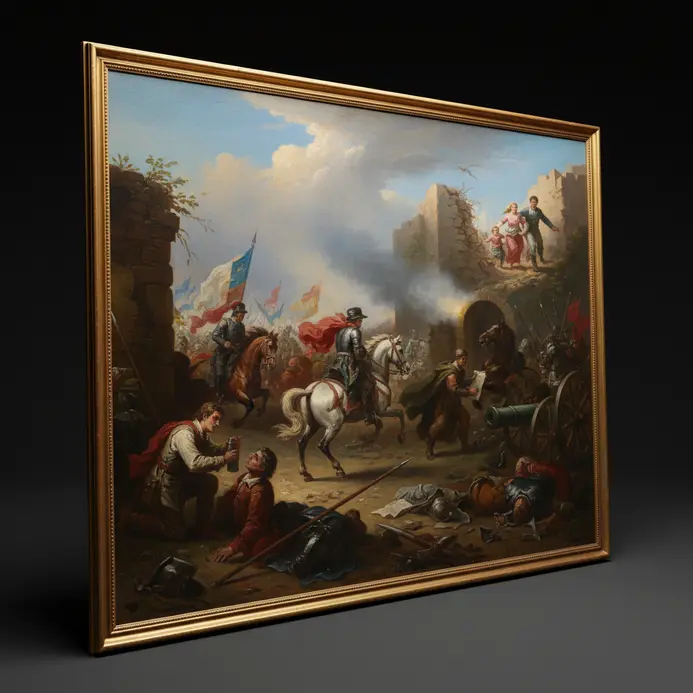
Many historical masterpieces tell two stories at once. The visible scene presents a familiar event, while the deeper layer comments on power, patronage, or the politics of the artist’s own time. That is why so many famous paintings belong in any discussion of paintings with hidden meanings. Raphael’s frescoes, for instance, include portraits of contemporary figures inside classical settings, turning philosophy into cultural politics. Goya’s violence strips away heroic gloss to confront terror head-on, and later history painting often reframed the past to influence the present. Once context enters the frame, the artwork reads less like a record and more like an argument.
10. Nature Symbolism Paintings and Their Botanical Meaning

Plants often function as a visual language in art. A white lily signals purity, ivy points to fidelity, and a fallen petal warns of passing beauty. In the hands of a skilled painter, a floral arrangement becomes one of the richest forms of paintings with hidden meanings. This code appears across religious painting, portraiture, and still life. A bouquet that seems decorative at first glance might carry a full set of references to love, death, resurrection, or marriage. The closer look changes the whole artwork, since one flower can shift the entire meaning of the scene, much like how Da Vinci’s “Last Supper” transforms a simple meal into a profound moment of divine symbolism.
11. Architectural Symbolism Painting with Structural Codes

Architecture in art often does more than set the stage. A cathedral, palace, or city plan might encode hierarchy, memory, faith, or political order through structure alone. These paintings with hidden meanings invite the viewer to read walls, arches, and spatial divisions as ideas rather than background. In some compositions, the building acts almost like a diagram of the mind. A central nave suggests conscious thought, a crypt implies buried memory, and the ceiling signals transcendence or divine order. Once those structural codes come into focus, the painting starts to feel less like scenery and more like a philosophical map.
12. Animal Allegory Paintings with a Secret Message

Animals in art rarely appear by accident. A fox signals cunning, a lamb suggests innocence, and a lion points to authority or danger depending on context, similar to the symbolism embedded in Da Vinci’s works. That symbolic range makes animal scenes fertile ground for paintings with hidden meanings. In Dutch genre scenes and still life painting, creatures often comment on appetite, morality, and social order, much like the moral undertones in Da Vinci’s “Last Supper.” A large fish swallowing a smaller one is not a simple depiction of nature; it becomes a critique of power itself. When predators and prey appear together in strange harmony, the scene often conceals a hope for peace or a warning about its fragility.
13. Scientific Paintings with Hidden Details and Formulas

Some artists built science directly into the image. Geometry, optics, anatomy, and proportion appear not as side notes but as part of the composition’s hidden structure. These are paintings with hidden meanings that reward anyone willing to search for formulas, measuring tools, or impossible spatial precision. Vermeer’s light has long been linked to optical study, while other masters embed diagrams or numerical order into the scene. A peaceful image might conceal a lesson about the human brain, mathematical harmony, or the mechanics of vision itself. Once you start looking for the system beneath the surface, the painting changes completely, revealing layers akin to those found in the Sistine Chapel.
14. Mythological Retelling in Famous Paintings with Commentary

Myths gave artists a flexible language for talking about present concerns. A scene from classical literature might look ancient, yet its emotional tone, symbolism, and costume choices often speak to the artist’s own era. That tension is why mythological scenes remain central examples of paintings with hidden meanings. Botticelli’s Venus became more than a goddess, while darker retellings transformed old stories into meditations on fear, violence, or obsession. If you want to read these works well, pay attention to mood and anachronistic details. They often reveal the secret message more clearly than the title does, echoing the hidden narratives in Michelangelo’s masterpieces.
15. Still Life Paintings: More Than Meets the Eye

Still life is often mistaken for a simple display of technical skill, yet the genre is full of coded thought, much like the intricate layers in “Terrace at Night.” Fruit, flowers, watches, glassware, and books often carry moral or spiritual weight, turning a tabletop arrangement into one of the richest categories of paintings with hidden meanings. A wilting bloom beside a polished clock speaks about time and loss, while an overturned glass or half-peeled lemon adds a note of transience or excess, reflecting the themes explored by Vincent van Gogh. Once you look closely, these objects stop being props and start acting like language. The stillness becomes narrative, and the quiet scene begins to speak.
Developing a Systematic Framework for Interpreting Hidden Meanings
After exploring these categories, it helps to build a repeatable method. Start with the historical context, then move to the artist’s biography, patronage, and intended audience. From there, scan the painting for recurring symbols, distortions, odd scale shifts, and visual elements that seem too deliberate to be accidental. This process turns casual looking into a disciplined reading of paintings with hidden meanings. Ask what the image tries to conceal, who was meant to understand it, and whether the code was religious, political, personal, or intellectual. Over time, those questions make each closer look more precise.
Conclusion
Great art is rarely only a pretty picture. It is a conversation, a puzzle, and at times a quiet act of resistance waiting for a curious viewer to engage with it. Each layer we uncovered adds new respect for the artist’s intention, and the world of paintings with hidden meanings keeps expanding the longer you look. Visit a museum or browse an online gallery with this perspective in mind, and the next painting you encounter might reveal far more than first meets the eye.
FAQs
Q: What are paintings with hidden meanings and why do artists like da vinci include them?
A: Paintings with hidden meanings are works where visual elements encode symbolism, allegory, or secret messages beyond the surface subject. Artists such as da vinci used layered imagery, iconography and careful composition to convey theological, scientific or personal ideas—sometimes to communicate with patrons, sometimes to test viewers’ observation skills. Examples include coded geometry, symbolic objects, and subtle facial expressions.
Q: Can famous works like “the last supper and “mona lisa contain intentional easter eggs?
A: Yes. Both “the last supper and “mona lisa have attracted claims of easter eggs—hidden figures, symbolic arrangements, and compositional clues that suggest deeper meaning. Scholars debate which of these are intentional versus coincidental; for da vinci, who documented experiments and ideas, intentional symbolism is likely in many cases.
Q: How do art historians find hidden meanings in one of the most famous paintings such as “the ambassadors by hans holbein the younger?
A: Art historians combine visual analysis, historical context, and technical study (like infrared reflectography) to decode hidden meanings. In “the ambassadors by hans holbein the younger, they identified symbolic objects, coded references to science and religion, and the famous anamorphic skull—an image that appears distorted until viewed from a specific angle—revealing vanitas themes and political messages.
Q: Are there hidden musical notes or references to a musician in paintings with hidden meanings?
A: Yes. Some paintings include musical instruments, notation-like marks, or visual motifs that indicate sound. Artists sometimes encoded musical notes directly into a composition or referenced a specific musician as allegory. For example, composers and patrons appear in portraits or as attributes to saints, and occasional patterns of shapes have been interpreted as musical notes by researchers.
Q: Which techniques reveal hidden layers in an original painting and works by jan van eyck?
A: Conservators and researchers use X-radiography, infrared imaging, pigment analysis and careful archival study to reveal underdrawings, changes, and concealed elements in original painting panels. Works by jan van eyck often show meticulous underpainting and iconographic detail that, when revealed, clarify symbolic additions or revisions that alter interpretation.