
Understanding Dot Art Fundamentals
Have you ever wondered where those mesmerizing patterns of dots come from? Let’s take a trip to their origins. Contemporary abstract dot art has deep roots in Indigenous Australian traditions. Artists have used this method for storytelling for thousands of years. Today’s artists blend those ancient techniques with modern abstract expression. This fusion creates a unique art form that feels both timeless and fresh.
The process involves incredible focus. Each dot is placed with intention, building up complex textures and rhythms. It truly takes a lot of patience, but the results are stunning. Are you ready to explore how this traditional method fuels modern masterpieces?
Essential Materials for Precision Dot Work
So, you are inspired to try dot painting yourself. What do you need to start? The good news is you have options. While traditional artists used natural pigments, modern abstract dot art often uses vibrant acrylics. Your surface can be a classic stretched canvas, a piece of wood, or even smooth stones. I love the versatility.
For the dots themselves, you do not need fancy tools. The end of a paintbrush, a stylus, or even a dotting tool from a craft store works perfectly. The key is finding a tool that feels good in your hand. This helps you control the size and consistency of each dot. What color palette speaks to you? Choosing your colors is the best part.
1. Australian Aboriginal Dot Painting Origins

Let’s get this straight right away. When you see a stunning abstract dot art painting today, you’re looking at a style born from one of the world’s oldest living cultures, but in a surprisingly modern way. We’re talking about Australian Aboriginal art, a tradition over 60,000 years strong. The contemporary dot style we adore exploded onto the scene in the early 1970s with the Papunya Tula movement. A schoolteacher named Geoffrey Bardon gave elders acrylic paints and boards, and wow, did they run with it! This wasn’t just about making pretty pictures. It was a powerful act of cultural survival and storytelling.
So, why all the dots? Here’s the fascinating part. Those meticulous dots were initially a way to conceal sacred knowledge. Artists could share their Dreamtime stories on canvas for a wider audience while keeping the most sacred symbols and rituals private. Can you see how brilliant that is? Each dot might represent a star, a fire, or an ancestor’s path. The layered patterns create this mesmerizing, almost vibrating effect on the canvas. It takes a lot of patience, and the process itself is deeply meditative, connecting the artist directly to their land and history.
Want a real-world example you can look up? Check out the work of pioneering artist Clifford Possum Tjapaltjarri. His pieces are incredible maps of ancestral lands, using fields of dots to depict terrain and sacred sites. They’re not just paintings; they’re legal documents and historical archives. This movement sparked a huge cultural revival and gave communities vital economic power. So next time you’re scrolling for modern dot art ideas on Pinterest, remember the profound history and resilience behind every single dot.
2. Modern Acrylic Dot Mandala Art
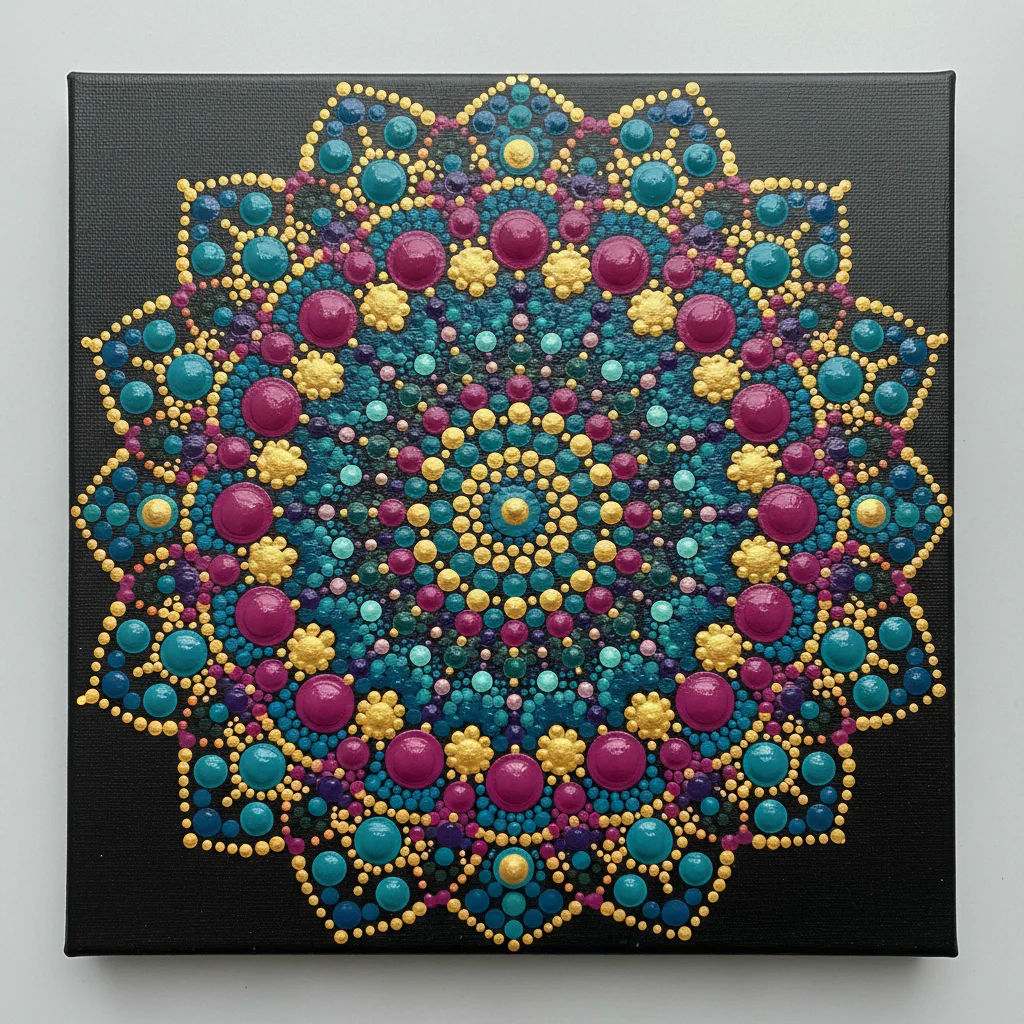
Let’s talk about the amazing bridge between ancient mindfulness and your art desk today. Modern acrylic dot mandala art takes that sacred, symmetrical symbol of the universe and makes it accessible with a squeeze of paint and a dotting tool. Isn’t it incredible how a practice meant for monks can become our own form of creative therapy? We get to explore color, pattern, and patience all at once. The core idea is simple: start from a center point and build your world outward, one perfect dot at a time.
You don’t need fancy supplies to begin. Grab a stretched canvas or even a smooth stone, some heavy-body acrylic paints, and something to make dots. I love using the back of a paintbrush or a bobby pin when I’m starting a new piece. The key is preparing your surface with a solid base coat and sketching light guidelines. This isn’t about being a perfect robot, but having a map so your design stays balanced. What’s the first color you’re reaching for?
Here’s a real-world example I see all the time: artists creating stunning, intricate mandalas on the lids of wooden jewelry boxes. It turns a functional item into a personal treasure, and each dot applied is a moment of focus. This kind of functional art is a huge trend, blending decoration with daily use. You can see amazing examples where artists mix metallic dots with matte backgrounds for stunning contrast. It proves that an abstract dot art painting doesn’t have to live only on a wall.
Remember, the goal is the journey. If a dot smudges, you can fix it. If your color combo feels off, you learn for next time. The rhythm of dipping your tool and placing each dot is where the magic happens. It takes a lot of patience, but the result is a unique, detailed piece full of your personal energy. Ready to make your first one?
3. Geometric Precision Dot Art Patterns
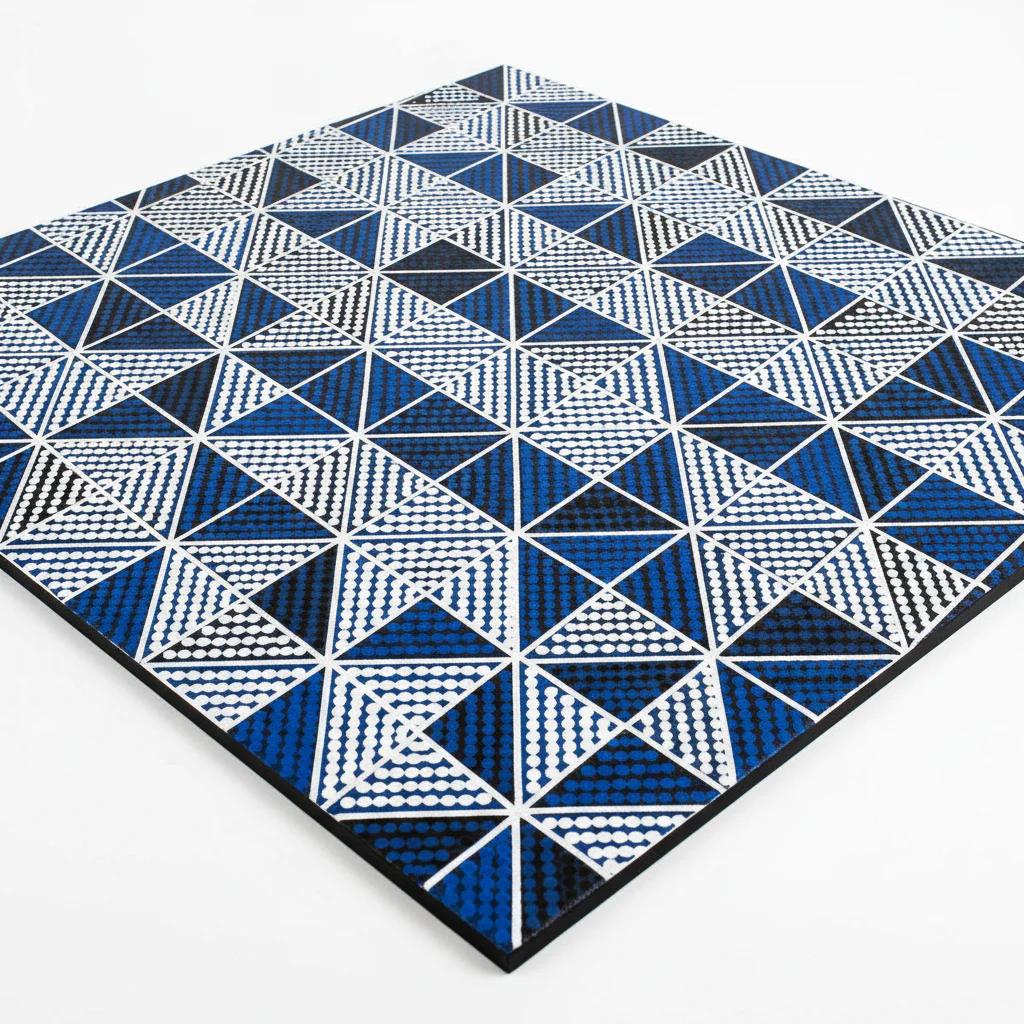
Okay, let’s get our symmetry on. Geometric precision dot art is where math meets meditation. We’re talking about structured designs where every dot has a specific, planned place. Think about the mesmerizing patterns of a mandala or the perfect repetition in a tessellation. Instead of freeform dots, we use guides like grids or compass-drawn circles to keep everything perfectly aligned. The result? A piece that feels balanced, rhythmic, and incredibly satisfying to look at. How cool is that?
You don’t need fancy gear to start, but a few key tools make a huge difference. I love using a set of specialty dotting pens for consistent dot sizes, but a simple toothpick works in a pinch. The real secret is your surface prep. Lightly sketching your geometric blueprint with a pencil and ruler is a non-negotiable first step. This is your roadmap. For paint, go with a high-pigment acrylic you can thin to a nice, creamy consistency. This control is everything for getting those crisp, uniform dots without bleeding.
Here’s a real-world example I adore: modern ceramic coasters with a precise, radial dot pattern. An artist starts with a compass to draw concentric circles on a plain white tile. Then, they build color outwards from the center, dot by dot, creating a stunning gradient that follows the geometric guide. This kind of abstract dot art painting takes a lot of patience, but the payoff is a functional, beautiful piece. You can find amazing inspiration for patterns like this by browsing geometric art on Pinterest.
Once your guide is down, the fun begins. Start dotting from the center and work outwards. This keeps your hand from smudging your work. Play with color theory to add depth. Try a monochromatic scheme for harmony, or use complementary colors for serious pop. Remember, negative space is your friend. Don’t feel like you need to fill every single millimeter. Those empty spots make the dense dot clusters shine even brighter. Ready to plan your first piece?
4. Freeform Organic Dot Art Compositions
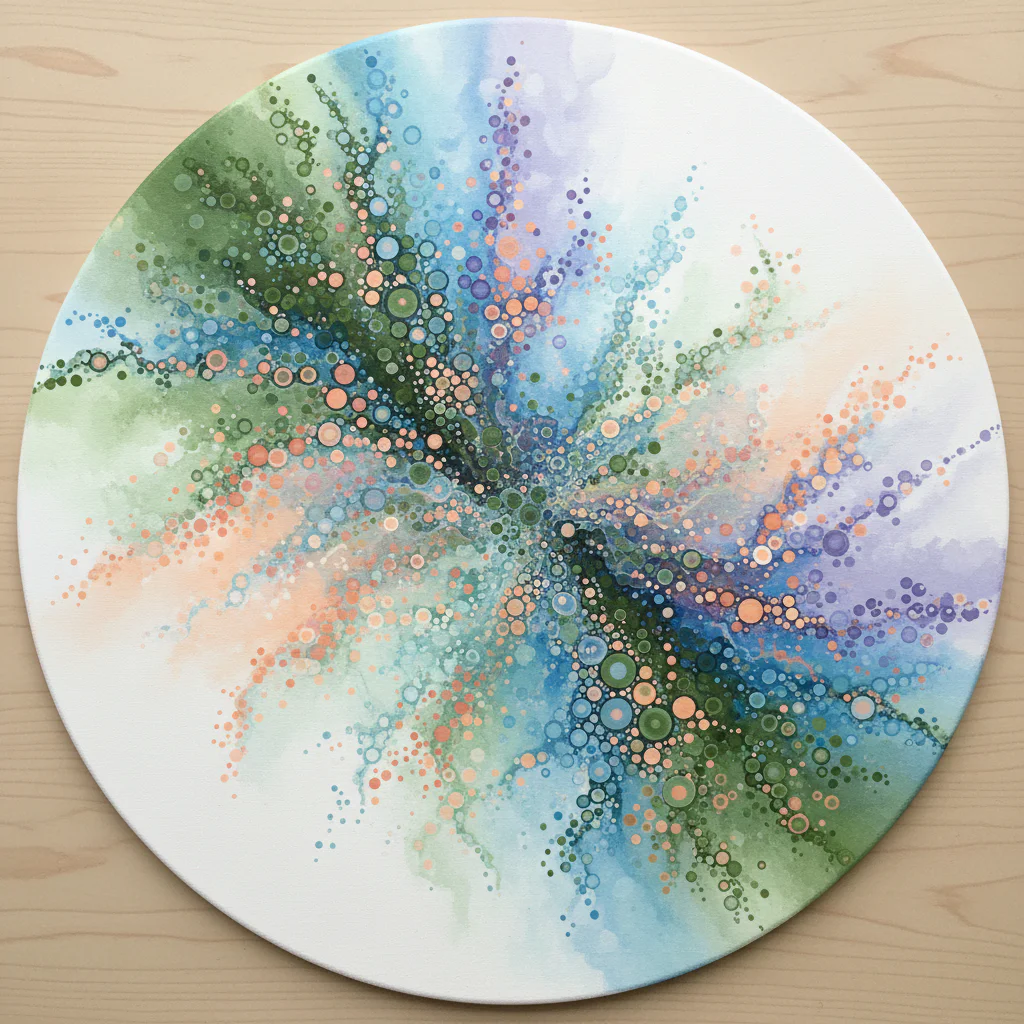
Okay, let’s get this straight. We’re not making a perfect grid or a symmetrical mandala here. The whole point of freeform organic compositions is to let go of the ruler and follow the flow. It’s about creating patterns that feel alive, like they grew there naturally. Think about the way moss spreads on a rock or how bubbles cluster on the surface of water. That’s the vibe we’re chasing. Have you ever stared at a coral reef photo and gotten lost in its wild, beautiful structure? That’s a perfect real-world example of the kind of chaotic harmony we’re trying to capture on our canvas.
First, you have to ditch the tools that force perfection. Put down the compass and the stencil. We’re picking up dotting tools with soft silicone tips or even weird household items like the end of a pencil eraser or a bottle cap. The goal is to embrace a little happy accident. This style pulls inspiration from ancient traditions, but we’re twisting it into something totally personal. It’s not about telling a specific story anymore. It’s about how the color and texture make you feel. Does a cluster of deep blue dots next to a smattering of gold make you think of a night sky? Perfect. That’s your composition starting to breathe.
The magic happens in the layering and spacing. You start with a few dots in one area, then build outwards with different sizes. Don’t space them evenly. Let some areas get dense and crowded, while others have plenty of breathing room. This uneven rhythm is what creates that natural, organic movement. You’re not just placing dots. You’re almost letting them decide where they want to go. I love to start with a light pencil sketch of flowing lines, just a gentle guide, and then completely ignore it as the dots take over. It takes a lot of patience, but the result is a one-of-a-kind original piece full of energy.
5. Mixed Media Dot Art Fusion

Let’s get our hands dirty. This style is where the meditative rhythm of dotting meets a whole playground of other materials. We’re not just talking paint on canvas anymore. We’re layering, embedding, and playing with texture until our abstract dot art painting has a life of its own. It’s a fantastic way to break out of a creative rut. Are you ready to see how far we can push those little dots?
Forget the standard dotting tools for a second. I want you to look around your workspace. See that bottle cap? That’s a dotting tool. Those fabric scraps? That’s your new background. The key here is strategic layering. You might start with a collage base using old book pages or textured paste, then build your dot painting patterns right on top. This creates incredible depth and a story you can literally feel with your fingers.
Here’s a real-world example I adore. Picture a simple glass vase. An artist gives it a deep blue and black wash, then uses metallic acrylics and a toothpick to dot on clusters of tiny stars and swirling nebulae. They finish by embedding a few small, flat glass beads as planets. Suddenly, you’re not looking at a vase. You’re holding a miniature galaxy. This kind of project shows how mixing media transforms an ordinary object into a detailed, original piece of art. What ordinary item could you transform?
6. UV Reactive Neon Dot Art Designs

Okay, I need you to picture this. We’re at a gallery, but the lights just went down. A second later, these 395nm wavelength blacklights snap on, and a wall-sized abstract dot art painting absolutely erupts in color. Pinks, greens, and blues you couldn’t even see a moment ago are now glowing with an electric, almost liquid intensity. That’s the magic of UV-reactive neon dot work, and let me tell you, it’s a whole different beast from regular dot painting. The planning is next-level because you’re designing for two separate realities: what it looks like in normal light and what happens when the switch flips.
So, how do we make this sorcery happen? It all starts with the right stuff. You can’t just use any old acrylic. We need Jacquard Neon paints or body-safe UV inks specifically formulated to fluoresce. And here’s a pro tip: start with a super dark canvas. That black base makes the neon colors pop insanely hard under the UV light. For the dots themselves, you’ll want your full range of dotting tools, from tiny needle tips for micro-details to big bottle caps for those bold, statement dots.
The real secret sauce is in the layering. I like to build up my pieces in three distinct stages. First, a base layer of standard dark acrylics. Then, a mid-layer where I thin the UV paint with a medium to get a cool, translucent effect. Finally, I go in with undiluted neon for the top dots that will scream with brightness. Are you wondering about making your design visible during the day too? A tiny bit of Titanium White mixed into your neon pigments boosts their daytime opacity without killing their nighttime glow.
I saw an incredible real-world example at a local music festival. An artist had created a massive mandala on a dark wood panel. Under the sun, you could see the intricate dot patterns, but the colors were muted. Once night fell and the blacklight stage lights hit it, the entire piece transformed. The concentric circles of dots pulsed with different neon colors, creating a dizzying, moiré pattern effect that felt alive. It was proof that this style isn’t just paint, it’s an experience. And the best part? You can start small. A simple glass painting design with UV dots on a dark bottle can be your perfect, low-pressure first project. Trust me, when you flip off the regular lights for the first time, you’ll be hooked.
7. 3D Textured Dot Sculpture Painting
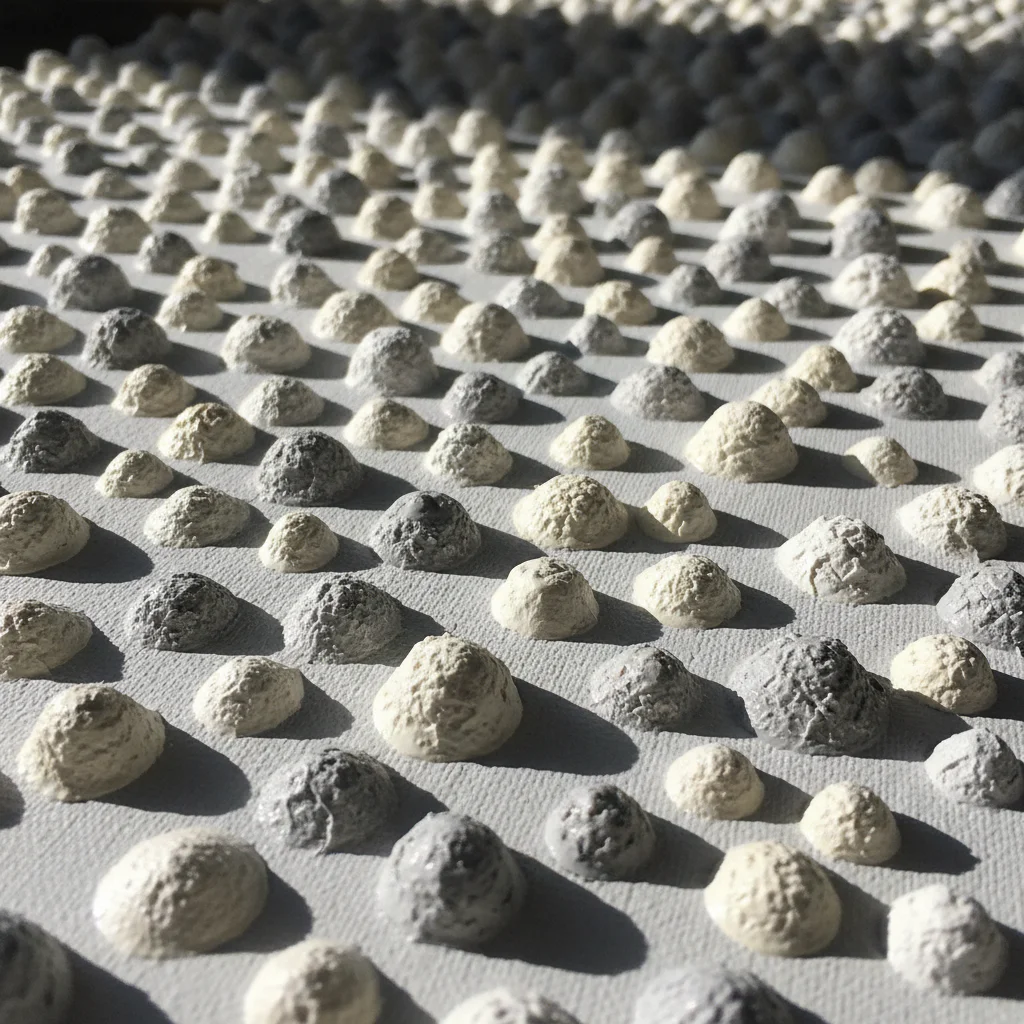
Okay, get ready to have your mind blown. We’re not just making dots on a flat surface anymore. We’re building them. This is where your abstract dot art painting literally jumps off the canvas. The core idea? We merge painting and sculpture into one super tactile, dimensional piece. Think of it like pointillism decided to go 3D. You build up forms first, then you decorate them with dots. It is pure magic.
So, how do we make this happen? You need the right stuff. Forget thin paint. We’re mixing our acrylics with modeling paste or heavy gel medium to create a thick, sculptural goop. Load it into a piping bag or a syringe and pipe your dots like you’re decorating the world’s coolest cake. For even wilder texture, you can glue on beads, tiny buttons, or little clay spheres. The goal is to create a surface you desperately want to touch. And yes, touch device users, I’m looking at you. This art is made for exploring by touch.
Let me give you a real-world example. Picture a wall panel where the dots aren’t painted on. They are these little raised mounds, built up in layers. Some are big and chunky at the bottom, with smaller ones stacked on top. You run your hand over it and feel every bump and ridge. The color isn’t flat either. You’d use darker shades in the crevices and lighter, maybe even metallic, paint on the highest peaks to catch the light. It creates insane shadows and depth. The whole piece feels alive. Are you excited to try this? I know I am. It takes a lot of patience, but the payoff is a one-of-a-kind masterpiece.
8. Miniature Micro-Dot Art Paintings

Have you ever seen a painting so tiny it fits on a pinhead? Let’s explore miniature micro-dot art, where artists create stunning images with dots microscopic in size. You need a magnifying glass or even a microscope to see all the details! It’s not just about small scale; it’s about precision and patience that blows my mind. Artists like Hasan Kale paint portraits on objects as small as a sesame seed, which is absolutely incredible.
To make these micro-masterpieces, artists rely on ultra-fine brushes and microneedles. They work under magnifiers, often in controlled environments to avoid any disturbance. The process is slow, with each dot placed deliberately over weeks or months. Can you believe the focus required? It’s a zen-like practice that demands steady hands and sharp eyes.
Here’s a cool example: some artists hide messages or patterns that only appear under high magnification. I read about a piece where a dot matrix encoded text visible at 50x zoom. It’s like a puzzle for your eyes! This approach can be applied to an abstract dot art painting, where colors and forms take on new meaning when viewed up close. Picture an abstract dot piece that reveals hidden shapes under a loupe.
We’re drawn to things that challenge our senses. Miniature micro-dot art does just that by making us look closer. It bridges art and science, showing how detail can transform perception. What do you think? Would you try creating something this tiny? The level of detail is amazing, and it takes a lot of patience, but the result is a unique piece of art that invites exploration.
9. Dot Gradient Color Art Transitions
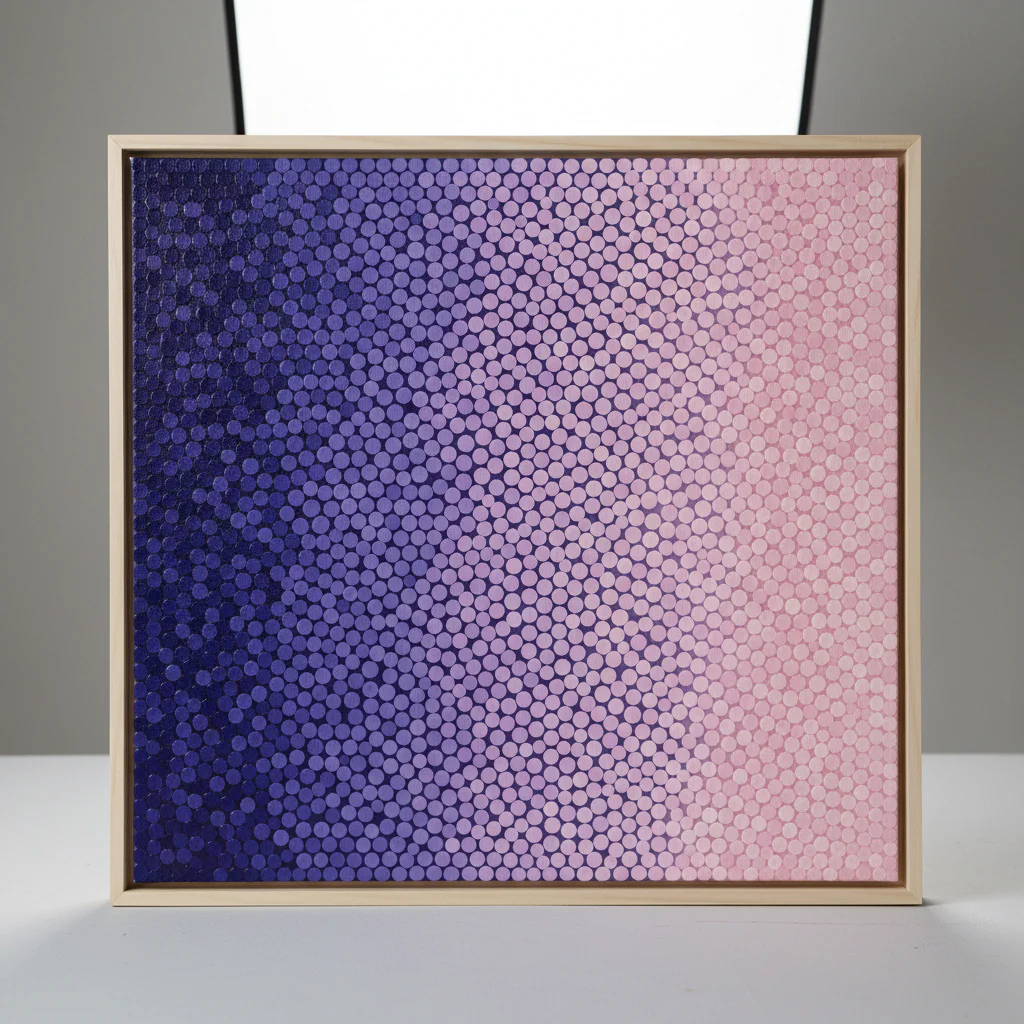
We’re moving beyond simple patterns now. This is where dot gradient color art transitions get magical. Instead of mixing paint on a palette, we let our eyes do the blending. The core principle here is optical blending. You place a cyan dot next to a magenta dot, but you don’t get a harsh line. You add a few intermediate dots of a purple shade right between them. From a few steps back, your brain sees a smooth, seamless fade from one color to the next. It’s a total illusion, but isn’t that the fun of an abstract dot art painting?
Let’s get concrete. Have you ever seen a stunning sunset piece done entirely with dots? The artist doesn’t use a single orange dot. They’ll start with a field of deep reds at the horizon, then layer in dots of lighter red, then red-orange, then pure orange, then yellow-orange, finishing with bright yellows at the top. Each tiny dot painting is a distinct color, but together they create a breathtaking gradient that feels alive. This dynamic scaling of dot sizes can make the color field appear to recede or pulse. The whole canvas becomes a dance of color built from thousands of patient, individual decisions. What a way to make an original piece!
10. Cultural Symbolism in Dot Art Patterns

Have you ever stared at an abstract dot art painting and felt there was more to it than meets the eye? We’re about to explore the incredible cultural stories packed into those patterns. Let’s start with a powerful example from Aboriginal Australian traditions.
In Central Australia, artists use dots to map ancestral lands and tell creation stories. I love how a single piece depicts waterholes, stars, and animal tracks all through meticulous dot placement. Dreamtime narratives are encoded in the density and arrangement, making each work a spiritual map. Isn’t it amazing how much meaning is held in such simple marks?
One concrete observation: during ceremonies, artists often create dot paintings as a meditative act, connecting to spirits. The dots aren’t random; they’re a language. For instance, in some communities, specific dot patterns represent sacred sites that are restricted from public view. This shows how cultural knowledge is preserved through art.
Beyond Australia, dots carry weight in other cultures too. Think of the Indian bindi or Polynesian tattoos. But in Aboriginal art, the symbolism is deeply tied to land and ancestry. When you see a dot painting, you’re looking at a story that’s thousands of years old, adapted with modern tools like acrylics. It’s a living tradition that continues to evolve, yet remains rooted in profound symbolism.
Modern artists like Emily Kame Kngwarreye have fused traditional techniques with contemporary themes, bringing dot art to global galleries. But remember, appreciating this art means respecting its origins. Always acknowledge the cultural heritage behind each piece. If you’re inspired to try your own dot art, start with patience and simple designs. Easy things to paint for beginners provide a great starting point without the pressure. Dot painting takes a lot of patience, but the result is worth it!
11. Alcohol Ink Dot Flow Art Techniques

Okay, get ready to play with fire (well, not literally, but the effects are just as dramatic)! Alcohol inks are the secret sauce for creating those mesmerizing, flowing abstract dot art painting effects you’ve probably seen all over Pinterest. The core idea? We’re using the unique properties of these inks to make our dots move, merge, and bloom into organic masterpieces. It’s a fantastic way to add a modern, fluid touch to your work.
First, let’s gather our gear. You’ll need those vibrant alcohol inks (I love Ranger or Piñata colors), and a non-porous surface like Yupo paper is a must. Grab a dropper, a straw for blowing, and some rubbing alcohol. Trust me, working on a slick surface changes everything. Have you ever tried painting on glass or ceramic tiles? The ink glides so differently, creating beautiful, unpredictable details.
Now for the fun part. Place a dot of ink on your surface and watch it bead up. Now, take your straw and gently blow. See how it streaks and feathers out? You can create whole galaxies from a single dot. Another favorite trick is the alcohol spritz. Mist a little rubbing alcohol near your wet dots and watch them explode into colorful cells. It takes a lot of patience to learn the timing, but the results are worth it.
Here’s a concrete idea to practice. On a small tile or piece of Yupo, drop three dots in a row: a dark blue, a purple, and a light pink. Before they dry, tilt your surface and let them run together. Then, use a toothpick to gently drag through the center, creating a tiny mandala pattern from the flowing colors. This simple exercise teaches you about color blending and control. What say we give it a shot?
12. Dot Art Therapy Applications

Have you ever felt so anxious that even breathing feels hard? Well, let me tell you, picking up a dotting tool and creating an abstract dot art painting does wonders for your mind. We’re talking about dot art therapy, and it’s not just pretty patterns—it’s healing in motion.
Think about the rhythmic tap-tap-tap of placing each dot. It’s like a meditation session! In clinical settings, therapists pair this with breathing exercises to reduce stress. For example, I visited a rehab center where PTSD survivors use dot mandalas to express emotions they can’t put into words. The predictability of the patterns grounds them, making each session a step towards peace.
But it’s not only for mental health. For kids on the autism spectrum, sensory tools like dot pens help regulate focus. And in physical therapy, precision dotting aids stroke recovery by improving motor skills. Want to try it yourself? Start with some easy painting ideas to build confidence.
Remember, this practice has deep roots, so always acknowledge its Indigenous origins. Whether you’re dealing with grief or just need a creative break, dot art offers a unique path to wellness. What will your first dot painting say about you?
13. Contemporary Dot Portrait Art Styles

Let’s talk about how artists are totally reinventing the portrait with dots. We’ve moved way beyond classic pointillism into this wild, modern space where digital tools and cultural fusion are creating faces you have to see to believe. It’s not just about patience anymore, though that’s still a huge part of it. Now, artists are using software like Procreate to map out insane gradients or pulling patterns from Aboriginal art painting to tell new stories. Have you seen those portraits where the image only snaps into focus from across the room? That kind of interactive, playful thinking is everywhere now.
One of the coolest shifts is in the materials. Sure, you can still create an amazing abstract dot art painting with a fine-tip marker on canvas. But artists are also using airbrushes for soft clouds of color or even doing dotwork tattoos for permanent, living portraits. I love the mix of high-tech and handmade. For instance, digital artist Jason Limberg uses algorithms to place dots, creating portraits that look like they’re glitching between pixels and organic patterns. It’s a brilliant comment on our digital identities, don’t you think?
Want to try a simpler, hands-on approach to get a feel for building an image? Starting with some easy things to paint for beginners can build your confidence with color and composition before tackling a detailed dot portrait.
To really get how far this has come, look at Miguel Endara’s piece titled ‘Hero’. This portrait is made from 3.2 million hand-drawn ink dots. No algorithms, no shortcuts, just a man and a pen for months on end. The detail is hyper-realistic, but up close, all you see is this mesmerizing sea of tiny marks. It shows the incredible dedication in this field and proves that sometimes, the most modern statement is made with the most traditional, painstaking method. What do you think, could you ever have that kind of patience?
14. Dot Pattern Optical Illusion Art

Have you ever looked at a piece and felt the dots start to swirl or bulge right before your eyes? That’s the magic of dot pattern optical illusion art! We’re playing tricks on our own perception here, using nothing but strategic arrangement, spacing, and color. The whole concept is rooted in classic op art from masters like Victor Vasarely, who knew exactly how to make a static image pulse with life. It feels a bit like a secret visual language, doesn’t it?
Let’s break down how you can create these effects yourself. A fantastic starting point is grid manipulation. By drawing two grids of dots and overlapping them with a slight rotation, you’ll create those mesmerizing moiré effects that seem to shimmer. For a sense of motion, try alternating dot sizes in your grid or staggering their placement. Want to imply depth? Use gradient scaling, making your dots larger in the ‘foreground’ and gradually shrinking them toward the ‘background’. I love using Procreate or graph paper to sketch these layouts—it takes a lot of patience, but the payoff is huge.
Here’s a concrete example you can observe and recreate: a simple spiral vortex. Draw concentric circles and place dots along each ring. Now, gradually reduce the spacing between the dots as you move toward the center. Alternate the dot colors between black and white. Stand back and watch as the pattern appears to twist inward, creating a stunning 3D effect from a completely flat abstract dot art painting. The key is testing your work from different distances and adjusting until the illusion pops. What do you think, ready to make your canvas come alive?
15. Large-Scale Installation Dot Art

Okay, let’s get huge! We’re moving from the easel to the epic with large-scale installation dot art. Think about transforming an entire wall or a public space with thousands of dots. It’s a project that takes a lot of patience and planning, but the payoff is a breathtaking piece everyone can experience. First, you need a solid plan. What’s your theme? Are you telling a story or creating a giant, abstract dot art painting that plays with color and geometry?
You can’t just start dabbing paint on a building. We need to secure permissions for the location and prep the surface properly. I learned this from watching incredible public works. For example, some artists creating murals in Australia use a grid system or a digital projector to scale their sketches perfectly onto a massive wall. They’ll test their weather-resistant acrylics on a small section first. This step prevents color mistakes you can’t easily fix later.
Forget tiny dotting tools. At this scale, you might use bottle nozzles or custom daubers to apply paint quickly and consistently. Working in sections is key, and having a team helps so much. You start with the big background dots and layer in the detail. After the final dot is placed, sealing the piece with a protective varnish is non-negotiable, especially for outdoor spots. The result is a modern, original piece of public art that invites touch device users and everyone else to explore by touch and sight. How cool is that?
Ethical Considerations in Contemporary Dot Art
As we embrace abstract dot art, let’s talk about respect. This technique is not just a cool trend. It is a living tradition with profound cultural significance for Indigenous Australian communities. When we adapt these dotting methods for our own abstract pieces, we must do so thoughtfully. How can we honor the source?
A great first step is to learn about the history and meaning behind the traditional art forms. Many contemporary artists also choose to support Indigenous creators directly. You can buy their original work or even attend workshops led by cultural knowledge holders. This practice is about more than making a beautiful piece. It is about connecting with a story much bigger than ourselves. Let’s make sure our creativity builds bridges of understanding.
More Abstract Dot Art Painting Gallery for Inspiration






Conclusion
We have journeyed through so many incredible ways to use dots. From their sacred origins to glowing UV designs, the potential of abstract dot art painting is truly limitless. Each style offers a different feeling, a different story. What did you connect with most? Was it the mindful repetition of dot therapy or the bold statement of a large-scale installation? The best part is, you can try any of these ideas yourself. You do not need fancy tools, just a surface, some color, and a stick for dotting. Let this exploration be your starting point. Find your rhythm, pick your palette, and start making your mark, one dot at a time. Grab some paints and see where the dots take you.
FAQs
Q: What is abstract dot art painting?
A: Abstract dot art painting is a form of non-representational art that uses dots, points, or small strokes to build patterns, textures, and compositions. Instead of depicting recognizable subjects, it emphasizes color, rhythm, contrast, and the spatial relationships created by the dots to evoke mood or visual interest.
Q: How do I get started with abstract dot art painting?
A: Begin with basic supplies: acrylic paints, fine brushes or dotting tools, a primed canvas or board, and a sketch or color plan. Practice making consistent dots and explore layering colors and sizes. Start with simple color schemes and compositions, gradually experimenting with scale, spacing, and texture as you gain confidence.
Q: What tools and materials work best for abstract dot art painting?
A: Common tools include round brushes, stylus or dotting tools, palette knives for texture, and high-quality acrylic paints for opacity and quick drying. Canvas, wood panels, or heavy paper can serve as supports. Sealants or varnishes protect finished pieces and enhance color depth.
Q: Which techniques can enhance my abstract dot art painting?
A: Techniques include pointillism-like layering, gradation by changing dot size or color intensity, negative space to define shapes, and textured backgrounds to add depth. Experiment with alternating dense and sparse dot arrangements, using metallics or gloss varnish for highlights, and combining dots with washes or brushwork.
Q: How do I choose a color palette for abstract dot art painting?
A: Select a palette based on mood, contrast, and harmony. Monochromatic schemes emphasize texture and form, complementary colors create vibrant contrast, and analogous palettes feel cohesive and soothing. Test small swatches to see how layered dots interact before committing to a full composition.