1. Observation: The Shared Foundation
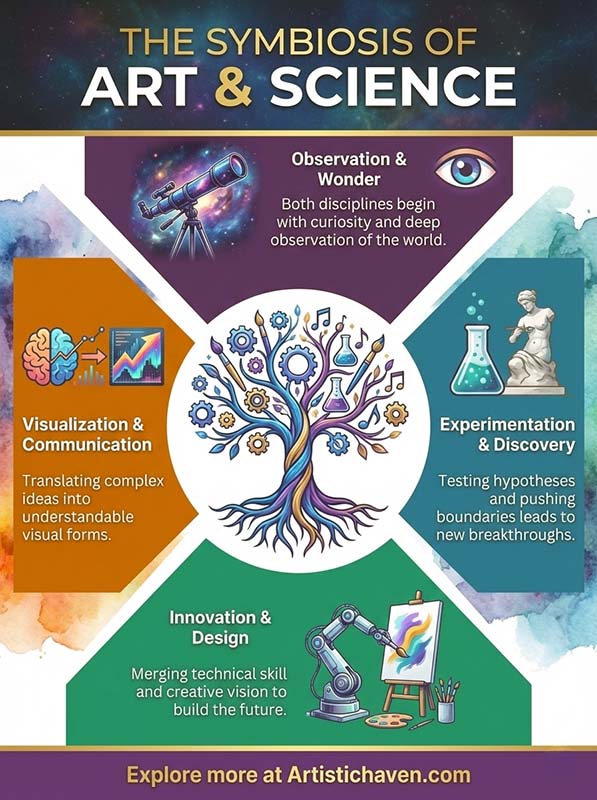
At their core, both art and science rely on one fundamental skill: intense observation and interpretation. Before a scientist can form a hypothesis, they must scrutinize the natural world. Similarly, before an artist puts a brush to canvas, they must study light, shadow, and form. Artistic practices often involve a level of detailed scrutiny that rivals any lab work. Consider the herbarium specimens of the early 19th century. These weren’t just scientific drawings; they were beautiful, detailed works of art that required the artist to catalog, decipher, and preserve the delicate details of plant life to create an accurate representation. Evidence: The National Academy of Sciences has frequently highlighted how scientific observations rely on visual acuity—a skill often honed through artistic practices. Actionable Takeaway: Explore the equation between art and science in your next project. Practice “active looking.” Next time you are outside, pick a single leaf or stone. Spend 5 minutes just looking at it and appreciate the visualization of visual art. Sketch it or write a detailed description. You are practicing the root skill of both biology and drawing.
2. Leonardo da Vinci: The Original “Renaissance Man”
You can’t talk about the relationship between art and science without mentioning Leonardo da Vinci. He is the ultimate proof that these fields belong together. Da Vinci didn’t see a barrier between sciences and the arts. To him, studying the anatomy of a human arm was essential to painting it correctly. His notebooks are a treasure trove where da Vinci’s scientific curiosity and artistic talent collide. He would dissect cadavers to understand muscle structure, engineer flying machines on paper, and sketch the flow of water. He is the quintessential Renaissance Man. Key Insight: Da Vinci used scientific breakthroughs in anatomy to improve his art, and used his art to document his scientific discoveries. It was a perfect loop. Actionable Takeaway: Don’t pigeonhole yourself. If you are a science student, try sketching your diagrams. If you are an art student, read about the anatomy of your subjects. It will make your work stronger, especially when you communicate science through visual art.
3. Visualizing the Invisible: From Cells to Cosmos
How do we understand things we can’t see with the naked eye? This is where art and science hold hands tightly. Scientific concepts like cellular structures or the The celestial bodies inspire countless works of visual art. bodies of a distant galaxy are often abstract until an artist renders them. This is a prime example of collaboration. Artists help scientists and artists collaborate to visualize the microscopic and the massive. Think about the famous “Pillars of Creation” image from the Hubble Telescope. That image is a scientific data set translated into color and light so we can grasp the The exploration of art provides a unique vision of the universe.. Verbs to Live By: Magnify, translate, illuminate. Evidence: Medical illustration is a thriving career path that requires a deep understanding of scientific progress and high-level artistic skill.

4. Color Theory: Where Physics Meets Pigment
Painters obsess over color, but color is fundamentally physics. Color theory is the study of how light hits a surface and reflects back to our eyes. When a Renaissance artist mixed pigments, they were engaging in chemistry. When a modern designer chooses a palette, they are using the physics of light. Understanding the science behind color allows artists to manipulate, refract, and blend light to create mood and depth. The Science: Sir Isaac Newton was actually the first to develop the color wheel when he refracted white light through a prism. Actionable Takeaway: Learn the basics of light physics. Understanding how warm and cool colors recede or advance can help you create depth in drawings without using perspective lines.
5. Experimentation: The Shared Methodology
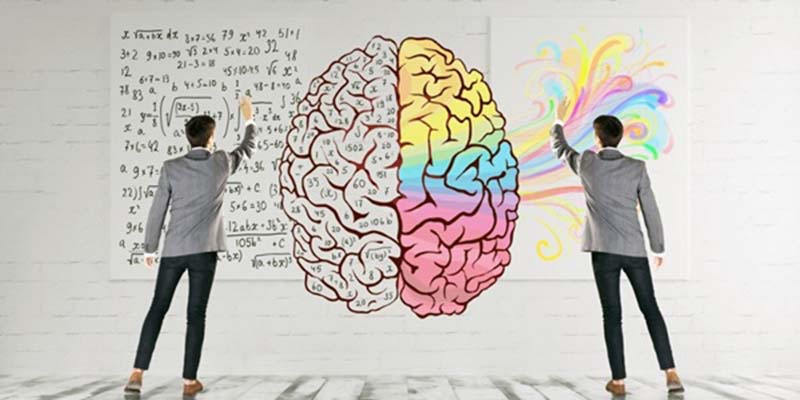
We often think of the “scientific method” as something that happens only in a lab. But art practice is built on the same kind of methodology. An artist has an idea (hypothesis), they try a technique (experiment), they see if it works (analysis), and they try again (iteration). This creating art process mirrors scientific inquiry. Whether you are mixing chemicals or mixing paints, you are engaging in a process of trial and error. You have to hypothesize, test, and refine. Insight: Both artists and scientists must be comfortable with failure. A failed experiment or a ruined painting is just data for the next attempt. This interdisciplinary This complementary approach strengthens both fields of arts and the sciences.
6. Cubism and Relativity: A New Way of Seeing
Did you know that Pablo Picasso’s Cubism and Albert Einstein’s Theory of Relativity happened around the same time? Many historians believe this wasn’t a coincidence. Both men were trying to interpret the world in a new way—moving beyond the fixed, static viewpoint of the past. While Einstein was proving that time and space are relative, Cubist painters were trying to fragment, distort, and reassemble objects to show multiple viewpoints simultaneously. This shifted the A deeper understanding of the universe can emerge from the intersection of science and visual art.. The Connection: Both represented a scientific revolution and an artistic one, shifting our understanding from 3D realism to 4D complexity. It showcased analytical thinking in art. Actionable Takeaway: Look at an object from three different angles. Now try to draw it as if you are seeing all three angles at once. You are thinking like a Cubist—and a physicist.
7. Technology as the New Medium
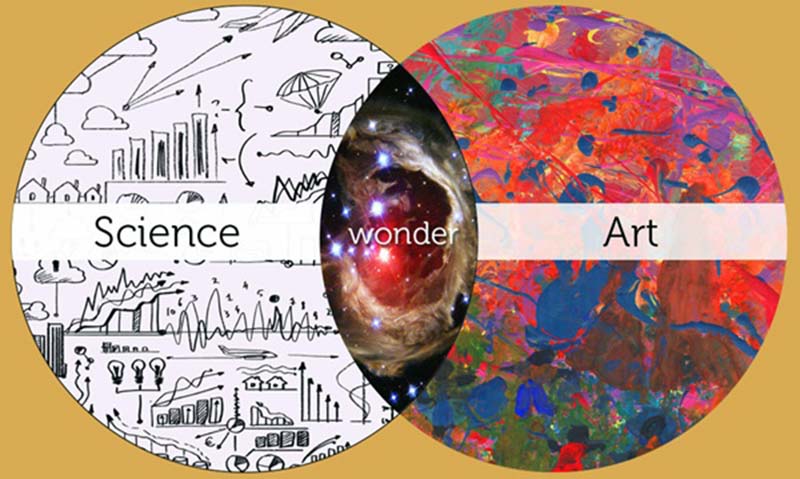
In the modern era, The synergy between science and technology enhances the understanding of visual art. have become the new paint and canvas. From steel sculptures engineered with precision to digital art created with code, the medium of art is changing. This is the natural progression of art and technology. Art and technology fuse in fields like generic design and VR. Artists and scientists share a workspace here, using science institutions To access tools that allow them to sculpt, code, and simulate new realities, artists must embrace applied science. Example: “BioArt” is a growing field where artists use live tissues, bacteria, and using scientific methodologies to create artwork. Trend: The progression of art is moving toward interactive, tech-driven experiences, blurring the lines between scientific and artistic endeavors.
8. Communication: Making the Complex Accessible
Science can be dry. Art makes it human. One of the most important roles of the collaboration between art and science is understanding and communication. We need artists to take complex scientific reports—like climate change data or scientific observations about an ecosystem—and turn them into something that makes people feel. A graph shows you the temperature is rising; a painting of a melting glacier makes you understand the loss. This is the use of art to convey truth. Verbs: Humanize, narrate, evoke. Evidence: The National Academy of Sciences has programs specifically designed to bring together Scientists and artists collaborate to improve science communication through the exploration of art.
9. Geometry and Structure in Nature
Nature is the ultimate artist, and it loves geometry. Artists and scientists both study the mathematical patterns found in the natural world. They observe aspects of nature to find order. From the Fibonacci sequence in a sunflower to the hexagonal structure of a honeycomb, math is the skeleton of nature. Artists use these scientific concepts to create balanced, pleasing compositions. They align, proportion, and structure their work of artists based on these universal rules. Takeaway: Study the “Golden Ratio.” It’s a mathematical ratio commonly found in nature that artists use to create aesthetically pleasing compositions.
10. Expanding the Imagination
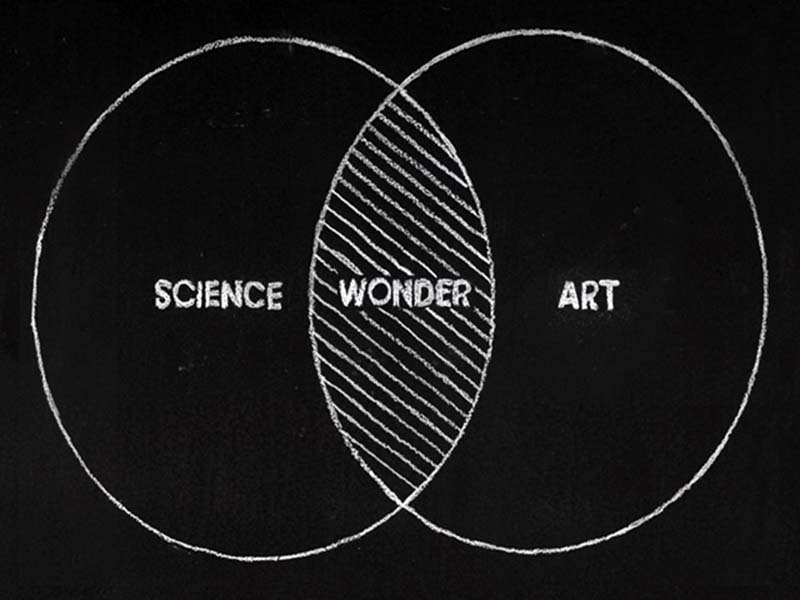
Finally, the most profound connection is that both fields push the boundaries of what is possible. Science fiction (art) often inspires real scientific breakthroughs. Think of the Futurist movement or early sci-fi novels. They imagined space travel, mobile phones, and AI long before scientists built them. Art provides the vision of the universe What we want to build; science provides the tools to build it, especially in the realm of visual art. This science-inspired creativity drives progress. Conclusion: Artistic and scientific thinking combined is what leads to true innovation. They galvanize each other to go further.

Conclusion
The relationship between art and science isn’t just about pretty pictures in a textbook. It is a profound connection that defines human progress and our quest for understanding the universe. From Leonardo da Vinci sketching anatomy to modern science studies using VR, these two disciplines work best when they work together. We need to bridge these two cultures. Science and art are not enemies. They are partners in the quest to understand the world. Science gives us the methodology to explore the universe, and art gives us the meaning to appreciate it through an artistic lens. Next Step: Pick one topic from this list—whether it’s color theory or the Golden Ratio—and spend 30 minutes this week learning the basics. You’ll be surprised how it changes the way you see everything and enhances your understanding of the environment.
FAQs
Q: What is the relationship between art and science?
A: The relationship between art and science is a mutual pursuit of understanding: science seeks to describe the world through systems, data and underpinnings, while art conveys ideas and emotions, using light and color, composition and points of view to make those concepts accessible and visually appealing. Historically and across time both fields inform each other, producing new concepts and methods that effectively communicate complex and abstract concepts.
Q: How have historical figures like a renaissance man bridged art and science?
A: A renaissance man exemplifies the blending of disciplines by practicing both art and scientific inquiry—sketching anatomical studies, exploring optics, and experimenting with materials. Such figures showed that the same curiosity that drives laboratory research or systems biology can fuel artistic experimentation, leading to lasting impact on how people see and describe the world.
Q: Can art classes help students understand scientific ideas?
A: Yes, art class can be an effective way to teach scientific principles: exercises focused on light and color illustrate optics, drawing trains observational skills central to scientific method, and visual projects help students convey ideas and effectively communicate results. Integrating artistic practice into STEM education supports the pursuit of understanding by making abstract concepts tangible.
Q: What role do research institutes and universities play in connecting art and science?
A: Research institutes and universities such as Stanford University, the University of Cambridge, and the University of California often host interdisciplinary programs and labs that combine art, technology and scientific research. Funders like NSF also support cross-disciplinary initiatives that foster collaborations, enabling scholars to explore underpinnings of perception, create new concepts, and develop tools for both inquiry and creative expression.
Q: How does working in digital media affect the interaction between art and science?
A: Working in digital environments amplifies the convergence of art and science by providing tools for visualization, simulation and data-driven design. Digital practices help render complex systems biology models or abstract concepts into interactive, visually appealing formats that convey ideas more effectively and invite broader points of view.